
History of ancient Israel and Judah
Overview of the Iron Age kingdoms of Israel and Judah: geography, origins, political history, exile and return, Hellenistic and Roman eras, cultural development and lasting legacy.
Overview
The histories of Israel and Judah describe two neighbouring polities that emerged in the southern Levant during the Iron Age. Their development took place within the broader context of the old Near East, and the earliest archaeological traces of a polity called Israel appear in the record often cited as the first archaeological mention. These entities occupied the western edge of the ancient Fertile Crescent between larger imperial powers and seafaring states such as Egypt to the south.
Image gallery
10 Images


Geography and cultural roots
The region of Israel and Judah lay in a narrow band between the coastal plain and the Jordan Valley, a landscape of hills and plateaus where small agricultural villages grew into towns. The populations shared many features of the older Canaanite culture inherited from the Late Bronze Age, including language, pottery styles and household practices, while gradually developing distinct political and religious identities.
Political development and conflicts
Scholars reconstruct a period of village consolidation and state formation in the centuries after the Late Bronze Age collapse. The traditional narrative describes a united monarchy followed by a division into a northern kingdom, Israel, and a southern kingdom, Judah. Israel rose to regional prominence in the 9th and 8th centuries BCE but was conquered by Assyria. Judah survived longer, navigating the ambitions of neighboring powers such as Babylonia, against whose hegemony it ultimately rebelled and was devastated in the early 6th century BCE.
Exile, return, and imperial provinces
The destruction of Jerusalem led to an elite deportation and a period conventionally called the Exile. With the fall of Babylonia, the region entered the Persian period, during which a province known as Yehud was administered within the imperial framework and some exiles returned to rebuild communal institutions and the Temple. Persian rule provided a degree of local autonomy while integrating the population into imperial economic and legal systems.
Hellenistic age, revolt, and Roman rule
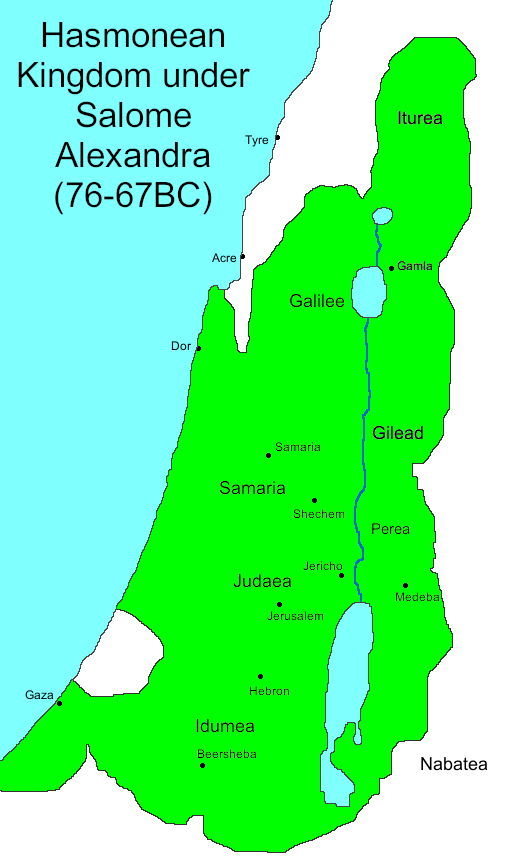
The conquests of Greece spread Hellenistic culture across the Near East and brought the former Judean province into the orbit of Greek-speaking kingdoms. In the 2nd century BCE a successful Jewish revolt established the Hasmonean polity, which later became entangled with Rome and finally fell under the control of the Roman Empire. During these centuries the region experienced shifting loyalties, cultural exchange, and internal tensions between different social and religious groups.
Key events and significance
- Formation out of Canaanite highland villages into territorial kingdoms; continuity with Canaanite culture.
- Israel's rise and Assyrian conquest; Judah's persistence and destruction by Babylon.
- Persian-era restoration of communities in Yehud and reconstruction of religious life.
- Hellenistic influence after the campaigns of Greece and the later Hasmonean revival in the 2nd century BC.
- Absorption into Rome and the end of sustained local independence amid imperial structures centered on Rome.
Distinctive aspects. Though small in territory, these kingdoms occupied a strategic crossroads and played a disproportionate role in religious and cultural history. Developments in belief and practice helped shape what later became rabbinic Judaism and, through different historical trajectories, early Christianity. Our understanding depends on a mixture of textual sources and archaeology; interpreting those records requires careful distinction between literary traditions and material evidence. The interplay of local traditions with imperial politics—Assyrian, Assyrian successors, Babylonian, Persian, Hellenistic and Roman—is central to the region's long-term history and legacy.
Questions and answers
Q: What is the time period covered in this text?
A: The time period covered in this text is from 1200 BCE to near the time of Jesus Christ.
Q: Where was Israel and Judah located?
A: Israel and Judah were located on the most eastern coast of the Mediterranean, between Egypt to the south, Assyria, Babylonia, later Persia to the north and east, Greece and later Rome across the sea to the west.
Q: When did Israel become an important local power?
A: Israel became an important local power in the 9th and 8th centuries BCE before falling to the Assyrians.
Q: How did Judah become rich?
A: Judah became rich inside of greater empires of the region before a revolt against Babylon led to it being destroyed early in the 6th century.
Q: Who created Hasmonean kingdom?
A: The Jews created Hasmonean kingdom in 2nd century BC.
Q: What happened after Alexander's conquests?
A: After Alexander's conquests, Yehud was absorbed into Greek-ruled kingdoms.
Q: How did Hasmonean kingdom come under Roman rule?
A: Hasmonean kingdom first became a Roman dependency then went under Roman rule.
Related articles
Author
AlegsaOnline.com History of ancient Israel and Judah Leandro Alegsa
URL: https://en.alegsaonline.com/art/44452
Sources
- books.google.com : A History of Ancient Israel and Judah
- books.google.com : The Oxford History of the Biblical World
- books.google.com : Biblical Peoples and Ethnicity: An Archaeological Study of Egyptians, Canaanites, Philistines, and Early Israel, 1300–1100 B.C.E
- books.google.com : Jerusalem in Bible and Archaeology: The First Temple Period
- books.google.com : Ancient Canaan and Israel: New Perspectives
- books.google.com : The Israelites in History and Tradition
- books.google.com : Reconstructing the Society of Ancient Israel
- books.google.com : The Early History of God: Yahweh and the Other Deities in Ancient Israel
- books.google.com : The Quest for the Historical Israel: Debating Archaeology and the History of Early Israel : Invited Lectures Delivered at the Sixth Biennial Colloquium of the International Institute for Secular Humanistic Judaism, Detroit, October 2005
- books.google.com : The Legacy of Mesopotamia
- books.google.com : A Brief History of Ancient Israel
- us-israel.org : Jewish Virtual Library