
Himalia: Jupiter’s largest irregular prograde moon
Himalia is the largest irregular, non-spherical satellite of Jupiter. Discovered in 1904, it belongs to the Himalia group and is thought to be a fragment of a larger body with a dark, carbonaceous surface.
Himalia is the largest of Jupiter’s irregular, prograde moons and the most prominent member of the so-called Himalia group. It appears non-spherical and relatively dark, with a surface that reflects characteristics similar to carbonaceous asteroids. As an irregular satellite, Himalia follows an inclined, distant orbit compared with Jupiter’s large inner moons.
Image gallery
6 Images


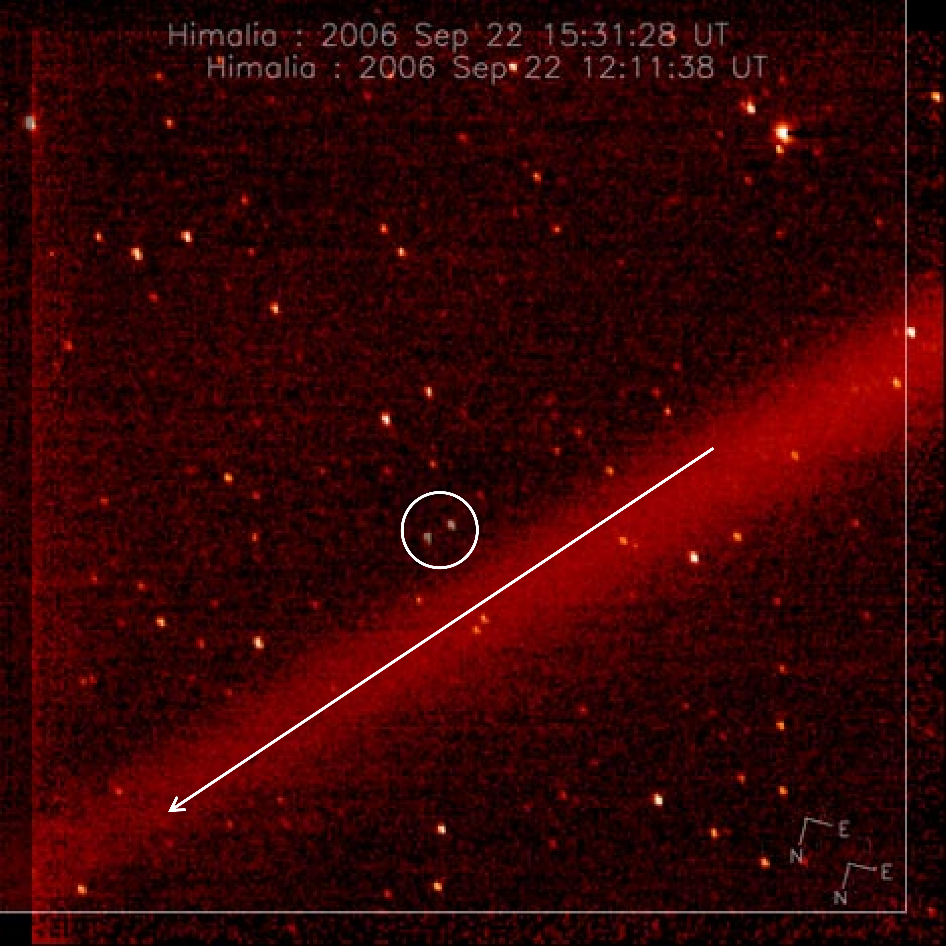


Physical characteristics and orbit
Himalia is noticeably elongated rather than round, indicating that its gravity is not strong enough to shape it into a sphere. Its diameter is on the order of a few hundred kilometres, making it substantially smaller than Jupiter’s major moons but large for an irregular satellite. It orbits far from Jupiter, with a long orbital period and a significant orbital inclination and eccentricity compared with the regular satellites.
- Shape: non-spherical, elongated.
- Surface: dark, spectrally similar to carbonaceous (C-type) bodies.
- Orbit: distant, prograde, and inclined relative to Jupiter’s equator.
Discovery and name
Himalia was discovered by astronomer Charles Dillon Perrine at the Lick Observatory on December 3, 1904. The name comes from a nymph of Greek myth, Himalia, who was associated with Zeus; names from classical mythology are commonly used for Jupiter’s moons. The satellite’s discovery was one of the earliest finds of small Jovian companions beyond the four large Galilean satellites.
Origin and group membership
Himalia is the largest member of a cluster of prograde irregular moons known collectively as the Himalia group. The similar orbits and physical properties of the group’s members suggest a common origin—most likely the breakup of a larger parent body captured by Jupiter’s gravity. Collisional fragmentation explains the spread of sizes and slight differences in orbital elements among the group.
Observations and significance
Himalia has been examined by telescopes on the ground and observed at a distance by spacecraft missions, providing limited imaging and spectral data that help constrain its composition and rotation. Studying Himalia and its kin sheds light on capture processes, collisional evolution in the outer Jupiter system, and the population of primitive small bodies in the early Solar System.
For additional context see entries on irregular satellites, the discovery site at Lick Observatory, the mythological nymph Himalia, the god Zeus, and the planet Jupiter.
Questions and answers
Q: What is Himalia?
A: Himalia is the largest non-spherical moon of Jupiter.
Q: Who discovered Himalia?
A: Charles Dillon Perrine discovered Himalia at the Lick Observatory on December 3, 1904.
Q: Why is Himalia named that way?
A: Himalia is named after the nymph Himalia, who bore three sons of Zeus (Jupiter).
Q: How big is Himalia compared to other moons of Jupiter?
A: Himalia is one of the larger moons of Jupiter, but it is not spherical and has an irregular shape.
Q: What is the significance of the discovery of Himalia?
A: The discovery of Himalia helped scientists to better understand the moons of Jupiter and the formation of the solar system.
Q: Can Himalia sustain life?
A: It is unlikely that Himalia can sustain life, as it is a cold and barren moon.
Q: Is there any ongoing research on Himalia?
A: There is ongoing research on Himalia and other moons of Jupiter, as scientists are always looking to expand their knowledge of the solar system.
Related articles
Author
AlegsaOnline.com Himalia: Jupiter’s largest irregular prograde moon Leandro Alegsa
URL: https://en.alegsaonline.com/art/44258
Sources
- doi.org : 10.1086/316817
- doi.org : 10.1016/j.icarus.2012.03.021
- doi.org : 10.1126/science.1079462
- adsabs.harvard.edu : "Discovery of a Sixth Satellite of Jupiter"
- adsabs.harvard.edu : "Sixth Satellite of Jupiter Confirmed (Himalaia)"
- adsabs.harvard.edu : "Discovery of a Sixth Satellite to Jupiter"
- adsabs.harvard.edu : "Orbits of the sixth and seventh satellites of Jupiter"
- cfa-www.harvard.edu : "Satellites of Jupiter"
- adsabs.harvard.edu : "Provisional Elements of Jupiter's Satellite VI"
- ui.adsabs.harvard.edu : 2012Icar..219..741P
- doi.org : 10.1006/icar.2001.6715
- doi.org : 10.1016/j.icarus.2003.12.016