
Anne Hutchinson
17th-century Puritan religious dissenter in New England whose preaching and trial shaped debates about authority, women’s roles, and religious freedom.
Overview
Anne Hutchinson (baptized July 20, 1591 – August 20, 1643) was an influential and controversial figure in early Puritan New England. Born Anne Marbury in Alford, Lincolnshire in England, she emigrated with her husband and children to the Massachusetts Bay area in the 1630s. Hutchinson led meetings in her home where neighbors gathered to discuss recent sermons and theological ideas, and her views set her at odds with Massachusetts leaders.
Image gallery
10 Images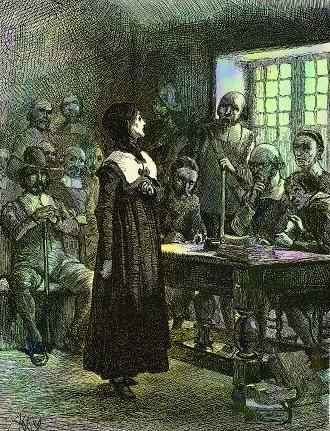


Early life and background
Hutchinson was the daughter of Francis Marbury and Bridget Dryden. Her father, a clergyman, provided her with an education that exceeded what many girls of the period received, and this learning helped her read and debate scripture independently. Her life in England and religious upbringing are often cited in discussions of why she developed into a prominent religious dissenter once in America. The social and religious climate of Puritan New England shaped both her opportunities and the opposition she would meet.
Beliefs and practices
Hutchinson emphasized the primacy of inward faith and direct experience of God's grace over outward conformity to moral laws. She criticized the emphasis some clergy placed on visible signs of righteousness and the necessity of good works as proof of salvation, arguing instead for a reliance on faith alone (a position akin to sola fide). She also maintained that God could reveal truth directly to individuals without mediation by ministers, a claim that alarmed leaders who feared disorder and false prophecy. Her home gatherings included discussion of scripture and theology and became a forum where women and men could exchange views that challenged established teaching (theology, direct revelation).
Conflict, trial, and banishment
Magistrates and ministers in the Massachusetts Bay Colony perceived Hutchinson's influence as a threat to social and religious order. Her willingness to judge the sincerity of prominent ministers and to teach mixed-gender meetings drew formal attention. In 1637 she was brought before a civil and ecclesiastical court, accused of holding and spreading opinions that conflicted with the colony's orthodoxy. Found guilty of errors often labeled as heresy and considered by some authorities a danger to the community, she was admonished and ultimately ordered to leave the settlement. Much of the dispute turned on competing understandings of community, authority, and the proper role of religious leaders (community norms).
Exile, later life, and death
After her banishment Hutchinson moved first to what became Rhode Island, a colony more tolerant of religious diversity, where other dissenters had found refuge. Following the death of her husband in 1642 she relocated to an area near present-day Pelham Bay on Long Island Sound. In 1643 she and most members of her household were killed during an attack by Native Americans. Contemporary reactions in Massachusetts varied; some congregants interpreted the event as a sign of divine displeasure, while later historians have offered more complex readings that consider frontier violence and politics.
Legacy and significance
Anne Hutchinson is remembered for challenging hierarchical religious authority and for expanding the space in which women could speak publicly about faith. Historians and commentators have variously portrayed her as a proto-feminist, a religious visionary, a social troublemaker, and an early advocate of conscience and religious liberty. Her trial illustrates tensions in early colonial society over governance, doctrine, and the boundaries of acceptable dissent. The debates she provoked contributed to the development of alternative settlements and to long-term conversations about liberty of conscience in America.
- Key themes: authority vs. conscience, public role of women, covenant theology.
- Places associated with her life: Alford, England; Massachusetts Bay; Rhode Island; Long Island Sound (Pelham Bay).
- Primary controversies: differing views on good works, the role of ministers, and claims of direct revelation.
For further reading on the cultural and religious context of Hutchinson's life, see accounts of sermons and doctrinal disputes (sermons, theology) and analyses of her trial and its significance in early American history (records, studies, background). Contemporary and modern perspectives continue to reassess her place in the story of religious freedom in North America.
Questions and answers
Q: Who were Anne Hutchinson's parents?
A: Anne Hutchinson's parents were Francis Marbury and Bridget Dryden.
Q: What type of education did Anne Hutchinson receive?
A: Anne Hutchinson received a homeschooled education from her father, who was a clergyman, which was more than most other girls at that time.
Q: What religious views did Puritan neighbors have?
A: Puritan neighbors believed good works were necessary for salvation.
Q: What religious view did Anne Hutchinson believe in?
A: Anne Hutchinson believed that only faith (Sola fide) was necessary for salvation. She also believed that God revealed himself to people without the help of the clergy.
Q: Where did Anne and her family move after leaving Massachusetts Bay Colony?
A: After leaving Massachusetts Bay Colony, Anne and her family moved first to Rhode Island.
Q: Where did she settle after her husband's death in 1642?
A: After her husband's death in 1642, she settled near present-day Pelham Bay on Long Island Sound.
Q: How did they die in 1643?
A; In 1643, Hutchinson, all her children except one, and all her servants were killed in an attack perpetrated by Native Americans.
Related articles
Author
AlegsaOnline.com Anne Hutchinson Leandro Alegsa
URL: https://en.alegsaonline.com/art/4419
Sources
- encyclopedia.com : Encyclopedia: Anne Hutchinson
- pbs.org : PBS God in America: Anne Hutchinson