
Hexham Abbey: history, architecture and present-day role
Hexham Abbey is an historic Anglican church in Hexham, Northumberland, originally a Saxon monastery and cathedral, now serving as the parish church and a landmark of medieval architecture.
Overview
Hexham Abbey is the principal church in the market town of Hexham in Northumberland. Dedicated to St Andrew, it functions today as the Anglican parish church of Hexham. Although its present building is largely medieval, the site has a continuous Christian association that reaches back to the early Middle Ages. Since the Dissolution of the monasteries in the 16th century the former abbey has served the local parish rather than a monastic community.
Image gallery
8 Images

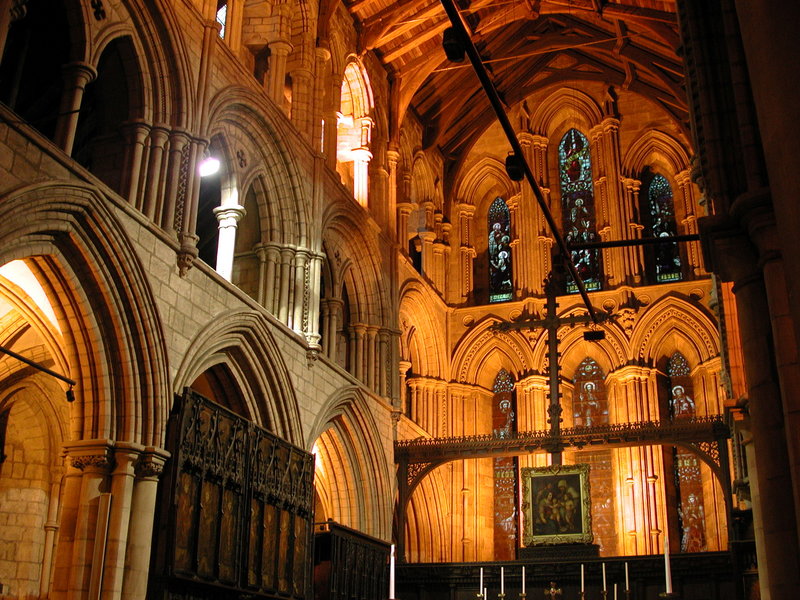


Architecture and principal parts
The abbey combines architectural elements from several periods. Visitors can see Norman and later medieval masonry, a long nave and aisles, and a choir area characteristic of a large monastic church. Notable surviving features include an early crypt and fragments of Anglo-Saxon stonework that attest to the site's antiquity. The fabric of the building shows centuries of repair and alteration, typical of churches that remained in continuous use.
History and development
The foundation of a religious house at Hexham is traditionally dated to the 7th century, connected with the expansion of Christianity in northern England during the Anglo-Saxon era. In Saxon times the church at Hexham functioned as a seat of ecclesiastical authority and is often described in sources as having cathedral status in that period; later medieval building campaigns produced much of the structure visible today. The abbey's role changed radically in the 1530s when the English Reformation led to the suppression of monasteries and the transfer of many former abbey churches into parish use.
Modern role and uses
Hexham Abbey is part of the Church of England's Diocese of Newcastle, whose administrative centre is in Newcastle upon Tyne. The diocese covers much of the historic county of Northumberland and the abbey continues to play a living role as a place of worship, community events and heritage tourism. Regular services, concerts and educational visits are typical activities that sustain both spiritual and cultural life.
Notable facts and visitor information
- The building retains evidence of its Saxon origins alongside later medieval work, making it of interest to students of English church architecture.
- After the Dissolution the structure was adapted to serve a parish congregation rather than a monastic community.
- Although once described as a cathedral in early sources, its present status is that of a parish church within a modern diocesan structure.
For those researching England's ecclesiastical history or planning a visit, Hexham Abbey offers a compact example of how religious buildings evolved from Anglo-Saxon foundations through medieval expansion to post-Reformation parish use. Further information and visitor guidance are available from local heritage resources and the abbey's own published materials.
Questions and answers
Q: What is Hexham Abbey?
A: Hexham Abbey is an Anglican church located in the town of Hexham, Northumberland.
Q: To whom is Hexham Abbey dedicated?
A: Hexham Abbey is dedicated to St Andrew.
Q: What happened to the Abbey after the Dissolution of the monasteries in 1537?
A: After the Dissolution of the monasteries in 1537, the Abbey became the parish church of Hexham.
Q: What was the Abbey in Saxon times?
A: In Saxon times, the Abbey was a cathedral.
Q: What is the Diocese of Newcastle?
A: The Diocese of Newcastle is a group of parishes under the leadership of a bishop who presides in Newcastle upon Tyne.
Q: What region does the Diocese of Newcastle include?
A: The Diocese of Newcastle includes the historic county of Northumberland in northeast England.
Q: Is Hexham Abbey part of the Diocese of Newcastle?
A: Yes, Hexham Abbey is part of the Diocese of Newcastle.
Related articles
Author
AlegsaOnline.com Hexham Abbey: history, architecture and present-day role Leandro Alegsa
URL: https://en.alegsaonline.com/art/44003
Sources
- britarch.ac.uk : "Old ruins, new world"