
Herrerasaurus: an early carnivorous dinosaur from the Late Triassic
Herrerasaurus, a small bipedal carnivore from northwestern Argentina, is among the earliest known dinosaurs. It sheds light on early dinosaur anatomy, ecology, and classification during the Late Triassic.
Overview
Herrerasaurus was a small to medium-sized bipedal carnivore that lived in what is now northwestern Argentina during the Late Triassic. Fossils of this genus come from strata of the Upper Triassic Ischigualasto Formation and are dated to about 231.4 million years ago. It is the best-known representative of the family Herrerasauridae, an assemblage of early dinosauriform predators.
Image gallery
10 Images



Physical characteristics
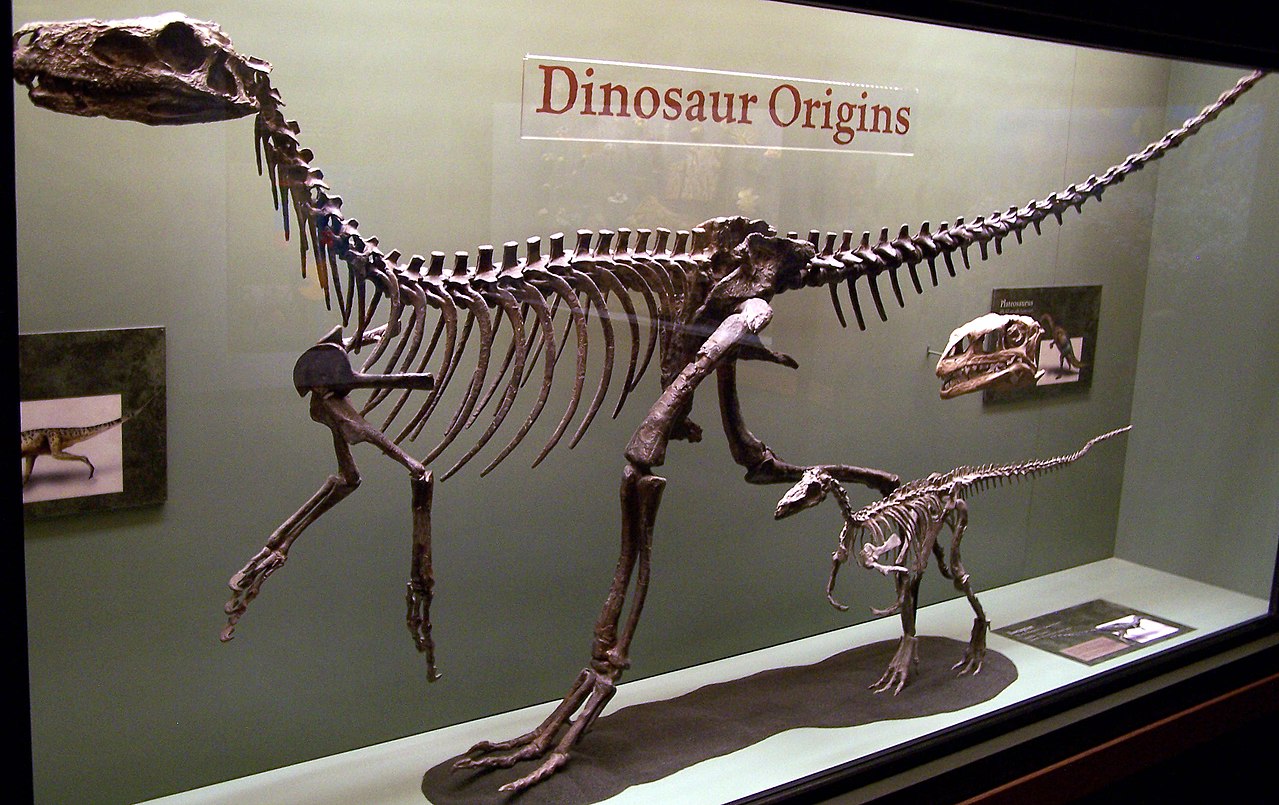
Herrerasaurus combined a light, agile body with features adapted for active predation. Its skull was elongated with recurved, serrated teeth suited for slicing flesh. The animal walked on strong hind limbs and had a long tail for balance. Forelimbs were shorter but equipped with grasping hands and claws.
- Size and posture: bipedal and lightly built, typically reconstructed as several meters in length.
- Skull and teeth: blade-like teeth with serrations, indicating a meat-eating diet.
- Limbs and tail: long hind limbs for running and a stiff tail for stability; hands capable of grasping.
Discovery and geological context
Specimens of Herrerasaurus were recovered from Triassic sedimentary beds in the Ischigualasto-Villa Unión Basin of Argentina. The genus name honors the discoverer of the first remains and the type species is commonly cited as Herrerasaurus ischigualastensis. Its fossils preserve enough skeletal detail to provide important anatomical information about early dinosaurs.
Classification and scientific debate
Herrerasaurus has been pivotal in studies of early dinosaur evolution. For decades its exact placement was debated: some researchers treated it as a very early theropod, others as a basal saurischian, and some as part of a separate early branch close to the root of Dinosauria. Today it is generally placed within or near Herrerasauridae, a distinct lineage of primitive saurischian-like dinosaurs.
Paleobiology and significance
As a top predator in Late Triassic ecosystems, Herrerasaurus likely preyed on smaller archosaurs and contemporaneous vertebrates. Its anatomy illustrates a mosaic of primitive and derived features that help paleontologists reconstruct the sequence of changes leading to later dinosaurs. Well-preserved specimens continue to inform studies of locomotion, feeding mechanics, and the early diversification of dinosaurs.
Questions and answers
Q: What is Herrerasaurus?
A: Herrerasaurus is one of the earliest dinosaurs discovered.
Q: Where have all the fossils of Herrerasaurus been found?
A: All known fossils of Herrerasaurus have been discovered in Upper Triassic strata in northwestern Argentina.
Q: When were the Upper Triassic strata, where Herrerasaurus fossils were found, dated?
A: The Upper Triassic strata where Herrerasaurus fossils were discovered have been dated to 231.4 million years ago.
Q: What type of dinosaur is Herrerasaurus?
A: Herrerasaurus is a carnivorous dinosaur.
Q: What family does Herrerasaurus belong to?
A: Herrerasaurus belongs to the Herrerasauridae family, which includes similar genera that were also among the earliest dinosaurs.
Q: Where in the world is northwestern Argentina located?
A: Northwestern Argentina is located in South America.
Q: How old are the Upper Triassic strata where Herrerasaurus fossils were found?
A: The Upper Triassic strata where Herrerasaurus fossils were discovered are 231.4 million years old.
Related articles
Author
AlegsaOnline.com Herrerasaurus: an early carnivorous dinosaur from the Late Triassic Leandro Alegsa
URL: https://en.alegsaonline.com/art/43879
Sources
- doi.org : 10.3897/zookeys.63.550
- ncbi.nlm.nih.gov : 3088398
- pubmed.ncbi.nlm.nih.gov : 21594020
- ui.adsabs.harvard.edu : 2009Sci...326.1530N
- doi.org : 10.1126/science.1180350
- pubmed.ncbi.nlm.nih.gov : 20007898
- jsg.utexas.edu : "New meat-eating dinosaur alters evolutionary tree"
- doi.org : 10.1016/0031-0182(82)90034-7
- palaeo.gly.bris.ac.uk : palaeo.gly.bris.ac.uk/benton/reprints/1982triassic.pdf
- gsa.confex.com : {{{title}}}