
Henri Poincaré: French mathematician, physicist and philosopher of science
Overview of Jules Henri Poincaré (1854–1912): his life, major mathematical and scientific contributions, influence on topology, dynamical systems, relativity, and his lasting legacy.
Jules Henri Poincaré (29 April 1854 – 17 July 1912) was a French mathematician and scientist whose work shaped many branches of modern mathematics and theoretical physics. Remembered for exceptional breadth, he was often described in his lifetime as a prodigy and later as one of the last scholars able to grasp much of the discipline as a whole. His writings combined rigorous technical results with broad reflections on method and the philosophy of science.
Image gallery
10 Images




Biography and professional life
Poincaré trained and taught in leading French institutions and held a range of academic posts, delivering research and lecture courses that influenced generations. He published original research papers, monographs and essays aimed at specialists and educated readers. His career bridged the 19th and 20th centuries, a period when mathematics was rapidly diversifying into specialized fields.
Main areas of work
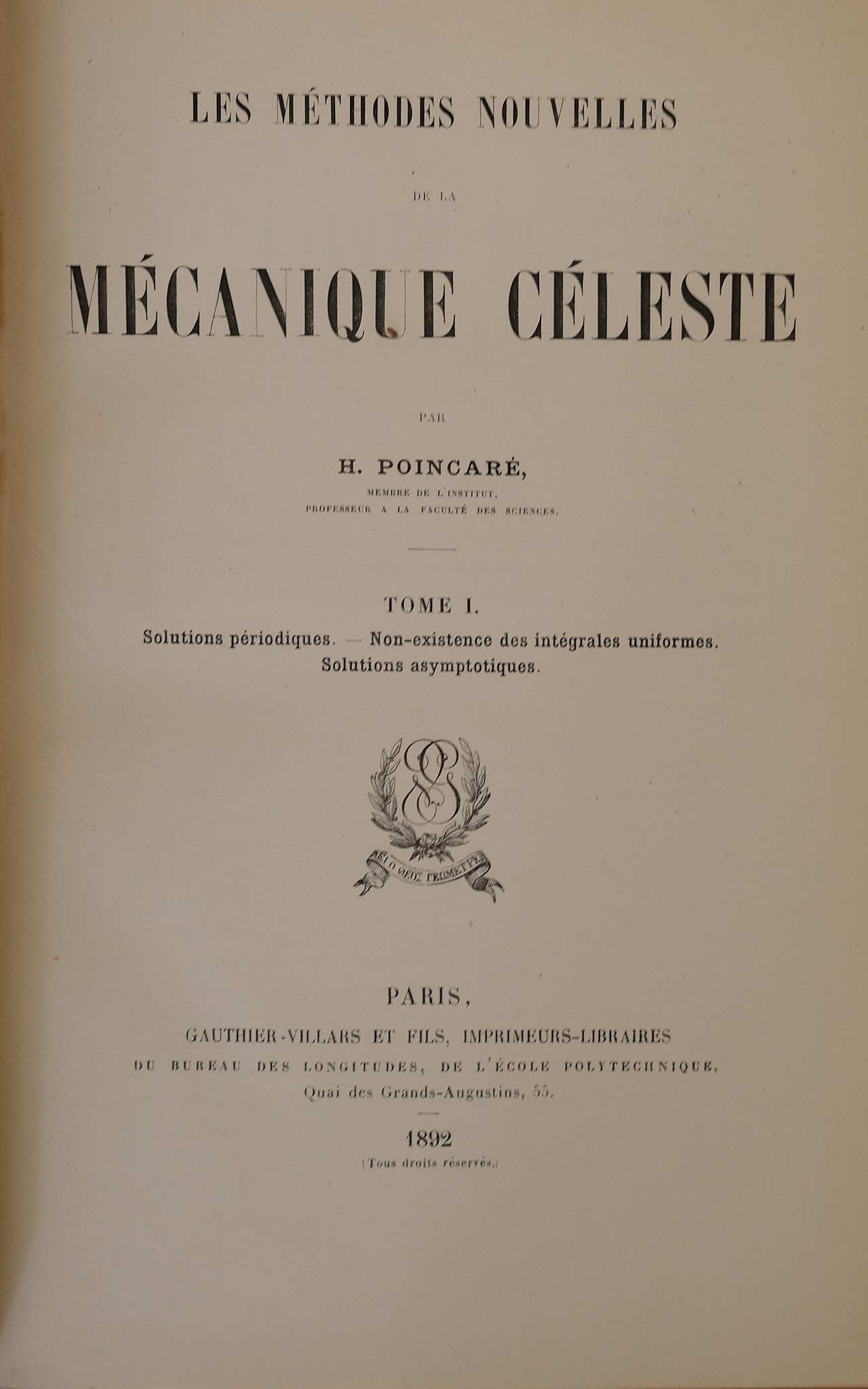
Poincaré made foundational contributions in several domains. He helped found modern topology, formulated deep problems in analysis, and advanced the qualitative theory of differential equations. In celestial mechanics he analyzed the three-body problem and discovered behaviors now recognized as early forms of deterministic chaos. He also investigated automorphic functions, algebraic topology, and the theory of analytic functions.
- Topology: introduced tools and ideas that led to algebraic topology and posed famous conjectures.
- Dynamical systems: developed methods for studying stability, periodic orbits and recurrence.
- Mathematical physics: explored electromagnetic theory and the mathematical structure of physical laws, contributing ideas later associated with relativity.
Many accounts describe him as someone who could survey the whole mathematical landscape; historians and mathematicians sometimes call him the "last universalist" in mathematics, reflecting the era when a single scholar could contribute across multiple subfields without narrow specialization. This characterization is cautious: it highlights his breadth rather than implying absolute completeness.
Influence and legacy
Beyond concrete theorems, Poincaré shaped how mathematicians approach qualitative problems and conceptual foundations. Concepts named after him — such as the Poincaré recurrence theorem, Poincaré map, and the Poincaré conjecture — testify to his lasting impact. His philosophical essays on scientific method and convention continue to be read for their clear exposition of the relations between mathematics, physics and epistemology. Together, his technical advances and broader writings helped set directions for 20th-century mathematics and theoretical physics.
For readers seeking more detail on his life and work, specialist biographies and collections of his papers provide chronological accounts and annotated references to his publications.
Questions and answers
Q: Who was Jules Henri Poincaré?
A: Jules Henri Poincaré was a French mathematician and scientist.
Q: When was he born and when did he die?
A: He was born on April 29, 1854 and died on July 17, 1912.
Q: What nickname did people give him?
A: People referred to him as a "monster of mathematics" when he was still a child.
Q: Why is he so famous?
A: He is famous because many people think that he was the last person to understand all branches of mathematics before the subject became too big for anyone to do this.
Q: What kind of scientist was Poincaré?
A: Poincaré was a mathematician and scientist.
Q: How long did Poincaré live for?
A: He lived for 58 years, from 1854 to 1912.
Related articles
Author
AlegsaOnline.com Henri Poincaré: French mathematician, physicist and philosopher of science Leandro Alegsa
URL: https://en.alegsaonline.com/art/43542