
Ankylosauridae — armored, tail‑club dinosaurs of the Cretaceous
Ankylosauridae is a family of heavily armored, quadrupedal herbivorous dinosaurs noted for osteoderms and, in many genera, a bony tail club; they lived across Laurasia and disappeared at the end of the Cretaceous.
Overview. Ankylosauridae is a family of heavily armored, quadrupedal dinosaurs within the larger infraorder Ankylosauria. Members of this family are best known for extensive body armor made of embedded bone plates (osteoderms) and, in many species, a distinctive bony tail club. They were herbivores that lived mainly during the Cretaceous period and disappeared at the end of the age of dinosaurs (around 66 million years ago). For a concise entry on the family see Ankylosauridae.
Image gallery
10 Images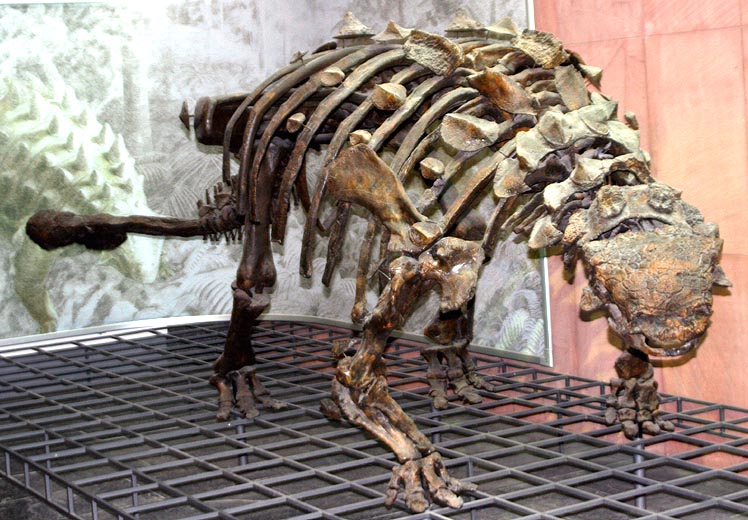


Key characteristics
Ankylosaurids share a suite of skeletal and soft‑tissue features that set them apart from other dinosaurs. Their bodies were broad and low to the ground, supported by stout, columnar limbs. The back, neck and head were protected by rows of osteoderms — bony scutes that ranged from small nodules to large plates. The skull was often heavily reinforced and the bones of the roof and sides were commonly fused into a solid structure. In many ankylosaurids the distal tail vertebrae were modified and encased in bone to form a flexible but massive tail club, which could have been used as a defensive weapon.
Distinctions and related groups
Within Ankylosauria, Ankylosauridae is commonly treated as the sister group to the Nodosauridae; the two families together comprise the major diversity of armored dinosaurs. Nodosaurids typically lacked a tail club and often bore long spikes along the sides of the body, while ankylosaurids more often evolved the tail club and highly fused skull roofs. For contrast see Nodosauridae and general pages on armored dinosaurs.
Fossil record, distribution and notable genera
Fossils attributed to ankylosaurids have been recovered mainly from Laurasian landmasses: western North America, Europe and East Asia, reflecting a distribution across what are now those continents. Well‑preserved skeletons are less common than fragmentary remains and isolated osteoderms, but several genera are well known from articulated specimens. Typical examples include North American forms and Asian taxa found in East Asia; European occurrences are rarer but important for understanding early evolution (Europe). Representative genera include Ankylosaurus, Euoplocephalus, Saichania and Pinacosaurus, each illustrating variations in size, ornament and tail morphology.
History of study
The study of armored dinosaurs began in the 19th century. Early finds such as Scelidosaurus, described by Richard Owen in 1861, helped establish the idea of armored, quadrupedal herbivores, though Scelidosaurus is usually treated as a basal thyreophoran and its exact relationships remain a topic of research. The modern concept of Ankylosauridae crystallized as more complete material from Cretaceous rocks became available in the 20th century, revealing the diversity of armor patterns and the evolution of the tail club.
Ecology and behavior
Ankylosaurids were low browsers that likely fed on dense, low vegetation, using relatively small, leaf‑shaped teeth suited for cropping plant matter. Their heavy armor and, where present, tail clubs suggest a life shaped by predator avoidance and defense. The armor may also have had secondary roles in display, species recognition, or thermoregulation, but direct evidence is limited. Pathologies and healed injuries in some fossils indicate these animals experienced violent encounters, consistent with defensive use of the tail or body armor.
Significance and open questions
Ankylosaurids illuminate how extreme dermal armor and specialized weaponry evolved among herbivorous dinosaurs. Important open questions include the timing and geographic origin of the family, details of tail‑club biomechanics, and how armor patterns related to behavior. Ongoing discoveries across North America, Europe and East Asia continue to refine their evolutionary story, and further comparative study with related taxa remains a lively area of paleontological research. For additional information and general context see entries on Lower Jurassic armored dinosaurs and broader dinosaur resources at dinosaur portals and databases (armour and family summaries provide good starting points).
Questions and answers
Q: What is Ankylosauridae?
A: Ankylosauridae is a family of armoured dinosaurs that lived between 125 million and 65 million years ago.
Q: When did Ankylosauridae become extinct?
A: Ankylosauridae became extinct during the Cretaceous-Tertiary extinction event, around 65 million years ago.
Q: What is the Ankylosauria?
A: The Ankylosauria is an infraorder that includes the Ankylosauridae and their sister group, the Nodosauridae.
Q: Where have Ankylosauridae been found?
A: Ankylosauridae have been found in western North America, Europe, and East Asia.
Q: Are good specimens of Ankylosauridae common?
A: No, good specimens of Ankylosauridae are rare and most are known only from fragments and bits of their armour.
Q: What is Scelidosaurus and when was it described?
A: Scelidosaurus is a quadrupedal armoured animal that lived in the Lower Jurassic and fed on low scrubby plants. It was described by Richard Owen in 1861.
Q: Is the exact position of Scelidosaurus in the Ankylosauridae group known?
A: No, the exact position of Scelidosaurus in the Ankylosauridae group is still not yet agreed upon.
Tags
Related articles
Author
AlegsaOnline.com Ankylosauridae — armored, tail‑club dinosaurs of the Cretaceous Leandro Alegsa
URL: https://en.alegsaonline.com/art/4327