
Ankylosauria: the armored, herbivorous dinosaurs with bony plates and tail clubs
Ankylosauria were heavily armored, quadrupedal herbivorous dinosaurs of Ornithischia. Known for osteoderms, tail clubs (in some), and worldwide fossil distribution from the Middle Jurassic to the end of the Cretaceous.
Overview
Ankylosauria were a group of herbivorous, armored dinosaurs within the order Ornithischia. They are best known for extensive body armor formed by internal bony plates and nodules, which protected a low, broad, quadrupedal body. Fossils assigned to ankylosaurs have been recovered from every continent, indicating they were widespread across multiple ancient ecosystems from the Middle Jurassic through the end of the Cretaceous.
Image gallery
10 Images


Anatomy and armor
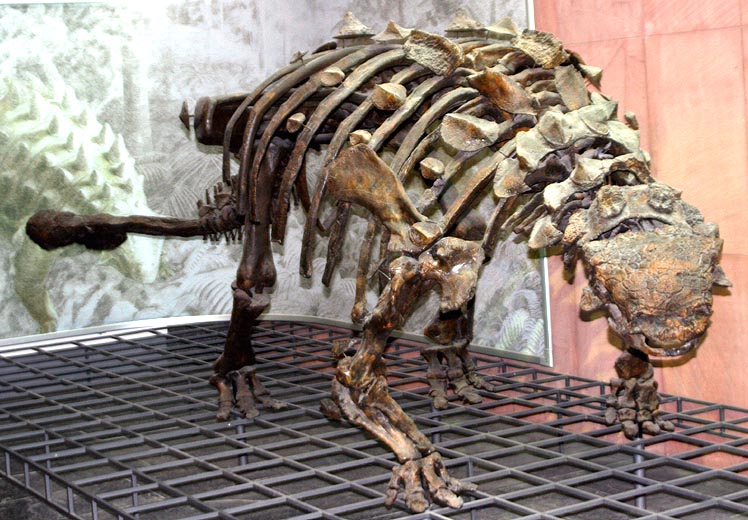
Ankylosaurs possessed a distinctive suite of anatomical features adapted for a defensive lifestyle. Their backs and flanks were covered in osteoderms—bony scales often called scutes—which could fuse with the ribs and skull. Other common traits were a shortened skull, small leaf-shaped teeth for processing plant material, and stout, pillar-like legs that supported a heavy body. Body size varied between genera, from relatively small forms to the very large, low-slung ankylosaurids of the latest Cretaceous.
Types and classification
Traditionally ankylosaurs are divided into two main families that reflect key differences in tail and body armor. Members of Ankylosauridae typically bear a tail club—an enlarged, ossified end to the tail formed from fused vertebrae and osteoderms—while Nodosauridae lack a tail club but often show prominent spikes or enlarged osteoderms along the shoulders and sides. Both families share the heavy armor and quadrupedal posture that define the group.
Evolution and fossil record
Ankylosaurs first appear in the fossil record during the Middle Jurassic and continued to diversify through the Cretaceous. Their fossils are particularly abundant in Late Cretaceous deposits of North America and Asia, but discoveries from Europe, South America, Africa and Antarctica show a broad geographic range. The group’s long history is documented by incremental changes in armor arrangement and skull form seen across successive strata.
Ecology and behavior
As herbivores, ankylosaurs fed on low vegetation such as ferns, cycads and low shrubs, using simple dentition and a large gut to ferment plant material. The heavy armor and, in some species, a defensive tail club, suggest predation pressure from large theropods was a significant selective force. Beyond defense, osteoderms may have had secondary roles in display, species recognition, or thermoregulation, though such functions are harder to confirm from fossils alone.
Notable genera and significance
Well-known ankylosaurs include the iconic Ankylosaurus and North American taxa often displayed in museums, as well as nodosaurids noted for their spiked armor. These dinosaurs are important for understanding dinosaurian defense strategies, convergent evolution of armored forms, and the diversity of herbivore niches in Mesozoic ecosystems. Research continues to refine their relationships, functional anatomy and geographic dispersal.
For further reading on classification and anatomy see resources on Ornithischia and detailed treatments of osteoderms at scutes, or family-level summaries at Ankylosauridae and Nodosauridae. Context for their first appearances in the fossil record is available at sources covering the Middle Jurassic.
Questions and answers
Q: What is Ankylosauria?
A: Ankylosauria is an order of herbivorous armoured dinosaurs in the order Ornithischia.
Q: What was the armour of Ankylosaurs made of?
A: The armour of Ankylosaurs was made of scutes, which are bony scales.
Q: How many legs did Ankylosaurs have?
A: Ankylosaurs were quadrupeds, meaning they had four legs.
Q: What were the two types of Ankylosaurs?
A: The two types of Ankylosaurs were Ankylosauridae, which were armoured from their head to their club-ended tail, and Nodosauridae, which had no tail club but spikes and bony bumps on their body.
Q: When did Ankylosaurs first appear?
A: Ankylosaurs first appeared in the Middle Jurassic period.
Q: On which continents have fossils of Ankylosaurs been found?
A: Fossils of Ankylosaurs have been found on every continent.
Q: How long did Ankylosaurs live for?
A: Ankylosaurs lived until the end of the Cretaceous period.
Tags
Related articles
Author
AlegsaOnline.com Ankylosauria: the armored, herbivorous dinosaurs with bony plates and tail clubs Leandro Alegsa
URL: https://en.alegsaonline.com/art/4326