
Hebridean Terrane: geology, structure, and regional significance
Summary of the Hebridean Terrane in northwest Scotland: its rocks, stratigraphy, bounds, geographic extent, tectonic history in the Caledonian orogeny, and exploration significance.
Overview
The Hebridean Terrane is a major component of the Caledonian mountain belt in northwest Scotland and adjacent islands. It comprises a sequence of ancient crystalline basement and younger sedimentary cover that records part of the geological history of the Laurentian margin during the assembly of the Caledonian orogen. The terrane forms the westernmost strip of mainland Scotland, most islands of the Inner Hebrides and all of the Outer Hebrides, and has equivalents recognized farther north on Shetland. The regional tectonic context is described in literature on the Caledonian orogeny.
Image gallery
5 Images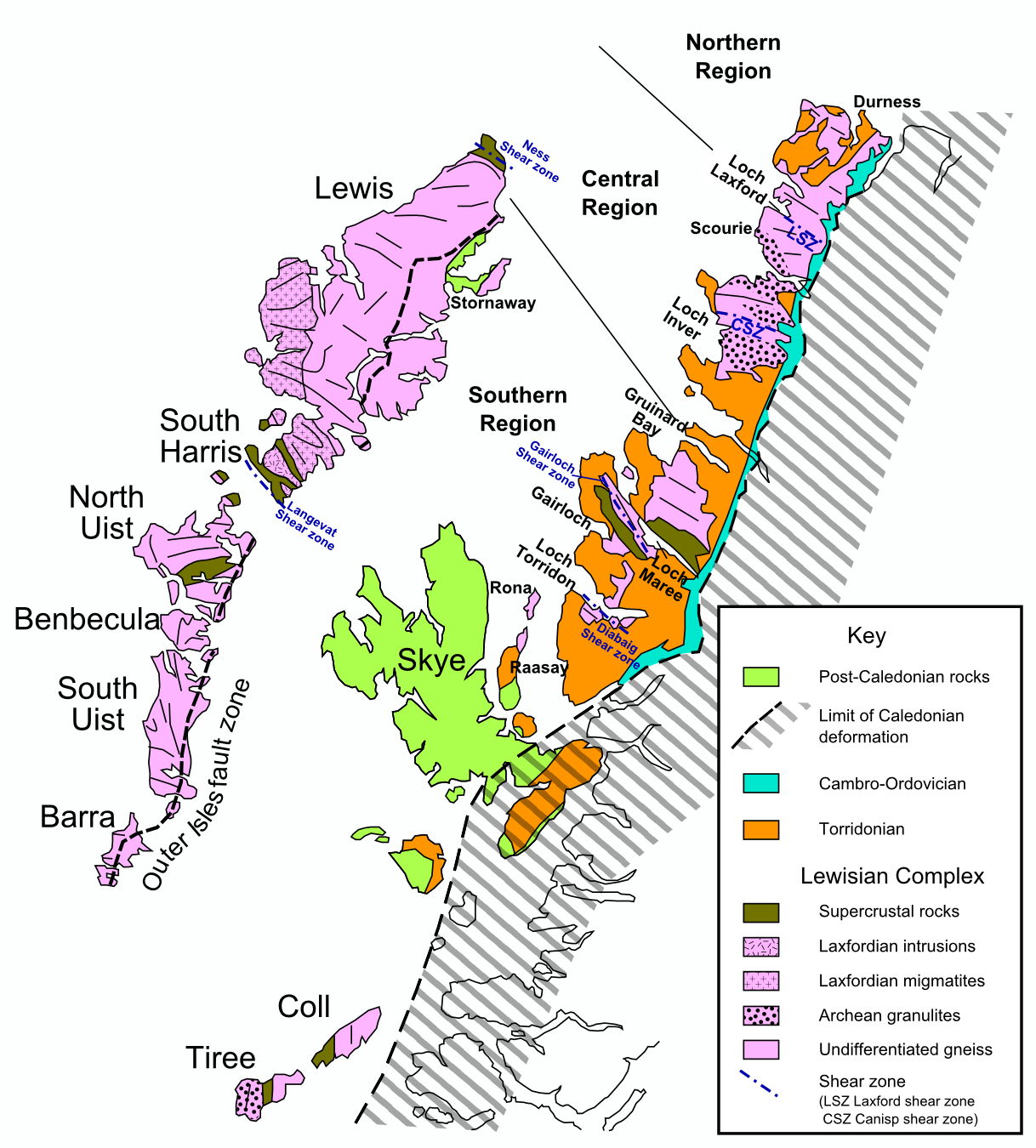

Bedrock and stratigraphy
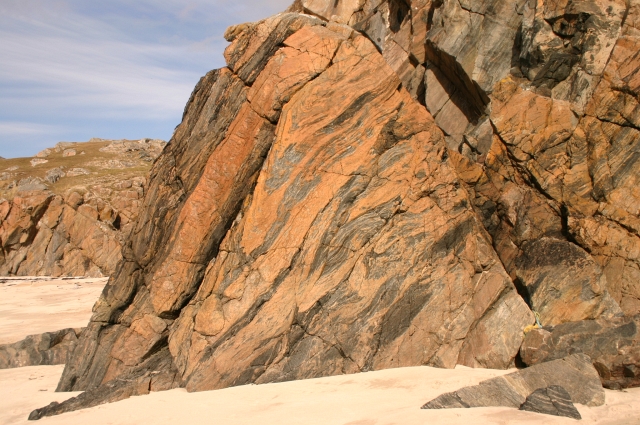
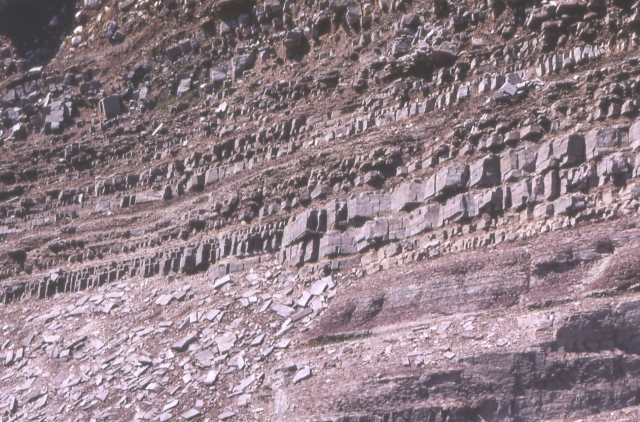
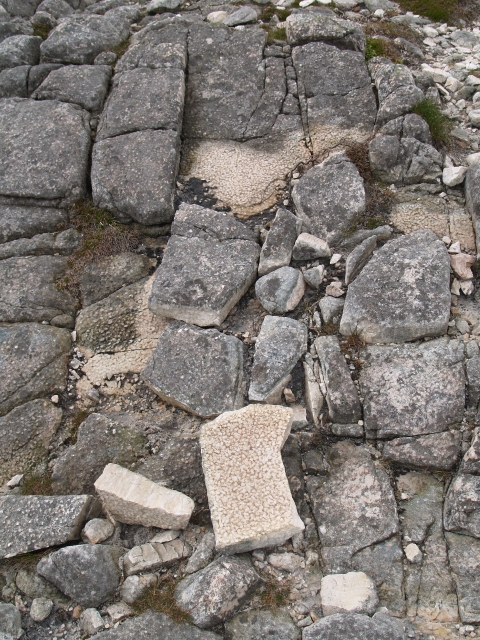
At its base the Hebridean Terrane rests on very old high-grade gneisses commonly referred to as the Lewisian complex. These rocks are predominantly of Archaean to Paleoproterozoic age and form a metamorphic basement. Above that basement is a thick package of weathered and red-bed sediments deposited in the Neoproterozoic, commonly grouped under the name Torridonian. The Torridonian sits unconformably over the Lewisian basement—a geometric break that is often described as an unconformity—and records long gaps in deposition. The Torridonian and other Neoproterozoic sequences are in turn overlain by marine Cambrian to Ordovician sedimentary rocks that reflect later shallow-sea conditions along the Laurentian margin.
Structure and boundaries
The terrane is structurally defined by major fault and thrust zones. Its eastern limit against the Northern Highland Terrane is marked by the Moine Thrust Belt, a key crustal-scale fault system that accommodated large-scale tectonic transport during the Caledonian collision. To the west the original limits of the terrane are masked by later events: Mesozoic rifting and subsequent sedimentation and volcanism obscured much of the western margin, complicating efforts to map the full extent of Hebridean-affinity rocks offshore.
Geographic extent and exploration
Onshore, the Hebridean Terrane is exposed across parts of northwest Scotland and the island groups named above. Offshore and beneath younger cover, similar rock types have been encountered by geological surveys and by hydrocarbon and scientific drilling; results from BGS boreholes and exploration wells confirm that Lewisian and Torridonian sequences extend beneath the continental shelf to the west and north. The presence of these old basement rocks has guided regional mapping and resource assessments.
Geological history and significance
In broad terms the Hebridean succession preserves three chapters of Earth history: an ancient crystalline basement recording early continental growth; a long interval of continental sedimentation in the Neoproterozoic (the Torridonian) that documents weathering and river-dominated environments; and later marine sedimentation during the early Palaeozoic as the region lay at the margin of the Laurentian landmass. During the Caledonian mountain-building episode the terrane behaved largely as a piece of Laurentian foreland that experienced thrusting at its margins rather than wholesale crustal imbrication.
Notable facts and distinctions
- The Lewisian basement records some of the oldest rocks in the British Isles and provides insights into Archaean–Paleoproterozoic crustal evolution.
- The Torridonian sequences are notable for their red-bed continental character and for being widely preserved on the Hebridean block.
- The Laurentian affiliation of the terrane explains its stratigraphic differences from terranes that originated on other palaeocontinents.
- Similar Hebridean-type rock packages and tectonic relationships are reported from northern outcrops on Shetland and are the subject of ongoing correlation studies.
- Key topics for further study include the precise offshore limits of the terrane and the effect of Mesozoic events on preservation of older rocks.
For further reading on the Caledonian tectonic framework and regional geology see general syntheses and regional maps held by geological surveys and academic reviews (Caledonian orogeny summaries, regional descriptions of northwest Scotland, and stratigraphic overviews of the Neoproterozoic and Palaeozoic sequences).
While compact in exposure, the Hebridean Terrane is a keystone for understanding the deep-time geology of the Scottish margin and the evolution of ancient continental crust in northwest Europe.
Questions and answers
Q: What is the Hebridean Terrane?
A: The Hebridean Terrane is one of the terranes that form part of the Caledonian orogenic belt in northwest Scotland. Its boundary with the neighbouring Northern Highland Terrane is formed by the Moine Thrust Belt.
Q: What type of rocks make up its basement?
A: The basement rock is formed by Archaean and Paleoproterozoic gneisses of the Lewisian complex.
Q: What sedimentary layers are present on top of this basement?
A: They are overlaid unconformably by Neoproterozoic Torridonian sediments, which in turn are unconformably overlain by a sequence of Cambro-Ordovician sediments.
Q: How did it form during continental collision?
A: It formed part of the Laurentian foreland during the Caledonian continental collision.
Q: Where can similar rocks be found outside Scotland?
A: Similar rocks are also thought to be present on Shetland. They have been proved west and north of the Outer Hebrides by BGS shallow boreholes and hydrocarbon exploration wells.
Q: How far does this terrane extend to the west?
A: The full extent of this terrane to the west is obscured by the effects of Mesozoic rifting.
Q: Are there any other areas where similar rocks occur outside Scotland? A: Some similar rocks occur in Shetland, which are the northern outpost of the Caledonian orogeny.
Related articles
Author
AlegsaOnline.com Hebridean Terrane: geology, structure, and regional significance Leandro Alegsa
URL: https://en.alegsaonline.com/art/43165