
Heart urchin (Spatangoida)
Heart urchins are infaunal echinoids adapted to burrowing in soft sediments; this article summarizes their anatomy, behavior, ecology, taxonomy, fossil record and role in coastal systems.
Overview
Heart urchins are a group of irregular sea urchins adapted to life within soft seabed sediments. They are commonly placed in the Order Spatangoida and include families such as the Loveniidae. Their rounded, often heart-shaped test and dense covering of short spines or setae suit a fossorial (burrowing) lifestyle. They occupy a similar ecological niche to sand dollars, but differ in body plan, gait through sediment and many anatomical details.
Image gallery
10 Images


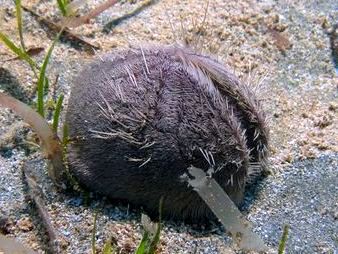


Anatomy and adaptations
Heart urchins show a pronounced front-to-back orientation, with the mouth on the underside and the anus displaced toward the posterior to suit life inside sediment. The petaloid ambulacra on the upper surface commonly serve respiratory functions, while the dense, hair-like spines and tube feet move and stabilise sediment. Many species secrete mucus and use ciliary tracts to collect organic particles. These features allow them to feed, respire and move while remaining largely buried.
Feeding and respiration
Most heart urchins are deposit or detritus feeders: they ingest sediment and extract organic matter and microalgae, or trap particles with mucous on specialised structures and convey them to the mouth by ciliary action. The petaloid areas and associated tube feet facilitate gas exchange with overlying oxygenated water brought into shallow burrow shafts, allowing them to remain buried while respiring.
Behavior and ecological role
These echinoids are important bioturbators. Their digging and feeding rework sediments, increase oxygen penetration and influence nutrient cycling and benthic community structure. Infaunal feeding traces and characteristic depressions on beaches or tidal flats often betray their presence. Predators include crabs, fish and shorebirds that can detect or expose buried individuals.
Distribution, habitat and common species
Heart urchins occur in temperate and tropical seas, from shallow subtidal flats to deeper soft-bottom habitats. The British coastal example Echinocardium is familiar on sandy shores and mudflats; field guides note how its test may be found washed up or detected by the disturbance it leaves on shores. Regional faunas differ in species composition and preferred sediment types.
Life cycle and reproduction
Reproductive modes vary but many species broadcast spawn gametes into the water column and have planktonic larvae that eventually settle and metamorphose into the adult form. Some species show seasonal reproductive peaks linked to local environmental conditions. Larval stages play a role in dispersal and population connectivity.
Taxonomy and fossil record
Heart urchins belong to a distinct lineage within irregular echinoids with a fossil record extending back many millions of years. Fossils demonstrate a variety of test shapes and adaptations to different sedimentary environments, helping to reconstruct past coastal ecosystems and evolutionary trends in burrowing echinoids; for introductory summaries see resources on burrowing echinoids.
Identification tips and human relevance
- Test shape: look for a bilateral, heart-like outline with anterior notch in some species.
- Petaloids: raised ambulacral areas on the upper surface suggest respiratory function.
- Spines and setae: short, hair-like and adapted for moving sediment rather than for defense.
Heart urchins are not major fisheries resources but are of interest to ecologists and collectors. They can be affected by habitat loss, dredging and pollution, which alter sediment composition. Their role as ecosystem engineers makes them useful indicators of benthic health in coastal management and scientific studies.
Questions and answers
Q: What are heart urchins?
A: Heart urchins refer to burrowing echinoids that belong to the Family Loveniidae in the Order Spatangoida.
Q: How is the lifestyle of heart urchins similar to that of sand dollars?
A: Heart urchins share a similar burrowing lifestyle with sand dollars.
Q: What is the standard British heart urchin found in sandy shores?
A: Echinocardium is the standard British heart urchin found in sandy shores.
Q: How do heart urchins pass food to their gut?
A: Heart urchins have sticky tube-feet that pass food to their gut.
Q: How much can heart urchins burrow in relation to their own height?
A: Heart urchins can burrow up to five times their own height.
Q: How do heart urchins keep connection with the surface for oxygenated water and food?
A: Heart urchins keep connection with the surface to access oxygenated water and food.
Q: What happens to the spicules of heart urchins?
A: The spicules of heart urchins are converted to a soft form.
Related articles
Author
AlegsaOnline.com Heart urchin (Spatangoida) Leandro Alegsa
URL: https://en.alegsaonline.com/art/43089