
Hydraulic head (hydrology and fluid mechanics)
Hydraulic head quantifies the total mechanical energy per unit weight of fluid at a point; used to describe pressure, elevation and flow potential in groundwater and engineered systems.
Hydraulic head is a scalar measure of the total mechanical energy of a fluid per unit weight at a given point, expressed as a length. It unites the effects of pressure, elevation and, where relevant, velocity into a single quantity that indicates the ability of water to do work or move. Because it represents energy per unit weight, hydraulic head is commonly measured in metres (or feet) above an arbitrary datum.
Image gallery
4 Images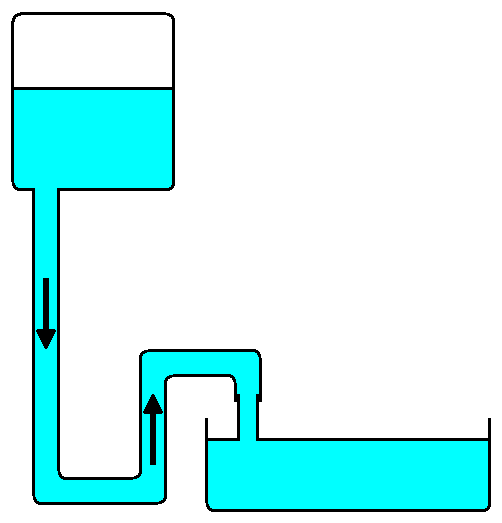


Components of head
The total hydraulic head is traditionally decomposed into three parts:
- Elevation head (z): the vertical position of the point relative to a chosen datum.
- Pressure head (p/γ): the height of a fluid column whose weight would produce the local static pressure (pressure divided by specific weight).
- Velocity head (v²/2g): the energy equivalent of fluid motion; often negligible in slow groundwater flow but important in open-channel and pipe flows.
Measurement and practical use
In hydrogeology, hydraulic head is measured with piezometers or wells: the elevation of the water level in the pipe or well above the chosen datum gives the piezometric head. For a well, the head equals the elevation of the measuring point minus the measured depth to water, plus any needed correction for well construction. Engineers use hydraulic head maps (potentiometric surfaces) to determine flow direction—water moves from high head toward low head—and to compute hydraulic gradients that drive flow according to Darcy's law.
Theoretical context and conservation
Hydraulic head is central to Bernoulli's equation and energy-balance descriptions of fluid flow. In ideal, inviscid flows the total head is conserved along a streamline; in real flows head losses occur due to friction and turbulence. In porous media, differences in hydraulic head between two points divided by distance define the hydraulic gradient, which, together with the medium's conductivity, determines volumetric flux.
Applications and notable facts
Hydraulic head underpins tasks such as groundwater resource assessment, contaminant transport studies, design of pumping schemes, and seepage analysis beneath dams. A useful conceptual point is that equipotential lines of equal head are perpendicular to streamlines of flow. Because head values are relative to a datum, absolute numbers matter less than differences and gradients. For more technical background see further reading.
Questions and answers
Q: What is hydraulic head?
A: Hydraulic head is a specific measurement of water pressure or total energy per unit weight above a datum.
Q: How is hydraulic head usually measured?
A: Hydraulic head is usually measured as a water surface elevation, expressed in units of length.
Q: What does hydraulic head represent in a piezometer?
A: Hydraulic head represents the energy at the entrance (or bottom) of a piezometer.
Q: What is a piezometric well?
A: A piezometric well is a specialized water well used to measure hydraulic head in an aquifer.
Q: How can hydraulic head be calculated in an aquifer?
A: In an aquifer, hydraulic head can be calculated from the depth to water in a piezometric well, and information of the piezometer's elevation and screen depth.
Q: What is the screen depth of a piezometric well?
A: The screen depth of a piezometric well is the depth at which water can enter the well from the surrounding aquifer.
Q: How is hydraulic head expressed?
A: Hydraulic head is expressed in units of length, typically in feet or meters.
Related articles
Author
AlegsaOnline.com Hydraulic head (hydrology and fluid mechanics) Leandro Alegsa
URL: https://en.alegsaonline.com/art/43023