
Harpsichord: history, construction, and musical role
Plucked keyboard instrument prominent in Renaissance and Baroque music. Covers construction, types (virginal, spinet, double-manual), repertoire, performance practice, tuning and modern revival.
The harpsichord is a family of keyboard instruments whose strings are sounded by being plucked with a small plectrum. This plucked action, often implemented with movable jacks and a plectrum, gives the harpsichord a bright, focused tone distinct from struck-string keyboards. The mechanism that plucks is usually called a plectrum in instrument descriptions, and its material (quill historically, plastic or leather in many modern instruments) affects timbre. By contrast, the clavichord produces sound by striking strings with a tangent, and the modern piano produces sound by hammers striking strings; these struck actions permit direct dynamic response to touch in ways the harpsichord normally does not.
Image gallery
10 Images


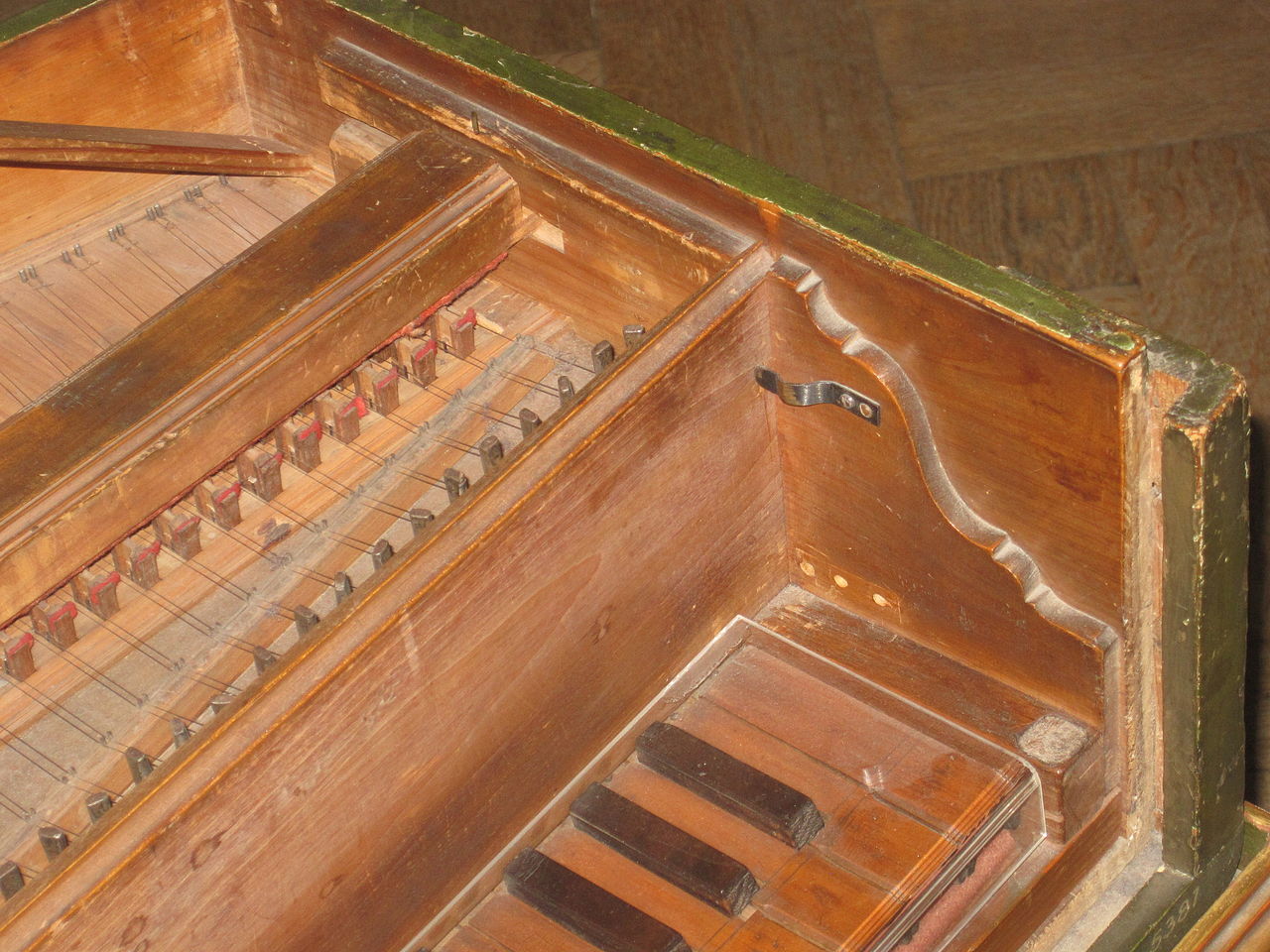


Construction and sound production
Typical harpsichord construction includes a wooden case, soundboard, bridges, strings arranged in one or more choirs, a keyboard, and the action composed of jacks and plectra. When a key is depressed a jack rises so that its plectrum plucks the string; when the key is released a damper silences the string. Many instruments have two or three choirs of strings at different pitches and one or two manuals (keyboards) to permit registration changes and contrasting timbres. Stops and couplers alter which choirs sound or couple manuals together, allowing a player to vary sonority though not touch-based dynamics.
Types and domestic forms
- Virginal: a compact, often rectangular instrument popular in England and the Low Countries; associated with domestic music-making and amateur players.
- Spinet: a small, triangular or oblique-string instrument designed for domestic use; compact and sometimes placed on a table when played. See examples of spinets in museum collections.
- Concert or full harpsichord: larger wing-shaped instruments with multiple choirs of strings and commonly two manuals; used for solo repertoire and continuo work.
Historical development and repertoire
The harpsichord emerged from early plucked-string instruments when keyboard mechanisms were applied to them and became central to musical life from the Renaissance through the Baroque. It served both as a solo instrument and as the primary harmonic foundation in ensemble practice, where it realized figured bass and continuo parts for singers and orchestras. For general background see sources on the Renaissance and the Baroque. It regularly appears in chamber music, opera, and orchestral continuo, complementing the orchestra and vocal writing.
Important composers who contributed to harpsichord literature include William Byrd, François Couperin, Domenico Scarlatti and Johann Sebastian Bach. Bach's monumental collection, The Well-Tempered Clavier, consisting of paired prelude and fugue in every major and minor key, is often cited as a landmark demonstrating tuning systems that made all keys usable for keyboard composition and performance.
Performance practice and expressive resources
Because the harpsichord offers little dynamic variation from touch, performers shape phrases through articulation, timing, ornamentation, registration changes and manual differences. Historic methods of ornamentation—trills, mordents and embellishments—are central to style. Players may change stops or engage a second manual to produce contrast between solo lines and accompaniment, or to alternate colors within a piece. Historically informed performance practice since the 20th century has emphasized period techniques, appropriate ornamentation and authentic temperaments for particular repertoires.
Modern revival, construction, and study
The 20th-century revival of interest in early music led to renewed building of harpsichords based on surviving historical instruments and treatises. Contemporary builders produce both faithful reconstructions and instruments that blend historical principles with modern materials. Scholars and luthiers study surviving instruments to understand regional building traditions, stringing, voicing, and temperaments. Conservators in museums document makers, provenance and repair histories to support performance and research.
Summary
The harpsichord occupies a distinctive place in Western musical history: its plucked sound shaped the texture and rhetoric of Renaissance and Baroque music and continues to inform modern performances of early repertoire. Its varieties—from virginals and spinets to two-manual concert instruments—provide a range of timbres that, together with stylistic performance practice, remain central to the study and enjoyment of historical keyboard music.
Questions and answers
Q: What is a harpsichord?
A: A harpsichord is a keyboard instrument that produces sound by having the strings plucked with a plectrum.
Q: How does it differ from a clavichord?
A: On a clavichord, the strings are hit to produce sound, whereas on a harpsichord they are plucked with a plectrum.
Q: How does playing the piano compare to playing the harpsichord?
A: On the piano, it is possible to play louder or quieter by playing the keys with more or less force. However, on a harpsichord this volume cannot be controlled in this way and instead relies on different "stops" for varying sounds.
Q: What were some of the smaller types of harpsichords called?
A: Smaller types of harpsichords were sometimes referred to as "virginals" and "spinets". Virginals were often played by young girls and spinets could be picked up and put on tables.
Q: When was the harpsichord popularly used in music?
A: Harpsichords were very important in music from Renaissance and Baroque periods. They were used both as solo instruments and accompaniments for orchestras.
Q: Who wrote The Well-Tempered Clavier?
A: Johann Sebastian Bach wrote The Well-Tempered Clavier which has preludes and fugues in every major and minor key.
Q: What was its purpose?
A: It is said that Bach wrote this collection of music to demonstrate how keyboard instruments like the harpsichord can be tuned so that they can play in any key.
Related articles
Author
AlegsaOnline.com Harpsichord: history, construction, and musical role Leandro Alegsa
URL: https://en.alegsaonline.com/art/42539