
Harmonic series (mathematics)
Infinite series of reciprocal integers 1 + 1/2 + 1/3 + …, notable for diverging slowly; central in analysis, number theory, probability and algorithm analysis.
Overview
The harmonic series is the infinite sum of the reciprocals of the positive integers: 1 + 1/2 + 1/3 + 1/4 + ···. It is one of the simplest examples of an infinite series whose terms tend to zero yet the series itself does not converge to a finite value. The name comes from a historical connection to musical harmonics: the frequencies or wavelengths of overtones on a string relate to integer divisors of the fundamental, which inspired the term harmonic. For further reading on the concept, see harmonic series, and for the symbolic expression see the series notation.
Image gallery
4 Images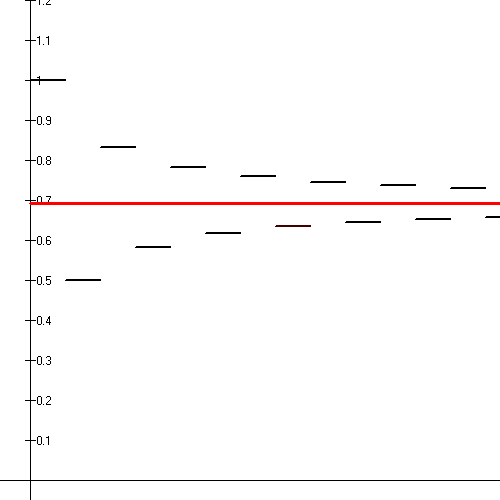


Key properties
Although each term 1/n tends to zero, the sequence of partial sums H_n = 1 + 1/2 + … + 1/n grows without bound; this is the statement that the series diverges. Its divergence is very slow: the nth partial sum behaves approximately like the natural logarithm, H_n ≈ ln(n) + γ, where γ is the Euler–Mascheroni constant (approximately 0.5772). This slow growth explains why adding many terms can still give modest totals despite unbounded increase.
Typical proofs of divergence
Several classical arguments show the harmonic series diverges. Two common elementary methods are:
- Comparison by grouping: Group terms as (1) + (1/2) + (1/3 + 1/4) + (1/5 + … + 1/8) + …; each group after the first is at least 1/2, so partial sums exceed any bound when enough groups are included.
- Integral test: Compare the sum to the integral of 1/x. The integral ∫_1^∞ dx/x diverges, and since 1/n is comparable to this integrand, the series diverges as well.
History and context
Awareness of the divergence of the harmonic series dates back many centuries. Early arguments appear in medieval and Renaissance mathematics; a clear proof using grouping is often attributed to Nicole Oresme in the 14th century. Leonhard Euler studied the harmonic numbers H_n and established their connection with the logarithm and with the constant now named after him. The harmonic series sits at the frontier between convergence and divergence: the p-series Σ 1/n^p converges for p>1 and diverges for p≤1, so the harmonic case p=1 is the critical borderline.
Applications and examples
Harmonic numbers and the harmonic series appear in diverse areas. In number theory the divergence of related sums can imply density results about primes — for example the sum of reciprocals of primes diverges more slowly than the harmonic series but still diverges. In probability and combinatorics the expected time to collect all coupons (the coupon collector problem) involves harmonic numbers. In computer science analyses, the harmonic series shows up in average-case costs and amortized analyses, for instance in certain algorithms and data structures where running times scale like H_n. The musical origin is often mentioned: the overtone sequence of a vibrating string has wavelength ratios that are reciprocals of integers, which motivated the name; see more on overtones at musical harmonics.
Related distinctions and notable facts
Several variants illustrate different behavior: the alternating harmonic series 1 - 1/2 + 1/3 - 1/4 + ··· converges (to ln 2), demonstrating how sign changes can change convergence. Weighted versions or restricting to subsequences can converge or diverge depending on density and size; for instance, the p-series with exponent p>1 converges. The surprisingly slow divergence of the harmonic series means that extremely large partial sums are required to reach modest numerical thresholds — a useful caution when estimating infinite sums in applications.
Overall, the harmonic series is a fundamental example in mathematical analysis, serving as a teaching model for convergence tests, asymptotic estimates, and connections between discrete sums and continuous integrals.
Questions and answers
Q: What is the harmonic series?
A: The harmonic series is an infinite divergent series where each term is equal to 1 divided by its position in the sequence.
Q: What does it mean for a series to be divergent?
A: Divergent means that as you add more terms, the sum never stops getting bigger and does not go towards a single finite value.
Q: What does it mean for a series to be infinite?
A: Infinite means that you can always add another term and there is no final term to the series.
Q: Where did the name of this series come from?
A: The name of this series comes from the idea of harmonics in music, where the wavelengths of overtones are 1/2, 1/3, 1/4, etc., of the string's fundamental wavelength.
Q: What is a harmonic mean?
A: A harmonic mean is when every term in a sequence is equal to the harmonic mean of its neighboring terms. This phrase also comes from music.
Q: How do we calculate each term in this sequence?
A: Each term in this sequence can be calculated by dividing one by its position in the sequence (1/n).
Related articles
Author
AlegsaOnline.com Harmonic series (mathematics) Leandro Alegsa
URL: https://en.alegsaonline.com/art/42492
Sources
- books.google.com : "Praefatio [Preface]"
- books.google.com : "Corollary III of De seriebus varia"
- books.google.com : Ars conjectandi, opus posthumum. Accedit Tractatus de seriebus infinitis
- oeis.org : "Sequence A082912 (Sum of a(n) terms of harmonic series is > 10n)"
- jstor.org : jstor.org/stable/24496876?seq=1
- stat.ualberta.ca : "Random Harmonic Series"
- doi.org : 10.2307/3647827
- mathworld.wolfram.com : Infinite Cosine Product Integral
- qbyte.org : "Nick's Mathematical Puzzles: Solution 72"
- pme-math.org : "Problem 52: Overhanging dominoes"