
Hardanger fiddle (hardingfele)
A Norwegian bowed string instrument with sympathetic strings, ornate decoration, and a central role in folk dance, ritual and regional music traditions.
Overview
The Hardanger fiddle, commonly called the hardingfele, is a traditional string instrument closely associated with rural musical culture in southwestern Norway. It resembles a violin in shape and playing posture but is distinguished by additional sympathetic strings running beneath the played strings. These extra strings and a thinner soundboard give the instrument a rich, resonant tone that supports the modal melodies used in local dances, ceremonies and folk ensembles.
Image gallery
2 Images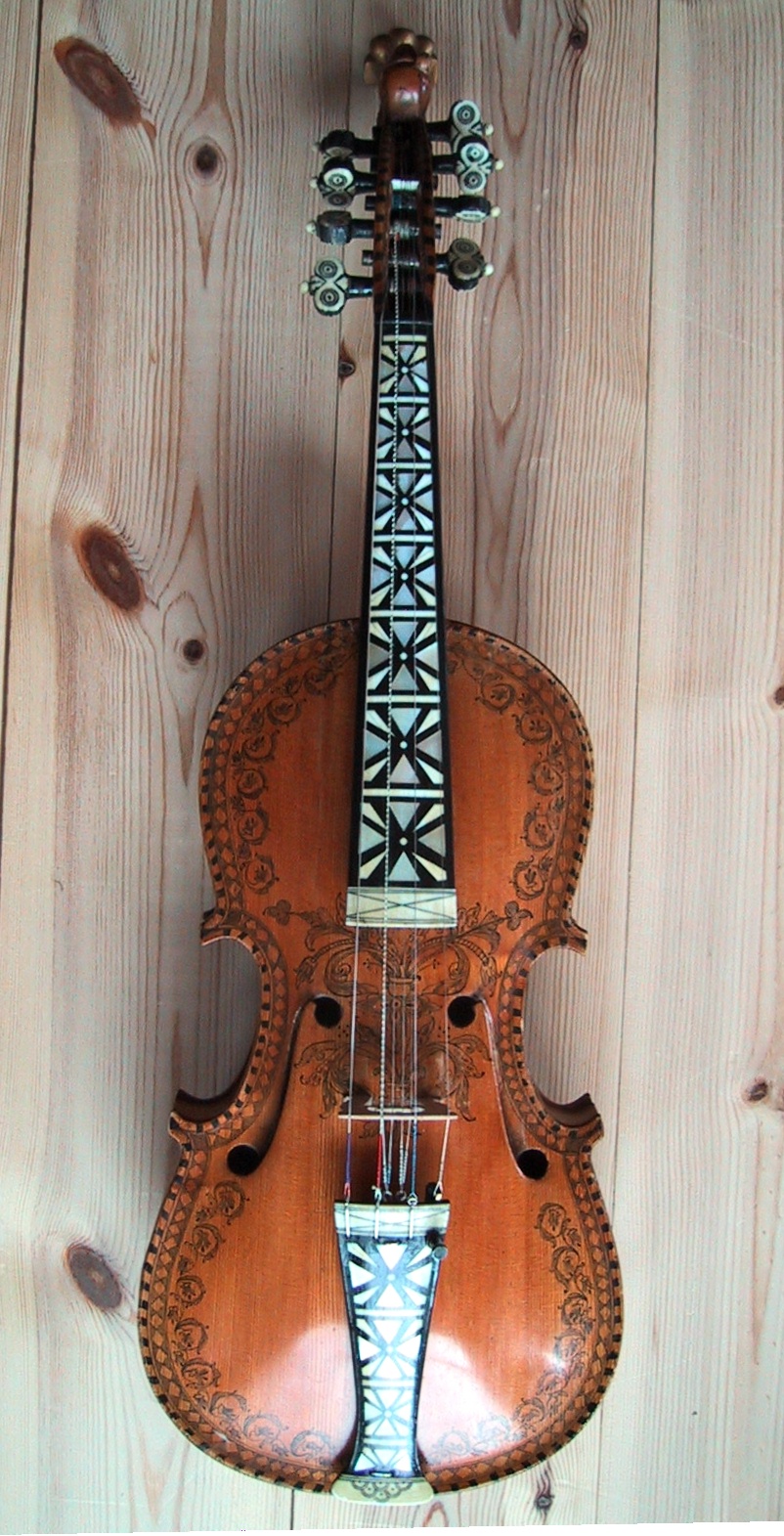

Construction and acoustic features
A typical hardingfele has four played strings tuned and bowed like a violin, and four or five sympathetic strings that vibrate in response to the main strings, producing an overtone-rich, ringing sustain. The instrument’s body and woodwork are often made with thinner plates than a standard violin to enhance sympathetic resonance. Players and makers vary tuning and bridge shaping to emphasize particular overtones, and the instrument’s distinctive sound depends on the interaction between the played strings and the unstopped sympathetic set, sometimes described as the defining characteristic of the sympathetic strings system.
Decoration and craft traditions
Decoration is a hallmark of the hardingfele. Many instruments display elaborate painted patterns (rosing), mother-of-pearl inlays on the fingerboard and tailpiece, and carved scrolls that may depict a female head, a lion, or other motifs. Inlays of bone and other materials are used on pegs and purfling to create a distinctive visual identity; for example makers often employ mother-of-pearl and bone inlay as ornamentation. These decorative traditions reflect regional aesthetics and the long artisan history of Norwegian fiddle-making.
Repertoire, tuning and playing context
The hardingfele is principally a dance instrument, used for halling, springar, gangar and other Norwegian social dances. Tuning is variable: players select scordaturas and open tunings to match the mode of a tune or the style of a particular district. The instrument is traditionally accompanied by rhythmic foot stamping or percussive steps, and in some rural customs a fiddler would lead celebrations such as bridal processions to the church. Repertoire includes locally transmitted dance tunes, marches and airs that emphasize drones, modal scales and ornamentation unique to each region.
History and cultural significance
Early examples of fiddle-making in Norway date back several centuries, and surviving instruments indicate the hardingfele developed into its recognizable form by the 18th and 19th centuries. Its history is tied to rural ceremony and community life; the instrument’s sound became symbolic of Norwegian folk identity in the 19th century when composers and collectors began to document regional music. For instance, the composer Edvard Grieg was influenced by Norwegian folk idioms and drew inspiration from native instrumental traditions when composing pieces such as the famous "Morning" from Peer Gynt, although that work is an orchestral tone-picture rather than a direct hardingfele solo. The instrument’s public profile grew further in the 20th century with recorders, festivals and competitions that promote stylistic preservation and innovation.
Makers, regional styles and modern practice
Hardanger fiddle making remains a living craft, and regional schools are noted for particular shapes, decorations and tonal preferences. Players are often expected to perform in the idiom of their home district at competitive events, and contemporary musicians blend traditional repertoire with new compositions, improvisation and cross-genre collaboration. Recorded examples, instructional resources and festival programs provide entry points for learners and audiences; further reading can be found through museum collections and specialized archives that document both instruments and repertoire.
Key characteristics at a glance
- Four playable strings with four or five sympathetic strings enhancing resonance.
- Thinner soundboard and specially adjusted bridge for rich overtones.
- Elaborate visual decoration including rosing, inlay and carved scrolls.
- Strong association with dance, ritual and regional musical styles.
- Active maker and player communities that sustain tradition and encourage innovation.
For introductions to sound samples, maker biographies and regional tune collections consult specialist resources and cultural institutions that focus on Norwegian folk music and instrument conservation, where more in-depth materials and recordings are available. Basic demonstrations and historical summaries are also accessible through educational pages and music archives that catalog traditional instruments and their repertoires (violin-family context).
Questions and answers
Q: What is a Hardanger fiddle?
A: A Hardanger fiddle, also known as a hardingfele in Norwegian, is a traditional string instrument used mainly in the south west of Norway. It is similar to the violin but has eight or nine strings and the wood is thinner.
Q: How are the strings on a Hardanger fiddle played?
A: Four of the strings are strung and played like a violin, while the other strings are sympathetic strings which vibrate when the others are played.
Q: What type of music is typically performed on a Hardanger fiddle?
A: The Hardingfele is traditionally used for dancing and was often used to lead bridal processions to church.
Q: What kind of decorations can be found on a Hardanger fiddle?
A: The instrument has many decorative features including carved animals or women's heads at the top of its pegbox, mother of pearl inlays in its tailpiece and fingerboard, and black ink decorations called 'rosing' on its body. Pieces of bone may also be used to decorate its pegs and edges.
Q: When was the earliest known Hardanger fiddle made?
A: The earliest known instrument dates back to 1651 although it is uncertain whether this date is correct. By 1850 it had developed into what we know today as the modern-day Hardanger fiddle.
Q: How can one tune their Hardanger Fiddle?
A: The tuning depends on what type of music will be played; there are many different ways one can tune their instrument depending on what they want to play.
Q: Who popularized Norwegian folk music with his compositions ?
A: Edvard Grieg popularized Norwegian folk music through his compositions; he wrote "Morning" for Peer Gynt with notes that would be played by a Hardingfele in mind .
Related articles
Author
AlegsaOnline.com Hardanger fiddle (hardingfele) Leandro Alegsa
URL: https://en.alegsaonline.com/art/42403