
Gurmukhī alphabet
Gurmukhī is the primary script for Punjabi in India. A Brahmic abugida with 35 core letters and later additions for Persian sounds, it is closely tied to Sikh scripture and regional identity in Punjab.
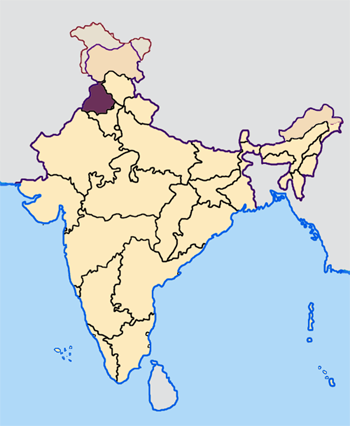
Overview: Gurmukhī is the script most commonly used to write the Punjabi language, especially in the Indian state of Punjab. It is the official script of Punjab and is used in education, administration, media and literature. The script’s name is traditionally understood to mean “from the mouth of the Guru,” reflecting its association with Sikh religious texts.
Image gallery
10 Images


Basic characteristics
Gurmukhī belongs to the Brahmic family of scripts and functions as an abugida: most consonant symbols carry an inherent vowel that can be changed or muted by diacritic marks. The system includes:
- consonant letters with an inherent vowel sound, modified by vowel signs;
- independent vowel letters for syllable-initial vowels;
- diacritics for vowel length, nasalization and consonant doubling;
- special marks and punctuation used in older and liturgical texts.
Letters and later additions
Traditionally there are 35 native letters in Gurmukhī. Over time, additional characters and modified forms were introduced—often grouped as a later set—to represent sounds that occur in Persian, Arabic and other languages. These later additions allow more accurate rendering of loanwords and names from those languages.
History and development
The emergence of Gurmukhī is commonly linked to the early Sikh community and is traditionally attributed to the period of the Sikh gurus in the 16th century, when it was adopted and standardized for use in religious and communal writing. Manuscripts and printed texts spread the script through religious, educational and literary activity. The script continued to evolve through usage, printing practices and contact with other languages.
Uses and cultural importance
Gurmukhī is the script of the central Sikh scripture and many other religious compositions, which has cemented its cultural role among Punjabi speakers. It is used for general literacy, publishing, signage and official documents in Indian Punjab. For contrast, Punjabi in Pakistan is often written in a Perso-Arabic-based script known as Shahmukhi.
Technical and notable facts
Gurmukhī is encoded in the Unicode standard and is supported by modern fonts and digital input methods. Its capacity to represent native Punjabi sounds plus adapted signs for foreign phonemes helped it remain the standard script in Indian Punjab. For further reading about the language and script, see resources on the Punjabi language, the script’s status as an official script and historical contacts with Persian.
Questions and answers
Q: What language is written using the Gurmukhī alphabet?
A: The Gurmukhī alphabet is used to write the Punjabi language.
Q: In which region is the Gurmukhī alphabet primarily used?
A: The Gurmukhī alphabet is primarily used in Punjab, India.
Q: Is the Gurmukhī alphabet the official script in Punjab?
A: Yes, the Gurmukhī alphabet is the official script in Punjab.
Q: How many native characters are there in Gurmukhi?
A: There are 35 native characters in Gurmukhi.
Q: What is the purpose of the Naveen Toli character family?
A: The Naveen Toli character family helps to pronounce and write Persian words with proper tone.
Q: What is the meaning of the word "Gurmukhi"?
A: The word Gurmukhi literally means "from the mouth of Guru".
Q: When was the Naveen Toli character family added to Gurmukhi?
A: The Naveen Toli character family was added in the 18th-19th century.
Related articles
Author
AlegsaOnline.com Gurmukhī alphabet Leandro Alegsa
URL: https://en.alegsaonline.com/art/41488