
Ground beetle (Carabidae): overview, traits, ecology and importance
Ground beetles (Carabidae) are a large, cosmopolitan family of mostly predatory beetles with over 40,000 described species; they occupy terrestrial habitats and play key roles in ecosystems and pest control.
Overview
Ground beetles belong to the family Carabidae, a widespread and diverse group of beetles. Scientists estimate more than 40,000 species worldwide, with roughly 2,000 recorded in North America and about 2,700 in Europe. The family contains many subfamilies and genera that occupy a variety of terrestrial habitats, from gardens and agricultural fields to forests and shorelines. For a general introduction to the family, see a summary entry on the taxonomic family.
Image gallery
5 Images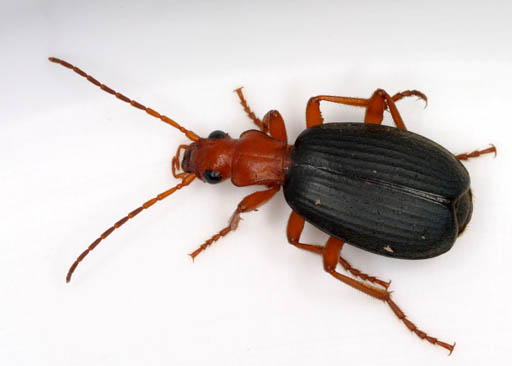


Physical characteristics
Ground beetles are typically characterized by a flattened, elongated body, hardened forewings (elytra) that protect the flight wings or abdomen, well-developed legs for running, and strong mandibles for capturing prey. Sizes range from a few millimetres to several centimetres, and coloration is often dark and glossy, though some species are metallic or patterned.
- Body: flattened, streamlined for moving under debris
- Wings: many species have functional flight wings, but many are flightless
- Diet: mainly predators, both as larvae and adults
Life cycle and behavior
Like all beetles, ground beetles undergo complete metamorphosis: egg, larva, pupa and adult. Many are nocturnal hunters that seek shelter under stones, logs, leaf litter or other cover during the day. Larvae are typically active predators in soil and litter. A few groups, such as the bombardier lineages, possess remarkable chemical defences that can deter predators.
Ecology and human importance
Ground beetles are important biological control agents because they consume a wide range of invertebrate prey including pests that damage crops. Their presence and species composition are frequently used in ecological studies as indicators of habitat quality, disturbance and the effects of agricultural practices. Researchers monitor ground beetle communities to assess biodiversity and the success of conservation measures.
Distinctions and conservation
Ground beetles are distinct from superficially similar groups (for example rove beetles) by their hardened elytra and body shape. Although many species are common and widespread, some specialized or habitat-restricted species face threats from habitat loss, pesticide use and landscape fragmentation. Conservation efforts focus on preserving habitat heterogeneity, maintaining cover and reducing harmful chemical inputs to support diverse ground beetle assemblages.
For further taxonomic details, distribution maps or management guidance consult specialist sources and regional faunal lists linked above via the provided references.
Questions and answers
Q: What are ground beetles?
A: Ground beetles are members of the Carabidae family, which is a large and diverse group of beetles.
Q: How many species of ground beetles are there worldwide?
A: There are over 40,000 species of ground beetles found all over the world.
Q: How many species of ground beetles can be found in North America?
A: There are approximately 2,000 species of ground beetles found in North America.
Q: And how many species of ground beetles are found in Europe?
A: There are about 2,700 species of ground beetles found in Europe.
Q: Are there any subfamilies of ground beetles?
A: Yes, there are numerous subfamilies within the Carabidae family of ground beetles.
Q: Do ground beetles prefer living on the ground?
A: Yes, ground beetles are so named because they typically live and move around on the ground.
Q: Are ground beetles found in all parts of the world?
A: Yes, ground beetles are a cosmopolitan family of beetles, meaning they are found in all parts of the world.
Related articles
Author
AlegsaOnline.com Ground beetle (Carabidae): overview, traits, ecology and importance Leandro Alegsa
URL: https://en.alegsaonline.com/art/41031
Sources
- doi.org : 10.1016/S0167-8809(99)00037-7
- carabidae.org : "Carabidae Taxa"
- darwinproject.ac.uk : "Letter to Leonard Jenyns, October 17, 1846"