
Gross domestic product (GDP)
Gross domestic product (GDP) measures the market value of all final goods and services produced within a country over a period. It is used to track economic size, growth and living standards, with important limits.
Gross domestic product (GDP) is a standard measure of the total market value of final goods and services produced within a country's borders during a specified period (usually a quarter or a year). Economists and policymakers use GDP to summarize the size of an economy, to compare economies over time or across countries, and to help guide fiscal and monetary policy. For a concise explanation of the concept and related terms see basic definitions.
Image gallery
7 Images



How GDP is measured
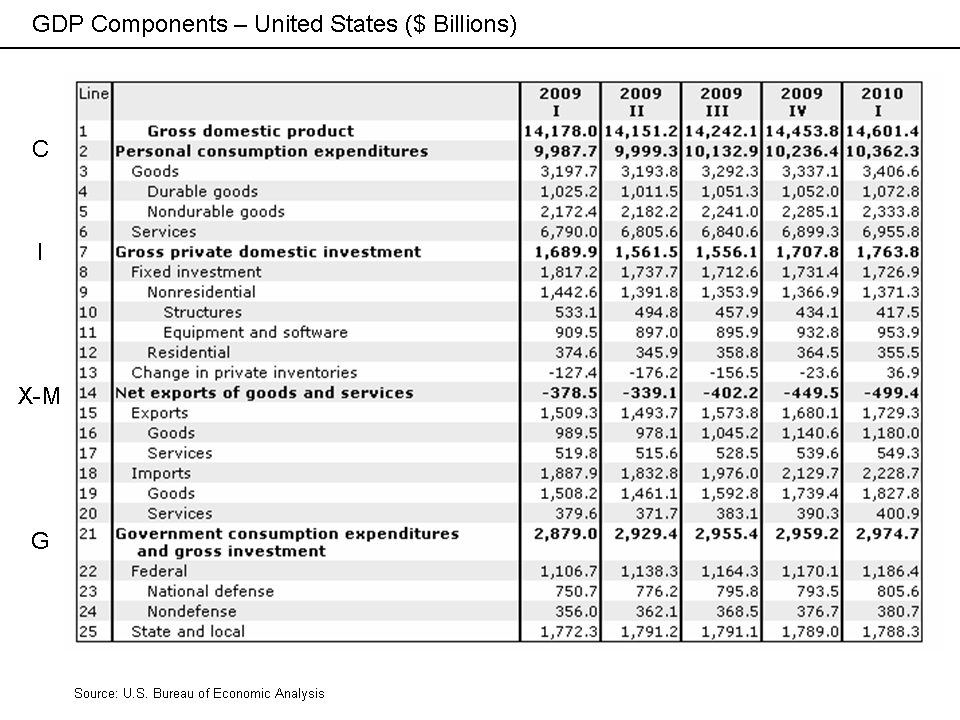
There are three commonly used approaches that produce the same overall value when applied consistently: the expenditure approach, the production (or output) approach, and the income approach. The expenditure approach is the most widely cited formula and adds the main spending categories:
- Consumption (C): household spending on goods and services.
- Investment (I): business capital spending, residential construction and inventory changes.
- Government spending (G): public purchases of goods and services (not transfer payments).
- Net exports (X − M): exports minus imports, capturing trade with other countries.
Expressed succinctly: GDP = C + I + G + (X − M). The production approach sums the value added at each stage of production across industries, while the income approach totals wages, profits, rents and taxes less subsidies. Each method offers a distinct perspective on the economy; further technical detail is available through national accounting sources such as output statistics and country reports (domestic accounts).
Variants and adjustments
Several forms of GDP report different aspects of economic activity. Nominal GDP values output at current market prices and therefore reflects changes in both quantities and prices. Real GDP adjusts for price changes (inflation or deflation) to show growth in actual output; this adjustment is often described in relation to measures of inflation. Another common comparison is GDP per capita, which divides GDP by population to approximate average material living standards. Economists also use purchasing-power-parity (PPP) conversions to compare living standards across countries more accurately.
History and examples
The modern concept of national income accounting developed in the early 20th century and was refined during the 1930s and 1940s; economist Simon Kuznets played a key role in formalizing measures of national product. After World War II, standardized national accounts were adopted internationally, allowing systematic comparisons. In contemporary usage, large economies such as the United States, China and major European economies (for example, Germany) are often discussed in terms of total GDP, while many commentators examine regional leaders such as Nigeria when considering continental or regional rankings.
Uses, limits and important distinctions
GDP is widely used to assess economic performance: rising real GDP indicates economic expansion, and a decline in real GDP over two consecutive quarters is a common rule of thumb for a recession. However, GDP has well-known limitations. It does not measure the distribution of income, non-market activities (like household labor), most informal-sector transactions, or environmental degradation. Quality improvements, digital services that are free at point of use, and changes in leisure or well-being are also poorly captured. Because of these gaps, analysts often pair GDP with measures such as income distribution statistics, employment rates, environmental indicators, and subjective well-being surveys.
Practical implications
When reading GDP figures, distinguish between levels (the size of the economy), growth rates (how quickly output is changing), and per‑capita measures (output per person). Policymakers track real GDP growth to set interest rates, design fiscal policy and evaluate long-term trends in productivity. For international comparisons, be attentive to whether figures are nominal, real, per capita or adjusted for purchasing power. For further reading on measurement techniques and data sources see national statistical offices and summaries on economic indicators.
Questions and answers
Q: What is GDP?
A: Gross Domestic Product (GDP) is an economic measure that shows the total production of a place over a certain amount of time.
Q: How is GDP calculated?
A: To calculate the GDP of a country, one adds up all consumer spending (C), all investment (I), all government spending minus taxes (G), and the value of exports minus imports (X – M). This is shown by the equation GDP=C+I+G+(X-M).
Q: What does it mean when a country has a high value of GDP?
A: A country with a high value of GDP can be called a large economy.
Q: Which countries have the largest economies in their respective regions?
A: The United States has the largest GDP in the world; Germany has the largest in Europe; Nigeria in Africa and China in Asia.
Q: What happens when a country's GDP is negative for two consecutive quarters?
A: When this occurs, it is considered to be in an unhealthy state known as recession.
Q: What are nominal and real GDP?
A: Nominal GDP is the total amount of money spent on all goods (new and final) within an economy while real GDP takes into account changes in prices by adjusting for inflation.
Related articles
Author
AlegsaOnline.com Gross domestic product (GDP) Leandro Alegsa
URL: https://en.alegsaonline.com/art/41008
Sources
- economist.com : "Africa's new Number One"
- investopedia.com : "Nominal GDP"