
Grey partridge (Perdix perdix): appearance, ecology and conservation
Compact overview of the grey partridge (Perdix perdix): identification, range, behaviour, threats from agricultural change and conservation measures, plus notes on human use and distinctions.
Overview
The grey partridge is a stocky, ground-dwelling gamebird of temperate open country in Europe and parts of Asia, with several introduced populations elsewhere. It is commonly known by the English name 'grey partridge' and by its scientific name Perdix perdix. The species is associated with farmland, hedgerows and grassy margins, and has long been familiar to people as a hunted species, a visible part of rural landscapes, and a subject of conservation concern where populations have declined.
Image gallery
3 Images

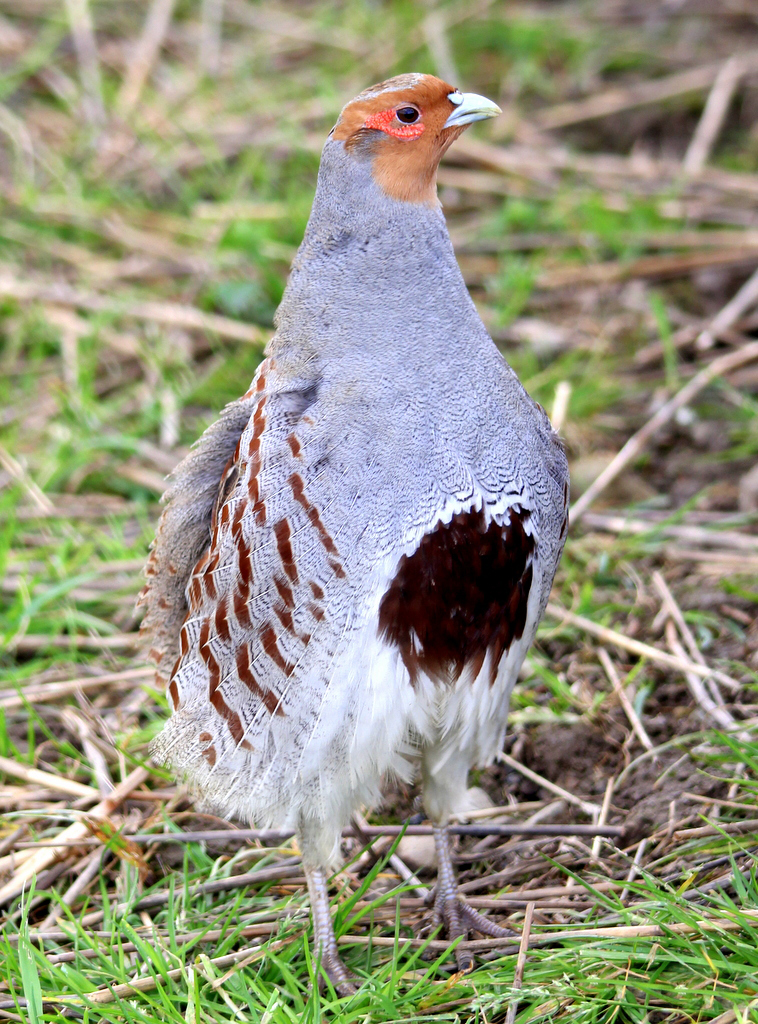
Identification and physical characteristics
The grey partridge is a medium-sized partridge about a foot long in overall appearance, with a compact body, short tail and rounded wings suited to short, rapid flights. Plumage features include a brown, streaked back; grey flanks and breast; and a paler belly often marked with a chestnut horseshoe-shaped patch. The face and throat are more buff or rufous, and there are subtle differences between individual birds rather than dramatic sexual dimorphism; using the belly mark alone to separate males from females is unreliable.
- Key field marks: brown-streaked upperparts, grey flanks, pale belly with chestnut horse-shoe-like mark, compact posture.
- Size and flight: adapted for brief, fast flights to escape danger; usually prefers to run or crouch when alerted.
- Vocalisations: a harsh, repeating call and short shrieks or rattling notes often given when flushed or alarmed.
Distribution, habitat and diet
Native to much of temperate Europe and western Asia, the grey partridge occupies open landscapes: mixed farmland, grassland, downs, steppes and similar habitats with a mosaic of crops, stubble, hedges and fallow patches. It favours warm, relatively dry areas where seeds and insect prey are available. Diets change seasonally: seeds and cereal grain dominate outside the breeding season, while adults feed chicks on a higher proportion of insects to provide the protein young birds need when growing.
Behaviour and reproduction
Grey partridges are largely ground-nesting and typically build a shallow scrape concealed among vegetation. They are social outside the nesting season, forming small groups or coveys, and show strong site fidelity where habitat remains suitable. Chicks are precocial — active and able to follow their parents shortly after hatching — and rely on insects as an early food source. Predation by foxes, raptors and mammals, together with nest disturbance, are natural limits on breeding success.
Conservation, threats and human interactions
During the 20th century and into the present, many grey partridge populations have declined in parts of their range, particularly where agricultural intensification removed fallow ground, hedgerows and insect-rich field margins. Widespread use of pesticides and changes to crop rotations reduce both cover and invertebrate food for chicks. Conservation efforts to support this species include habitat management on farmland, creation of uncultivated margins and set-aside, targeted predator control in some regions, and careful use of agri-environment schemes to restore breeding habitat.
- Main threats: habitat loss through intensified farming, reduced insect prey from pesticide use, nest disturbance and fragmentation.
- Conservation actions: management of headlands and hedgerows, re-establishment of spring-sown crops and refuges, monitoring and population surveys.
- Human use: historically and currently valued as a gamebird; management for shooting has driven both declines and local reintroductions.
Taxonomy and notable facts
The species name is directly reflected in its binomial, and the word for partridge has deep classical roots: the Latin scientific name corresponds to the common word and is derived from Ancient Greek perdix. The grey partridge remains an emblematic bird of cultivated countryside and a focus for farmland biodiversity efforts. Its presence is often used as an indicator of less intensive agricultural practices and richer field-edge habitats that support a broader community of farmland wildlife.
Overall, the grey partridge is a distinctive, ground-oriented bird whose fortunes are closely tied to how rural land is managed. Continued attention to habitat diversity and insect-rich margins can help stabilise and restore populations where they have fallen.
Questions and answers
Q: What is a grey partridge?
A: A grey partridge is a 30 cm tall bird with brown-backed feathers and grey flanks and chest. The belly is white and typically marked with a chestnut-brown horse-shoe mark.
Q: How can you differentiate between male and female partridges?
A: The large chestnut-brown horse-shoe mark on the belly should not be the only detail used to differentiate between male and female partridges.
Q: What is the song of a grey partridge?
A: The song of a grey partridge is a harsh kieerr-ik or keev-it, often followed by calling rick rick rick or it-it-it.
Q: Where do partridges typically live?
A: Partridges usually live in open country including farmland, moorland, downs, steppes, semi-deserts and sand dunes.
Q: What kind of climate do partridges prefer?
A: Partridges prefer a warm and dry climate.
Q: What do partridges eat?
A: Partridges eat grains, seeds and small insects.
Q: What is the origin of the scientific name of grey partridge?
A: The scientific name of grey partridge, Perdix perdix, is derived from the Ancient Greek perdix, which means "partridge" in Latin.
Related articles
Author
AlegsaOnline.com Grey partridge (Perdix perdix): appearance, ecology and conservation Leandro Alegsa
URL: https://en.alegsaonline.com/art/40886
Sources
- iucnredlist.org : "Perdix perdix"