
Greater Yellowstone Ecosystem
A largely intact temperate-region ecosystem centered on Yellowstone National Park, spanning parts of Wyoming, Montana and Idaho, notable for its wildlife, geothermal geology, research value and conservation debates.
Overview
The Greater Yellowstone Ecosystem (GYE) is a contiguous landscape centered on Yellowstone National Park and extending into surrounding national forests, wilderness areas and private lands in parts of Wyoming, Montana and Idaho. It is widely regarded as one of the largest nearly intact temperate-zone ecosystems on Earth, supporting extensive native habitats and large populations of wide-ranging wildlife.
Image gallery
3 Images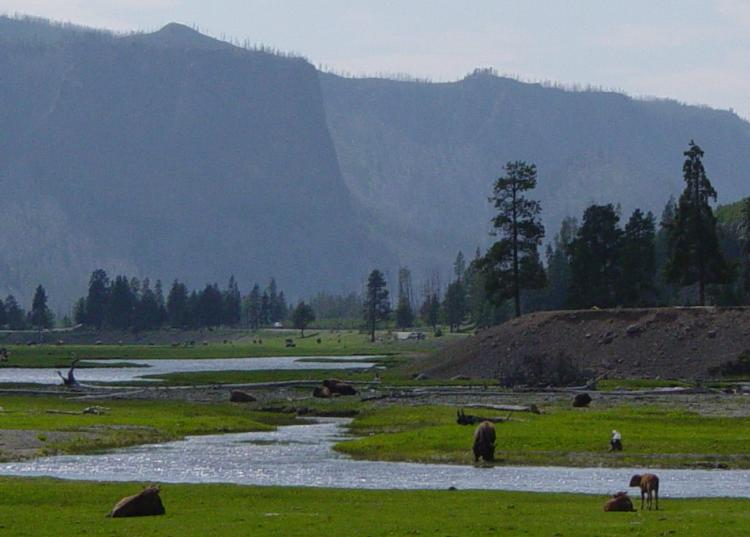


Landscape and geology
The region includes diverse landforms: high-elevation plateaus, mountain ranges, river valleys, alpine meadows, sagebrush steppe and the hydrothermal basins that make Yellowstone famous. Much of its character is shaped by volcanic history — the Yellowstone caldera and ongoing geothermal activity create hot springs, geysers and fumaroles that contribute to the area's unique geology and ecology. For readers seeking more detail on its geologic context, see geology resources.
Wildlife and ecological importance
The GYE supports a broad suite of native species and ecological processes. Large mammals such as grizzly bears, elk, bison and wolves coexist with numerous birds, fish and plant communities. The area functions as a living example of predator–prey dynamics, landscape connectivity and habitat heterogeneity across elevational gradients. Its position in the northern temperate zone makes it an important refuge for species adapted to cold-season cycles.
History, research and education
Scientists and students have long treated the GYE as a "natural laboratory" for studies in landscape ecology, wildlife biology, fire ecology and volcanic processes. Research in the region has informed ideas about ecosystem management, the role of apex predators, and the effects of fire and climate on forest and grassland systems. A variety of academic and governmental programs maintain ongoing studies; see general references on the GYE's role as a research landscape.
Conservation, management and public use
Management of the GYE involves multiple federal agencies, state wildlife departments, tribal governments and private stakeholders. The area is a focal point for conservation organizations that advocate for ecosystem-scale approaches and connectivity across administrative boundaries — for example, many conservation groups use the GYE to promote large-landscape protection. The region is also a world-class destination for recreation, offering hiking, wildlife viewing, fishing and geothermal tourism, all of which must be balanced with habitat protection.
Challenges and future directions
The GYE faces ongoing pressures: climate change, invasive species, habitat fragmentation from roads and development, and competing uses such as grazing and energy exploration. Management efforts emphasize connectivity, adaptive fire regimes, species conservation and cooperative governance across jurisdictions. Maintaining the ecological integrity of the Greater Yellowstone Ecosystem depends on coordinated science-based policy, landscape-scale planning and continued public engagement.
Key features at a glance
- Core centered on Yellowstone National Park and adjacent public lands.
- Distinctive geothermal features and volcanic history (geology).
- Important habitat for large mammals and migratory species in the temperate north.
- Longstanding site for ecological research and education (natural laboratory).
- Subject of conservation advocacy and multi-agency management (conservation groups, state and federal partners).
- Popular recreational destination (recreation).
Questions and answers
Q: What is the Greater Yellowstone Ecosystem?
A: The Greater Yellowstone Ecosystem is a large, mostly intact ecosystem in the northern temperate zone of the Earth.
Q: Where is the Greater Yellowstone Ecosystem located?
A: The Greater Yellowstone Ecosystem is partly located within Yellowstone National Park.
Q: Why has the management of the Greater Yellowstone Ecosystem been controversial?
A: The management of the Greater Yellowstone Ecosystem has been controversial because it is a flagship site for conservation groups that promote ecosystem management.
Q: What makes the Greater Yellowstone Ecosystem unique?
A: The Greater Yellowstone Ecosystem is unique because it serves as a natural laboratory in landscape ecology and geology.
Q: What is the Greater Yellowstone Ecosystem known for?
A: The Greater Yellowstone Ecosystem is world-renowned as a recreational site and is home to the animals of Yellowstone.
Q: Is the Greater Yellowstone Ecosystem fully intact?
A: The Greater Yellowstone Ecosystem is mostly intact, but not completely so.
Q: What is the significance of the Greater Yellowstone Ecosystem?
A: The Greater Yellowstone Ecosystem is significant because it represents one of the last remaining large, nearly intact ecosystems in the northern temperate zone of the Earth.
Related articles
Author
AlegsaOnline.com Greater Yellowstone Ecosystem Leandro Alegsa
URL: https://en.alegsaonline.com/art/40609
Sources
- biology.usgs.gov : "The Greater Yellowstone Ecosystem" · web.archive.org