
Great Smoky Mountains National Park
A US national park on the Tennessee–North Carolina border, famed for its Appalachian landscapes, high biodiversity, extensive hiking trails, historic sites, and status as a UNESCO World Heritage Site.
Overview
Great Smoky Mountains National Park preserves a large portion of the southern Appalachian Mountains along the Tennessee–North Carolina border. It is one of the most visited national parks in the United States and is recognized internationally for its natural values as a UNESCO World Heritage Site and biosphere reserve. The park protects a broad elevational range, from low river valleys to high ridgelines capped by rounded summits, and it contains a variety of forest types, meadows, streams and historic cultural resources.
Image gallery
10 Images




Landscape and ecology
The terrain is dominated by folded metamorphic rock and long forested ridges. The park’s elevations span from valley bottoms to Clingmans Dome, the highest point at 6,643 feet (2,025 m); several other peaks exceed 6,000 feet. Lower slopes hold rich deciduous forests, while higher elevations support northern-type spruce–fir communities and scattered fir balds. Deep coves and moist hollows create microclimates that foster high plant diversity and complex forest structure.
Plants and wildlife
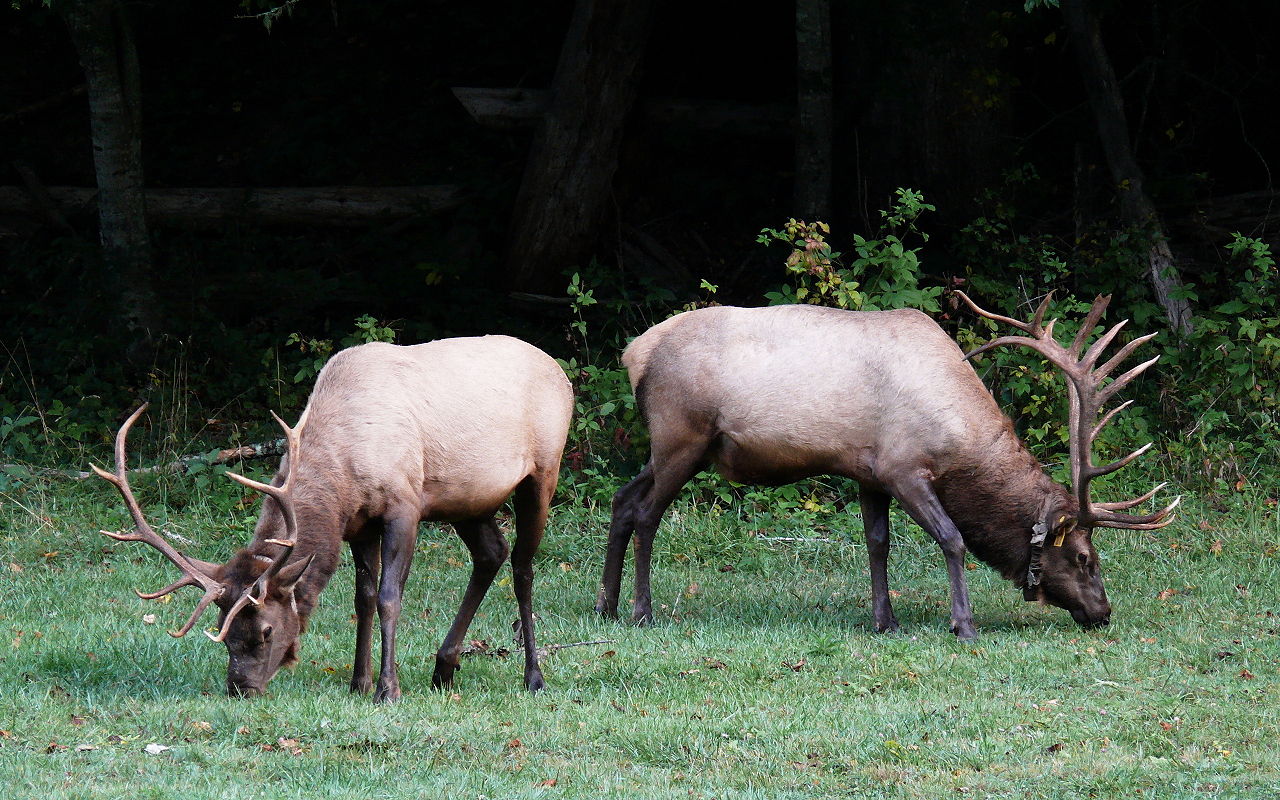
Great Smoky Mountains is notable for its biological diversity. The park harbors more than a hundred species of trees, well over a thousand species of flowering plants, and thousands of non‑flowering plants, including abundant mosses and liverworts. Amphibian diversity is especially high; the park is home to many lungless salamanders. Visitors may encounter black bears, white‑tailed deer, a variety of birds, and fish in clear mountain streams. Elk were reintroduced to parts of the region in the early 21st century.
History and stewardship
The national park was created in the 1930s through a combination of federal, state and private efforts; philanthropic support and land purchases were critical to its formation. During the 20th century, programs for land protection, erosion control and forest restoration reshaped management practices. The park contains numerous historic structures—cabins, churches and mills—that reflect Appalachian settlement patterns and are preserved as cultural resources.
Recreation and importance
Recreational opportunities are extensive and oriented toward hiking, wildlife viewing, backcountry camping and scenic driving. More than 850 miles of trails and unpaved roads provide access to waterfalls, vistas, historic sites and remote wilderness. The park supports scientific research, education and regional tourism, and it plays a key role in conserving temperate forest ecosystems and migratory corridors across the Appalachians.
Notable facts
- Most visited national park in the United States by annual visitation.
- Contains one of the richest temperate forest floras in the world.
- Important center for salamander diversity and other endemic species.
- Preserves historic Appalachian settlements and traditional rural landscapes.
Further information and resources
- Official park overview
- National park service page
- UNESCO World Heritage details
- World Heritage listing
- Blue Ridge Mountains context
- Elevation and topography information
- Species lists and biodiversity reports
- Amphibian and salamander resources
- Black bear ecology
- Forest and tree species guides
- Deciduous forest communities
- Coniferous forest information
- Wildflower and plant inventories
- Backpacking and trail planning
- Camping and visitor services
Questions and answers
Q: What is Great Smoky Mountains National Park?
A: Great Smoky Mountains National Park is a national park in the United States and is a UNESCO World Heritage Site.
Q: Where are the Great Smoky Mountains located?
A: The Great Smoky Mountains are part of the Blue Ridge Mountains.
Q: What is the highest point in the park?
A: Clingmans Dome at 6,643 feet (2,025 m) is the highest point in the park.
Q: How many black bears are in the park?
A: The park has about 1,500 black bears.
Q: What kind of trees grow in the park?
A: Over 100 species of trees grow in the park. The lower forests are mostly deciduous leafy trees while at higher elevations, there are more coniferous trees.
Q: How many miles of trails and unpaved roads are there in the park?
A: There are 850 miles (1,368 km) of trails and unpaved roads in the park for hiking.
Q: What activities does the park offer?
A: The park offers backpacking, camping, and hiking.
Related articles
Author
AlegsaOnline.com Great Smoky Mountains National Park Leandro Alegsa
URL: https://en.alegsaonline.com/art/40547
Sources
- nature.nps.gov : "Listing of acreage as of December 31, 2011"
- irma.nps.gov : "NPS Annual Recreation Visits Report"
- nps.gov : GSMNP main page
- nps.gov : "Natural Features & Ecosystems"
- nps.gov : "Black Bears - Great Smoky Mountains National Park"