
Great Sandy Desert (Australia)
Vast arid region in northwestern Australia, second-largest Australian desert; known for red sandplains, spinifex vegetation, Indigenous cultural regions, and mineral activity under a tropical-influenced climate.
Overview
The Great Sandy Desert is a large desert region in the remote northwest of Australia, lying mostly within Western Australia. It is the second-largest desert on the continent after the Great Victoria Desert and covers a broad area of sandplains, dune fields and sparse rock outcrops. The desert stretches eastward toward the Tanami Desert and adjoins other arid regions to the south and west. Although often imagined as empty, it supports a mosaic of habitats and human uses across more than 280,000 square kilometres.
Image gallery
5 Images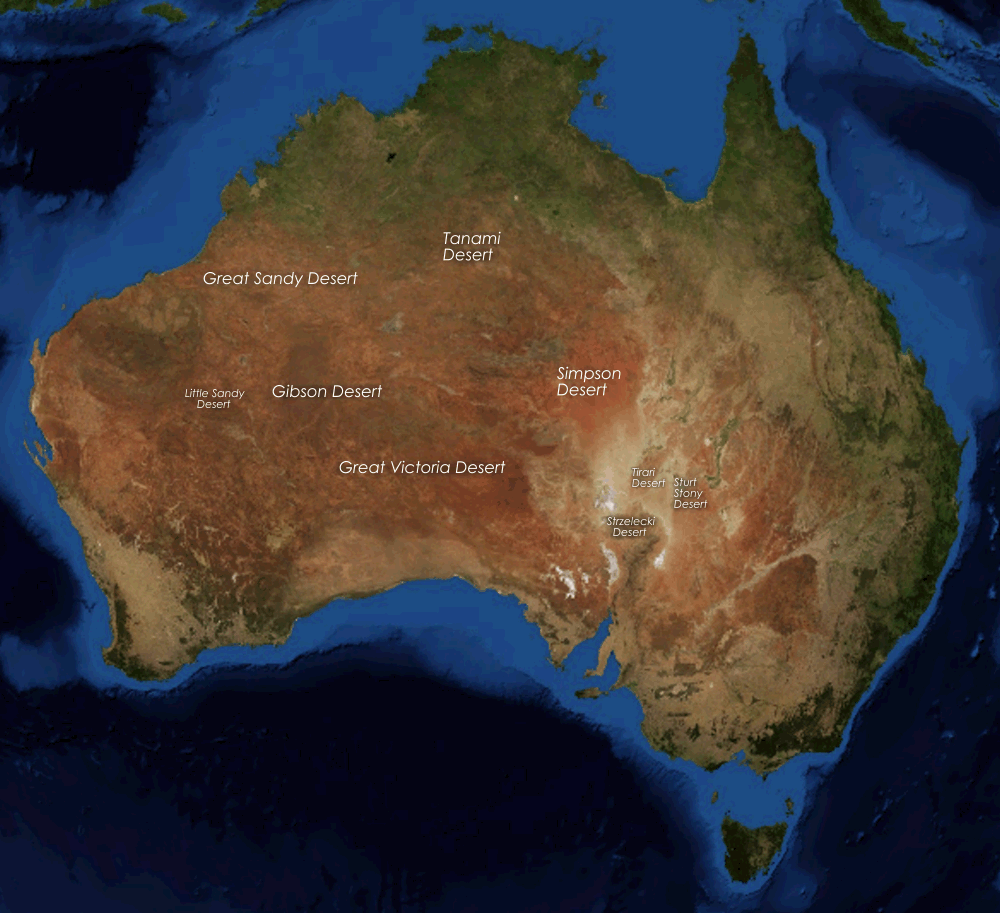


Geography and climate
Terrain in the Great Sandy Desert is dominated by red sandplains, longitudinal dunes and scattered drainage lines. Vegetation is typically open and low, with isolated salt pans and ephemeral wetlands forming after heavy rains. Annual precipitation is low and highly variable; local records show that rain is infrequent but when it falls it can produce sudden growth and temporary lakes. High rates of evaporation limit persistent surface water. Most rainfall events are convective thunderstorms, and long drought periods are punctuated by seasonal systems such as the monsoon and occasional tropical cyclone remnants that bring intense but short-lived downpours.
Flora and fauna
Vegetation is adapted to aridity and fire. The ubiquitous hummock grass known as spinifex dominates large tracts, forming low, spiny clumps that stabilise dunes and provide habitat. Shrubs and scattered eucalypts occur where soils and moisture allow. Animal life ranges from common desert mammals to specialised reptiles and marsupials.
- Dingoes — opportunistic predators found across the region.
- Red kangaroos — large macropods adapted to open outback country.
- Monitor lizards — including goannas that forage near watercourses.
- Bilbies — once widespread, now locally vulnerable.
- Marsupial mole — a subterranean specialist of sandy soils.
- Thorny devils and bearded dragons — among the notable desert reptiles.
People and history
Human occupation of the Great Sandy Desert extends for tens of thousands of years. Contemporary Indigenous residents include communities of the Martu peoples in the west and groups such as the Pintupi in the east; many speak varieties of the Western Desert languages. European exploration in the 19th century recorded some dramatic journeys across the region. One well-known overland crossing was undertaken by Peter Warburton in 1873–74; accounts from that expedition highlight the critical role of Aboriginal companions such as Charley in guiding and keeping travellers alive during severe hardship.
Uses, management and conservation
Population density is very low; settlements are typically small Indigenous communities and a number of resource-based towns associated with mining. Pastoral leases exist at the desert margins, and there is growing recognition of Indigenous land management and conservation programs that combine traditional knowledge with scientific approaches. Protected areas, cultural sites and conservation initiatives aim to balance biodiversity protection with economic activity and pastoral livelihoods.
Notable facts and distinctions
The Great Sandy Desert is notable for its size, red sands and the resilience of life adapted to extremes. Its climate behaviour — long dry spells interrupted by intense wet episodes — shapes ecological cycles and human activity. The desert sits within a broader network of Australian arid zones, and its cultural landscapes remain important to Indigenous nations, offering both scientific value and spiritual significance.
Questions and answers
Q: What is the Great Sandy Desert?
A: The Great Sandy Desert is a desert in the northwest of Australia, mostly in Western Australia. It is the second-largest desert in Australia (after the Great Victoria Desert). It covers about 284,993 square kilometres (110,036 sq mi).
Q: Who are the main Aboriginal groups living in the area?
A: The main Aboriginal groups living in the area are the Martu and Pintupi. They both speak Western Desert languages.
Q: How much rain does this area get?
A: This area does not get much rain, but even in its driest parts rainfall rarely drops below 250 mm (9.8 in). Most of the rain comes from thunderstorms. On average for most of the area there are about 20-30 days where thunderstorms form.
Q: What kind of plants grow across this desert?
A: Most of the plants growing across this desert are spinifex grasses.
Q: What kind of animals live here?
A: Animals living in this desert include dingos, red kangaroo, monitor lizards, bilbies, marsupial mole, thorny devils, bearded dragons and many other species of lizard.
Q: Who was first European to cross this desert?
A: The first European to cross this desert was Peter Warburton who made his journey from Alice Springs leaving in April 1873 and arriving at De Grey Station January 1874.
Q: How did Warburton survive his journey throught he Great Sandy Desert?
A: Warburton credited his survival on his Aboriginal companion Charley when he arrived starving and blind in one eye after crossing throught he Great Sandy Desert
Related articles
Author
AlegsaOnline.com Great Sandy Desert (Australia) Leandro Alegsa
URL: https://en.alegsaonline.com/art/40544
Sources
- outback-australia-travel-secrets.com : "Outback Australia - Australian Deserts"
- environment.gov.au : "Department of the Environment WA - Refugia for Biodiversity"
- nationalgeographic.com : "National Geographic - Great Sandy-Tanami desert (AA1304)"
- adbonline.anu.edu.au : "Australian Dictionary of Biography - Peter Warburton"
- tools.wmflabs.org : 20°S 125°E / 20°S 125°E / -20; 125