
Great Pacific Garbage Patch: overview, causes, impacts, and responses
A dispersed concentration of floating plastic and debris in the North Pacific gyre, formed by ocean currents; affects marine life, fisheries, and coastal regions and spurred research and cleanup efforts.
Overview
The Great Pacific Garbage Patch is an area in the central North Pacific where floating garbage and debris—especially plastic—accumulates. Located within a broad system of circulating currents known as the North Pacific Gyre, it is not a solid island of trash but a diffuse zone with varying concentrations of debris, from large discarded objects to tiny microplastics.
Image gallery
9 Images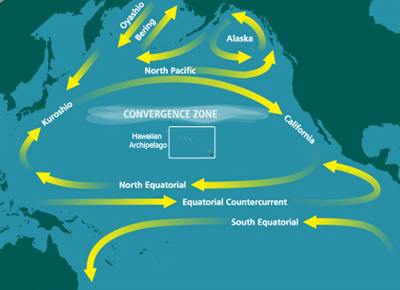





Characteristics and composition
Debris in the patch ranges from fishing gear, buoys, and containers to fragmented consumer plastics that have broken down into small particles. Sunlight and waves break larger items into smaller pieces, so much of the material is now microscopic and suspended beneath the surface as well as floating on it.
Formation and dynamics
The patch exists because of persistent water currents and wind patterns that converge and trap buoyant material. These flows circulate around the central region of the northern Pacific Ocean, collecting debris from coastal sources, shipping, and rivers and concentrating it over time. The size and density of the accumulation change with seasons, storms, and currents.
Environmental and economic impacts
The concentration of debris poses hazards to marine animals through entanglement and ingestion, and microplastics can move through food webs, affecting species from plankton to seabirds and fish. There are also economic consequences for fisheries, tourism, and coastal communities that must manage stranded debris.
Research and responses
Scientists study the patch to understand transport mechanisms, ecological effects, and the lifecycle of plastics at sea. Cleanup proposals range from targeted removal of large debris to prevention strategies that reduce plastic inputs at the source. Because material is widely dispersed and includes tiny particles, experts emphasize upstream solutions—better waste management, product design, and international cooperation—alongside selective removal techniques.
Notable distinctions
- The term "garbage patch" can be misleading: it describes a region of higher concentration, not a continuous solid mass.
- Some debris sinks or is transported to coastlines, so the patch is part of a larger global issue of marine pollution.
- Efforts to address it connect scientific research, policy, industry changes, and public behavior to reduce plastic pollution worldwide.
Questions and answers
Q: What is the Great Pacific Garbage Patch?
A: The Great Pacific Garbage Patch is a large patch of garbage and debris in the middle of the northern Pacific Ocean.
Q: Where is the Great Pacific Garbage Patch located?
A: The Great Pacific Garbage Patch is located in the middle of the northern Pacific Ocean.
Q: How did the Great Pacific Garbage Patch form?
A: The Great Pacific Garbage Patch formed because currents near the center of the Northern Pacific Ocean move around in a kind of circle, which catches and holds floating pieces of plastic.
Q: What kind of garbage and debris is found in the Great Pacific Garbage Patch?
A: The Great Pacific Garbage Patch is made up of floating pieces of plastic and other debris.
Q: Why is the Great Pacific Garbage Patch a problem?
A: The Great Pacific Garbage Patch is a problem because it harms marine life and pollutes the ocean.
Q: Is the Great Pacific Garbage Patch getting bigger?
A: The Great Pacific Garbage Patch is constantly growing, and it is estimated to be three times the size of France.
Q: What is being done to address the problem of the Great Pacific Garbage Patch?
A: Efforts are being made to reduce plastic waste and clean up the ocean, such as beach cleanups, plastic reduction campaigns, and developing technology to collect and recycle ocean plastic.
Related articles
Author
AlegsaOnline.com Great Pacific Garbage Patch: overview, causes, impacts, and responses Leandro Alegsa
URL: https://en.alegsaonline.com/art/40531
Sources
- sfgate.com : sfgate.com/cgi-bin/article.cgi?f=/c/a/2007/10/19/SS6JS8RH0.DTL&hw=pacific+patch&sn=001&sc…
- independent.co.uk : independent.co.uk/environment/the-worlds-rubbish-dump-a-garbage-tip-that-stretches-from-h…
- naturalhistorymag.com : naturalhistorymag.com/master.html?http://www.naturalhistorymag.com/1103/1103_feature.html
- nationalgeographic.com : "The Great Pacific Garbage Patch Isn't What You Think it Is"
- nature.com : "Evidence that the Great Pacific Garbage Patch is rapidly accumulating plastic"
- gyrecleanup.org : "gyrecleanup.org"
- time.com : "Expedition Sets Sail to the Great Plastic Vortex"
- news.yahoo.com : news.yahoo.com