
Androphilia and gynephilia: attraction-focused terms for sexual orientation
Androphilia and gynephilia name attraction to men/masculinity or women/femininity. Used in research and clinical settings to describe focus of attraction without assuming a person’s sex assignment or gender identity.
Androphilia and gynephilia are terms used to identify the direction of a person’s sexual or erotic attraction: androphilia refers to attraction to men or masculine characteristics, while gynephilia refers to attraction to women or feminine characteristics. The Greek-derived labels focus on the target of attraction rather than on a person’s legal sex, anatomy, or social gender roles. Because they name the object of desire directly, these terms are often used in contexts where identity labels may be ambiguous or inappropriate.
Image gallery
2 Images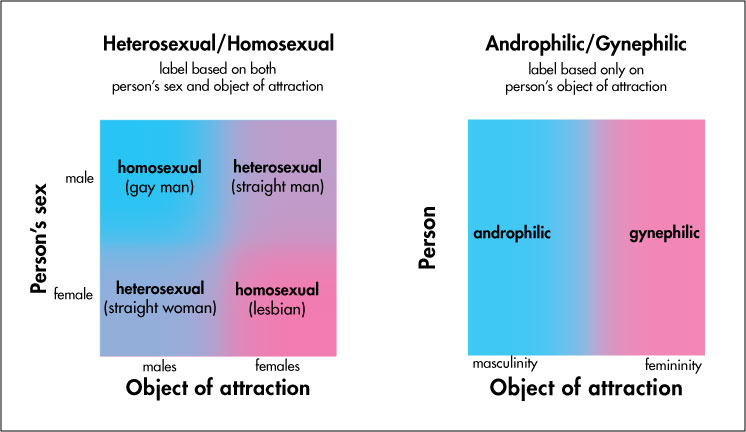

Definitions and etymology
The roots of the words are andro- (man) and gyne- (woman) combined with -philia (affection or attraction). In practice, researchers may describe someone as androphilic or gynephilic to indicate the target of attraction without implying a particular social identity. These descriptors are intentionally neutral about whether the attracted person is cisgender, transgender, nonbinary or intersex.
Purpose and use in research and practice
Scholars and clinicians use attraction-centered terms when they need precision. For example, in studies that compare sexual patterns across different cultures, researchers may prefer these terms over labels such as homosexual or heterosexual, since cultural categories and identity terms do not translate directly in every society. By describing the focus of attraction, investigators avoid conflating attraction with a person’s assigned sex at birth or their chosen gender identity.
- Neutral description: Indicates who is attracted to whom without asserting identity.
- Inclusive scope: Applies across diverse populations, including people whose bodies or identities do not fit binary categories.
- Cross-cultural clarity: Helps compare patterns of desire across regions where local terms differ.
Relationship to identity labels
It is important to distinguish attraction from identity. A person who is androphilic may identify as gay, straight, bisexual, queer, or use another label; similarly, gynephilic people may adopt different social identities depending on culture and personal history. The combination of androphilic and gynephilic attractions is sometimes called ambiphilia, and in everyday language this overlap is often described as bisexuality. Using attraction terms can clarify descriptions without erasing lived identities.
Cross-cultural and clinical considerations
Attraction-focused language can reduce misunderstandings in comparative work between areas like the West and the East, or within regions with distinct gender systems. In clinical settings, specifying attraction rather than assuming identity or anatomy can improve intake, assessment and treatment planning, especially when working with people who have a nonstandard sex assignment history or who are transgender or intersex.
Limitations and critiques
Despite their utility, these technical terms are not substitutes for community identities that carry political and social meaning. Some people find them impersonal, and critics caution that attraction does not always map onto simple categories: desire can be fluid over time and shaped by social context. Researchers therefore balance the clarity of attraction-focused terms with attention to identity, lived experience and cultural nuance.
In summary, androphilia and gynephilia are pragmatic, attraction-centered descriptors widely used in academic and clinical contexts to specify the target of desire without assuming a person’s sex assignment or gender identity. They support clearer communication in comparative research and inclusive practice while acknowledging that personal identities and social meanings remain central to how people understand their own attractions.
Questions and answers
Q: What are androphilia and gynephilia?
A: Androphilia and gynephilia are terms used in behavioral science to describe sexual orientation. Androphilia refers to attraction to a man or masculinity, while gynephilia refers to attraction to a woman or femininity.
Q: How do these terms differ from the gender binary?
A: These terms offer an alternative to the gender binary in homosexual and heterosexual, as they describe the focus of attraction without crediting a sex assignment or gender identity to the person.
Q: What is ambiphilia?
A: Ambiphilia, or bisexuality, is the combination of androphilia and gynephilia, meaning attraction to both masculinity and femininity.
Q: How can these terms help to understand people between the West and the East?
A: These terms will skirt any difficulty to understand people between the West and the East, as they do not rely on cultural understandings of gender.
Q: Do these terms apply only to cisgender individuals?
A: No, these terms can also describe intersex and transgender people.
Q: Is there a need to credit a person's gender identity or sex assignment when using androphilia or gynephilia?
A: No, these terms describe the focus of attraction with no need to credit a sex assignment or gender identity to the person.
Q: Can these terms replace the labels of homosexuality and heterosexuality?
A: These terms do not replace homosexuality and heterosexuality but offer alternative language to describe sexual orientations that are not reliant on gender binary assumptions.
Tags
Related articles
Author
AlegsaOnline.com Androphilia and gynephilia: attraction-focused terms for sexual orientation Leandro Alegsa
URL: https://en.alegsaonline.com/art/4051
Sources
- worldcat.org : Migrating Genders : Westernisation, Migration, and Samoan Fa'afafine
- worldcat.org : The Corsini encyclopedia of psychology
- dx.doi.org : "Sexual Anomalies"
- doi.org : 10.1097/00006842-194507000-00013
- worldcat.org : 0033-3174
- worldcat.org : Encyclopedia of homosexuality
- worldcat.org : Androphilia : a manifesto : rejecting the gay identity, reclaiming masculinity
- worldcat.org : Bisexual politics: theories, queries, and visions