
Great Commission: Christian mandate to make disciples
The Great Commission is the instruction attributed to the risen Jesus to his followers to proclaim his teaching, baptize, and form disciples worldwide; central to Christian mission and practice.
The Great Commission refers to the instruction given by the risen Jesus to his followers to spread his message, baptize new adherents, and teach them to observe his teachings. It is a foundational text for Christian mission and has shaped centuries of evangelism, baptismal practice, and church self-understanding. The Commission appears most clearly in the Gospel of Matthew, but related passages in the other Gospels and Acts have also informed how Christians interpret and apply it.
Image gallery
5 Images


Primary sources and related passages
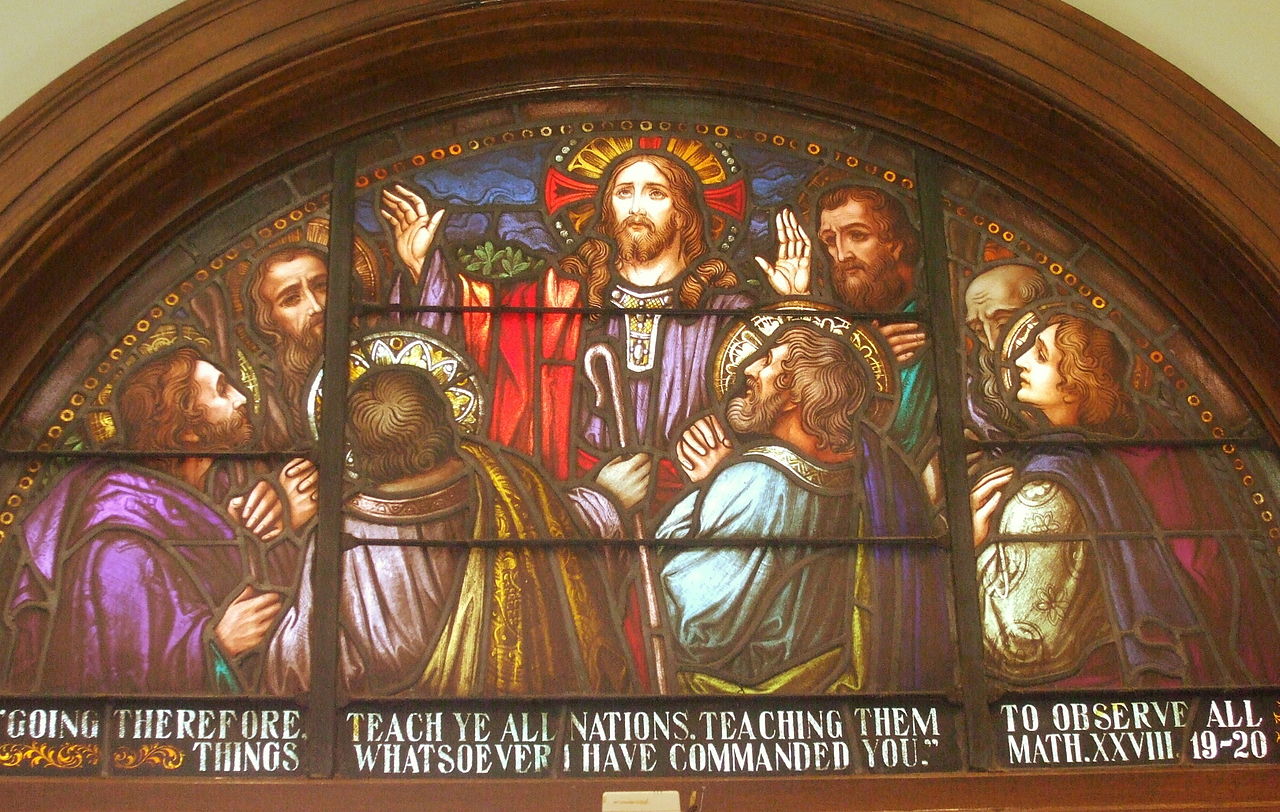
The best-known form of the Commission is recorded in Matthew 28:16–20, where Jesus meets his disciples on a mountain in Galilee and commissions them to "make disciples of all nations". Other New Testament passages that echo or relate to this instruction include Jesus' post-resurrection words in the Gospels and the mission-oriented summary in Acts. Readers frequently compare Matthew's account with parallel material in Mark, Luke and John to understand its scope and emphasis. Because the Gospel traditions vary in setting and wording, scholars and church traditions sometimes emphasize different elements of the Commission.
Essential elements
- Go: an outward movement or sending of followers beyond their immediate circle or community.
- Make disciples: forming committed followers, not merely attracting converts.
- Baptize: initiation into the community, in Matthew using the trinitarian formula in the name of the Father, the Son and the Holy Spirit.
- Teach: instructing new disciples to observe Jesus' commands and way of life.
- Authority: Matthew frames the directive as issued with Christ's authority over heaven and earth.
Historical development and interpretation
In early Christianity the Great Commission provided an impetus for mission outside the Jewish community. While Jesus earlier sent limited groups of disciples on short missions, the post-resurrection Commission is commonly read as universal in scope. Church fathers, medieval missionaries, Reformation leaders and modern mission movements have all appealed to this text, though they read it through differing theological and cultural lenses. Debates have arisen about whether the instruction was meant only for the original apostles or for all believers, and how "making disciples" should be carried out in different historical contexts.
Practical significance and examples
Practically, the Commission informs a wide range of Christian activity: organized missionary work, church planting, evangelistic campaigns, baptismal rites and educational ministries. Denominations vary in emphasis—some stress evangelism and public proclamation, others prioritize discipleship, social service and long-term community formation. Churches commonly cite the Commission in mission statements, sermons and theological education to justify outreach and cross-cultural engagement.
Distinctive issues and scholarly notes
- Textual variation: Gospel accounts differ in setting and phraseology; for example, Matthew locates the encounter on a Galilean mountain (Galilee) while Luke and John describe post-resurrection appearances with overlapping but not identical emphases.
- The scope of "all nations": interpreters debate whether this phrase extends the mission beyond Israel to Gentiles or signals a broader, ongoing universal mission.
- Baptismal formula: Matthew's trinitarian baptismal wording has been influential for liturgy and sacramental theology across many traditions (Christian belief about baptism).
- Authority and timing: Matthew places the command after Jesus speaks of having all authority; other accounts place decisive missionary commissions in different narrative moments (the Twelve Apostles and broader disciples)
Because the Great Commission combines theological claims, ritual practice and a clear missionary impulse, it remains a central and often-discussed passage in Christian thought, worship and institutional life. Churches and scholars continue to reflect on how best to interpret its commands in changing cultural, social and global circumstances.
Questions and answers
Q: What is the Great Commission in Christian belief?
A: The Great Commission is something that Jesus told his followers after his resurrection, instructing them to go all over the world and tell everyone about him.
Q: Where can the most well-known version of the Great Commission be found?
A: The most well-known version of the Great Commission can be found in Matthew 28:16-20.
Q: What did Jesus tell his Twelve Apostles to do according to the Great Commission?
A: Jesus told his Twelve Apostles to make disciples of and baptize everyone in the name of the Father, Son, and Holy Spirit.
Q: Who did Jesus send out to preach and heal before giving the Great Commission?
A: Jesus sent out 70 of his followers to preach and heal, but only to the Jews.
Q: Who was Jesus' message for according to the text?
A: Jesus' message was for everyone after rising from the dead, although at the beginning of his public work he spoke to his own people.
Q: Why is the Great Commission important to missionaries?
A: The Great Commission is important to missionaries who believe that God wants them to go to every country in the world and preach about Jesus.
Q: What did Jesus do before his followers according to the Great Commission?
A: Jesus met his followers on a mountain in Galilee and gave them the Great Commission to go and tell everyone about him.
Related articles
Author
AlegsaOnline.com Great Commission: Christian mandate to make disciples Leandro Alegsa
URL: https://en.alegsaonline.com/art/40483