
Great Artesian Basin
An overview of Australia's Great Artesian Basin: its geology, extent, uses, environmental issues and management, and its significance to people and ecosystems.
Overview
The Great Artesian Basin is a vast, pressurised groundwater system underlying large areas of inland Australia. It is widely recognised as one of the world's largest and deepest confined aquifers—the classic example of an artesian basin—and provides a critical source of freshwater in regions where surface water is scarce. The basin supports towns, livestock, springs and important wetland habitats in otherwise arid and semi‑arid landscapes.
Image gallery
9 Images




Extent and physical characteristics
Covering roughly 1,711,000 square kilometres, the basin underlies parts of several Australian states and territories. Much of northern and central Queensland lies above the system, along with northern New South Wales, the south‑east corner of the Northern Territory, and sections of north‑east South Australia. In places the sedimentary rocks that contain the water reach depths around 3,000 metres. Estimates suggest the formation holds on the order of tens of thousands of cubic kilometres of water, and temperatures in deeper zones can rise from about 30°C to approaching 100°C.
Geology and hydrology
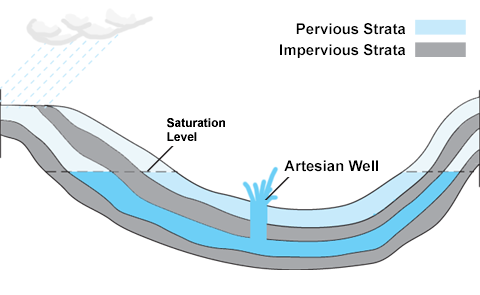
The basin is a layered sequence of porous sandstones and low‑permeability seals that trap and transmit groundwater under pressure. Rain that falls on recharge areas at higher elevations gradually percolates into porous rock and moves slowly through the system toward lower‑pressure discharge zones, sometimes emerging naturally as artesian springs. Because the water is confined and under pressure, wells can flow without pumping where the pressure exceeds the land surface.
Uses and importance
For many inland communities and pastoral operations the basin is the only dependable water supply. It supports domestic use, stock watering, small‑scale irrigation and tourism associated with natural springs. Some of the water is hot and mineralised, and in isolated cases has been used for bathing or local heating. More broadly, the Great Artesian Basin underpins ecosystems that depend on permanent or semi‑permanent springs, which are often biologically unique and culturally significant.
Environmental and management issues
- Uncontrolled artesian bores and leaks from poorly maintained wells have historically caused large, avoidable losses of pressure and freshwater, reducing flow to natural springs.
- Water quality varies across the basin; in some areas salinity or dissolved minerals limit suitability for some uses.
- Extraction must be balanced with recharge rates, which are slow; unsustainable use can lower pressure and reduce natural discharges.
To address these challenges, governments and communities coordinate management efforts. Organisations such as the Great Artesian Basin Coordinating Committee help plan bore rehabilitation, meter and regulate extraction, and work on conservation of springs. Research and monitoring also inform improved practices for sustaining the resource and the ecosystems that depend on it.
History, culture and research
European settlers relied on the basin early in inland pastoral expansion because it made reliable water available beyond the river systems. Indigenous Australian groups have longstanding cultural connections to many springs and groundwater features; those places often carry significant ecological and spiritual values. Scientific study of the basin spans geological mapping, hydrogeological modelling, and ecological surveys of spring communities, and continues to inform water policy, land use planning and conservation projects.
For further technical or regional information consult resources on the basin as an aquifer system (aquifer) and specialised sites covering groundwater science (groundwater). Additional jurisdictional references and management programs are available through regional portals in Queensland, Northern Territory, South Australia and New South Wales.
Questions and answers
Q: Where is the Great Artesian Basin located?
A: The Great Artesian Basin is located in Australia.
Q: What is the size of the Great Artesian Basin?
A: The Great Artesian Basin stretches over 1,711,000 square kilometres, which is 22% of the surface area of Australia.
Q: How deep is the Great Artesian Basin in places?
A: The Great Artesian Basin is 3,000 metres deep in places.
Q: How much groundwater may the Great Artesian Basin contain?
A: The Great Artesian Basin may contain 64,900 cubic kilometres of groundwater.
Q: What is the temperature range of the Great Artesian Basin?
A: The temperature range of the Great Artesian Basin is from 30°C to 100°C.
Q: What is the role of the Great Artesian Basin Coordinating Committee?
A: The Great Artesian Basin Coordinating Committee coordinates activity between the various levels of government and community organisations regarding the Great Artesian Basin.
Q: Is the Great Artesian Basin the only reliable source of freshwater in inland Australia?
A: Yes, the Great Artesian Basin is the only reliable source of freshwater through much of inland Australia.
Related articles
Author
AlegsaOnline.com Great Artesian Basin Leandro Alegsa
URL: https://en.alegsaonline.com/art/40452
Sources
- derm.qld.gov.au : "Underground water factsheets: Great Artesian Basin"
- www4.gu.edu.au : The phylogeny of prokaryotes associated with Australia's Great Artesian Basin
- gabcc.org.au : GABCC website
- springerlink.com : "Mound springs of the Great Artesian Basin in South Australia: a case study from Olympic Dam"
- doi.org : 10.1007/s002540050452