
Gravitational Waves: Theory, Astrophysical Sources, and Detection
Overview of gravitational waves: the theory from general relativity, astrophysical sources like merging black holes and neutron stars, and detection methods that opened a new observational window on the universe.
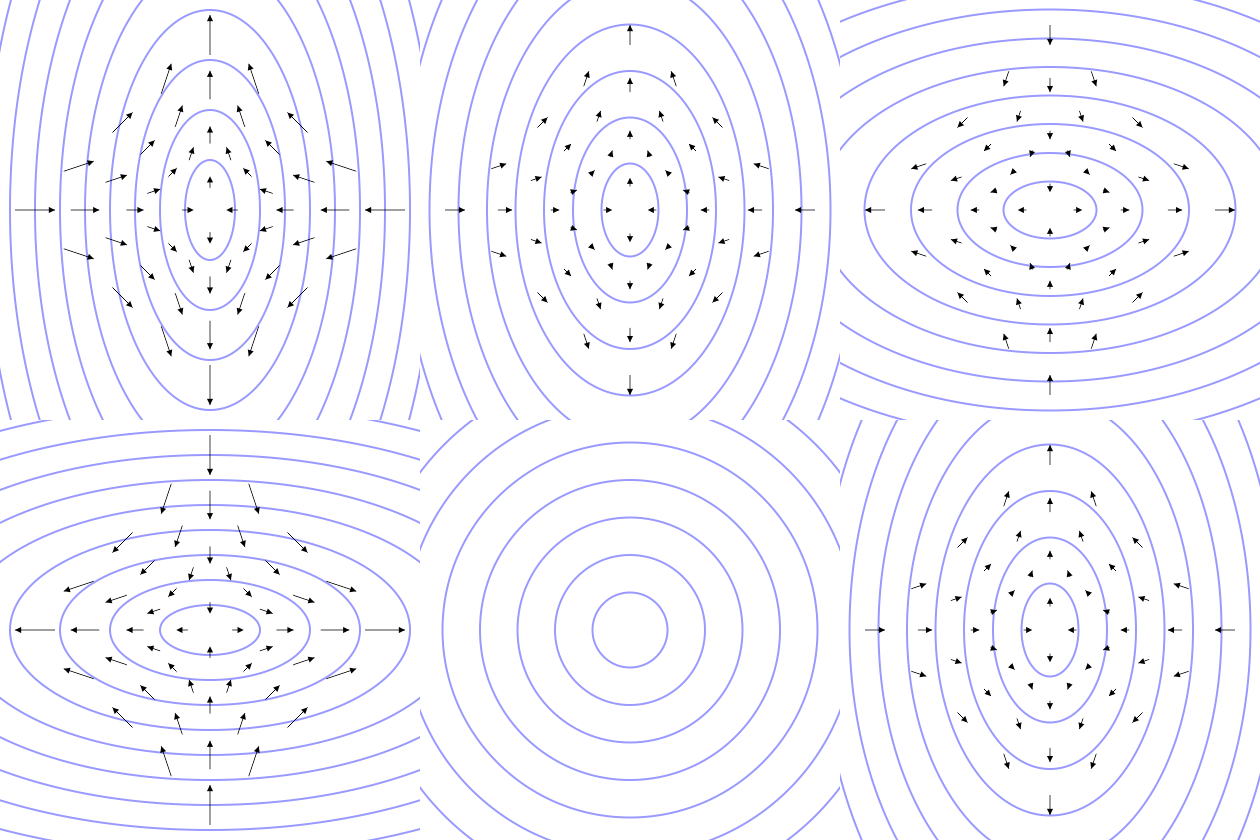
Gravitational waves are propagating disturbances in the geometry of spacetime produced when the distribution of mass or energy changes in an asymmetric way. They carry energy away from their sources and travel at the speed of light. The idea was first worked out by Albert Einstein in 1916 as a consequence of his theory of general relativity. These signals arise from the motion of bodies that have mass and are strongest when those masses accelerate rapidly and unevenly.
Image gallery
10 Images





How they are generated
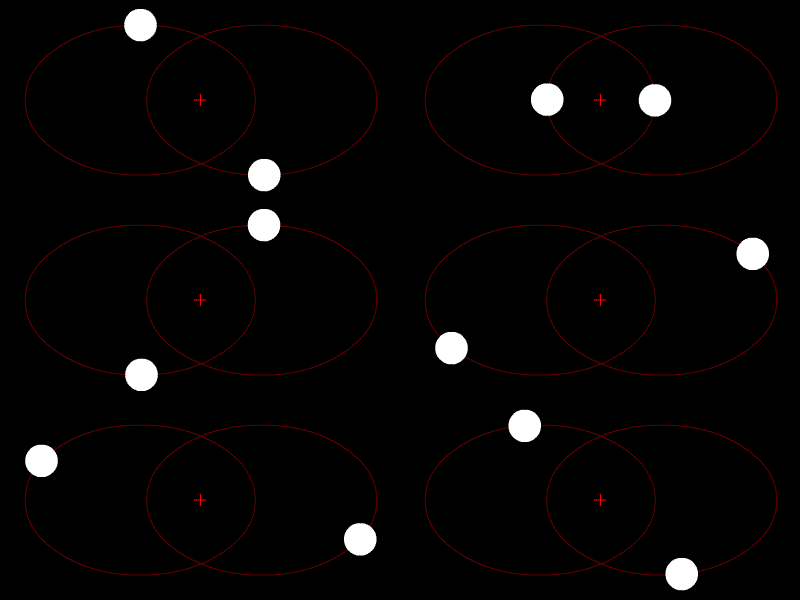
Because gravity couples to all forms of mass and energy, any accelerated mass can in principle produce gravitational waves. In practice, detectable waves require enormous masses moving at relativistic speeds or large changes in the system's quadrupole moment. The most promising and well-observed sources are compact, rapidly orbiting systems whose motion is not spherically symmetric.
Astrophysical sources
- Close binary star systems, especially those in which the stars are compact objects.
- Binaries of compact remnants such as white dwarfs, which can produce continuous or long-lived signals in some cases.
- Pairs of neutron stars, whose inspiral and merger emit strong, short-lived bursts and—when they collide—can be accompanied by electromagnetic radiation.
- Coalescing black holes, which are among the loudest gravitational-wave sources and played a central role in the first direct detections.
Observation and significance
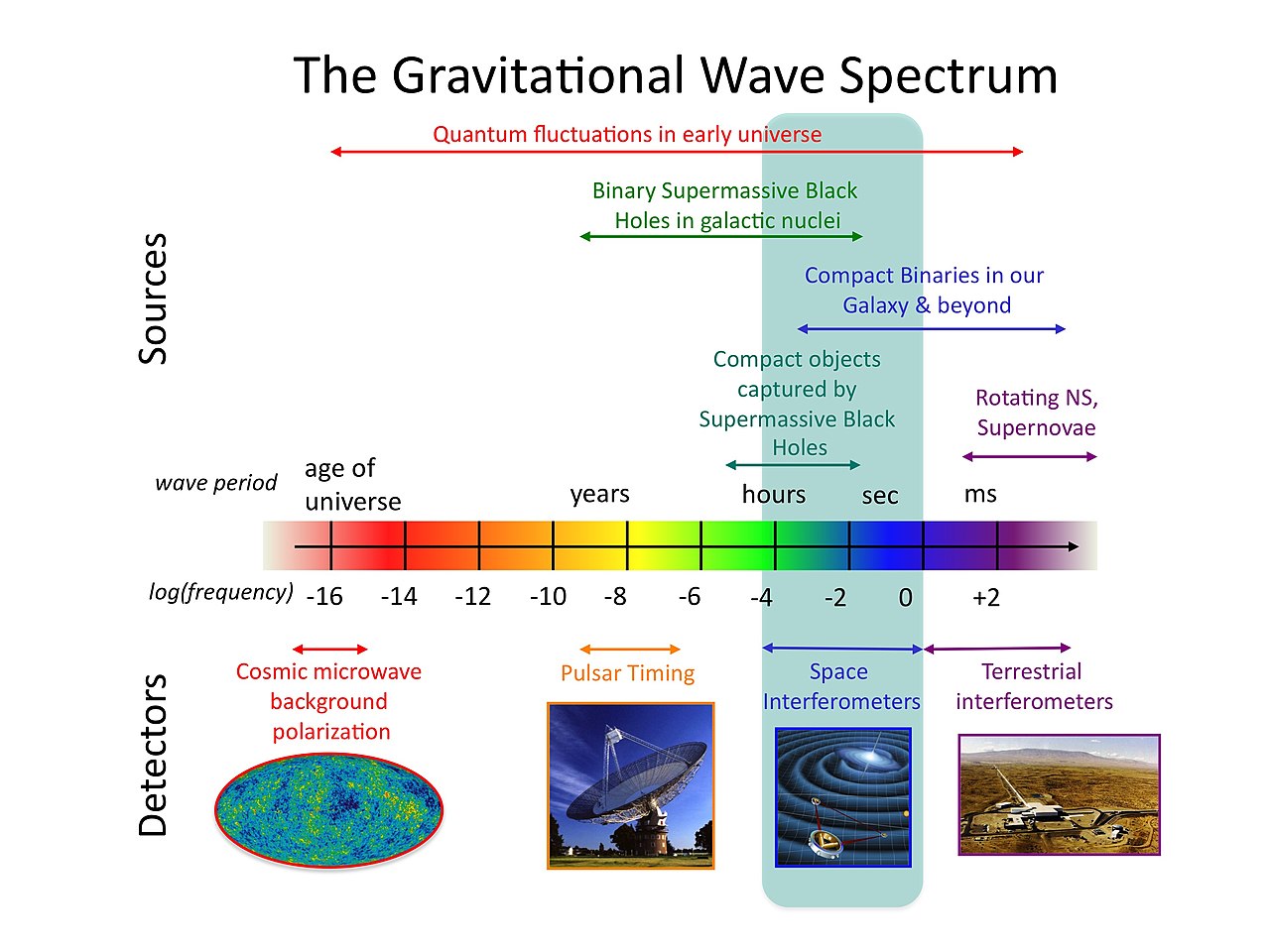
Indirect evidence for gravitational waves existed before direct measurement, for example from orbital decay in binary pulsar systems. The first unambiguous direct detection was recorded on 14 September 2015, confirming Einstein’s prediction and opening a new observational window on the universe. Modern detectors measure tiny fractional changes in distance (strain) produced by passing waves, allowing astronomers to study phenomena—such as compact-object mergers—that are difficult or impossible to observe with light alone.
Questions and answers
Q: What are gravitational waves?
A: Gravitational waves are ripples in spacetime created by the movement of objects with mass.
Q: Who predicted the existence of gravitational waves?
A: Albert Einstein predicted the existence of gravitational waves in 1916 based on his theory of general relativity.
Q: When were gravitational waves first directly detected?
A: Gravitational waves were first directly detected on September 14, 2015.
Q: What is required to make gravity waves strong enough to be detected?
A: Something very massive must accelerate very fast in order to make gravity waves strong enough to be detected.
Q: What are some sources of detectable gravitational waves?
A: Binary star systems composed of white dwarfs, neutron stars, or black holes are sources of detectable gravitational waves.
Q: Can gravitational waves be observed with visible light telescopes?
A: No, gravitational waves cannot be observed with visible light telescopes. They require different types of detectors and equipment.
Q: Why is the detection of gravitational waves significant?
A: The detection of gravitational waves provides evidence for the general theory of relativity and has opened up a new field of astronomy, enabling us to better understand the universe and its origins.
Related articles
Author
AlegsaOnline.com Gravitational Waves: Theory, Astrophysical Sources, and Detection Leandro Alegsa
URL: https://en.alegsaonline.com/art/40402
Sources
- commons.wikimedia.org : Gravitational waves
- dpf99.library.ucla.edu : dpf99.library.ucla.edu/session14/barish1412.pdf
- doi.org : 10.1103/PhysRevLett.116.061102
- phys.org : "Einstein's gravity theory passes toughest test yet: Bizarre binary star system pushes study of relativity to new limits"
- bbc.co.uk : bbc.co.uk/news/science-environment-41640256