
Andrey Kolmogorov: mathematician, probabilist and founder of algorithmic complexity
Soviet mathematician Andrey Kolmogorov (1903–1987) established the modern axioms of probability, advanced turbulence theory and founded algorithmic complexity, influencing many areas of mathematics and science.
Andrey Nikolaevich Kolmogorov (Russian) 
Image gallery
3 Images
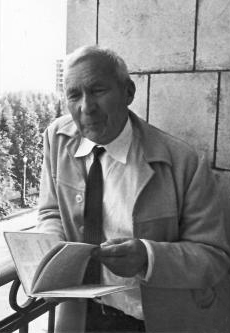

Overview
Kolmogorov's contributions span multiple fields: probability theory, topology, the study of Fourier series, mathematical approaches to turbulence, aspects of classical mechanics and links to information theory. He formulated clear definitions and frameworks that allowed these subjects to develop along rigorous lines and to interact with one another. His style combined measure-theoretic methods with probabilistic and statistical intuition.
Major contributions
- Axiomatization of probability: Kolmogorov's formulation placed probability theory on measure-theoretic foundations, making the subject mathematically rigorous and widely teachable.
- Algorithmic complexity: He introduced a way to quantify the information content of individual objects via shortest effective descriptions, now called Kolmogorov complexity.
- Turbulence and fluid dynamics: He developed statistical theories of turbulence that explain how energy cascades between scales and predict characteristic spectral laws used in physics and engineering.
- Stochastic processes and limit theorems: He advanced general theory for random processes and asymptotic results used across probability and statistics.
Life and career
Born into a family in Tambov, Kolmogorov studied at Moscow where he trained under Nikolai Luzin and completed his doctorate in 1929. He later held positions at Moscow State University and became a full professor there. In 1939 he was elected to the USSR Academy of Sciences. Throughout his career he supervised students, organized research schools, and applied mathematical ideas to practical problems in physics and engineering. He died in Moscow in 1987.
Importance and legacy
Kolmogorov's influence is visible in both pure theory and applications. His axioms underpin modern probability courses and research. Kolmogorov complexity created a bridge between computation and information, influencing theoretical computer science, randomness tests, and philosophy of information. The statistical theories he proposed for turbulence remain a reference point in fluid mechanics. Many theorems, inequalities, and tools bear his name, and his students and followers expanded his methods into areas such as ergodic theory and mathematical statistics.
Because his work connects abstract mathematics with concrete phenomena, Kolmogorov is often cited across disciplines. For further reading on his life and selected works, consult specialized biographies and collections of his papers that compile both his foundational texts and later expository writings.
Online and library resources provide entry points for non-specialists and researchers; see institutional pages and curated bibliographies for detailed lists of publications and translations.
Name and language • Mathematician status • Probability • Topology • Fourier analysis • Turbulence • Mechanics • Information theory • Moscow State University • Professorship • Academy membership • Place of death
Questions and answers
Q: Who was Andrey Nikolaevich Kolmogorov?
A: Andrey Nikolaevich Kolmogorov was a Soviet mathematician and computer scientist known for his significant contributions to probability theory, topology, algorithmic complexity theory, and other fields.
Q: What were some of Kolmogorov's early career focuses?
A: In the early years of his career, Kolmogorov worked on intuitionistic logic and Fourier series.
Q: Was Kolmogorov involved in the study of classical mechanics?
A: Yes, Kolmogorov also contributed to the study of classical mechanics, which involves the motion of objects under the influence of forces.
Q: What is algorithmic complexity theory?
A: Algorithmic complexity theory, also known as Kolmogorov complexity theory, is a field of computer science and mathematics that deals with measuring the complexity of a given object or system based on the length of the shortest possible algorithm that can compute the object or system.
Q: Where did Kolmogorov study and work?
A: Kolmogorov studied and worked at Moscow State University, where he eventually became a professor.
Q: Who was Kolmogorov's doctoral supervisor?
A: Kolmogorov's doctoral supervisor was Nikolai Luzin.
Q: When did Kolmogorov pass away?
A: Andrey Nikolaevich Kolmogorov passed away on October 20, 1987, in Moscow.
Related articles
Author
AlegsaOnline.com Andrey Kolmogorov: mathematician, probabilist and founder of algorithmic complexity Leandro Alegsa
URL: https://en.alegsaonline.com/art/4029