
Grand Canyon: geology, landscape, history and significance
The Grand Canyon is a vast river-cut gorge in northern Arizona. This article summarizes its size, geology, ecosystems, human history, recreational value and conservation status.
Overview
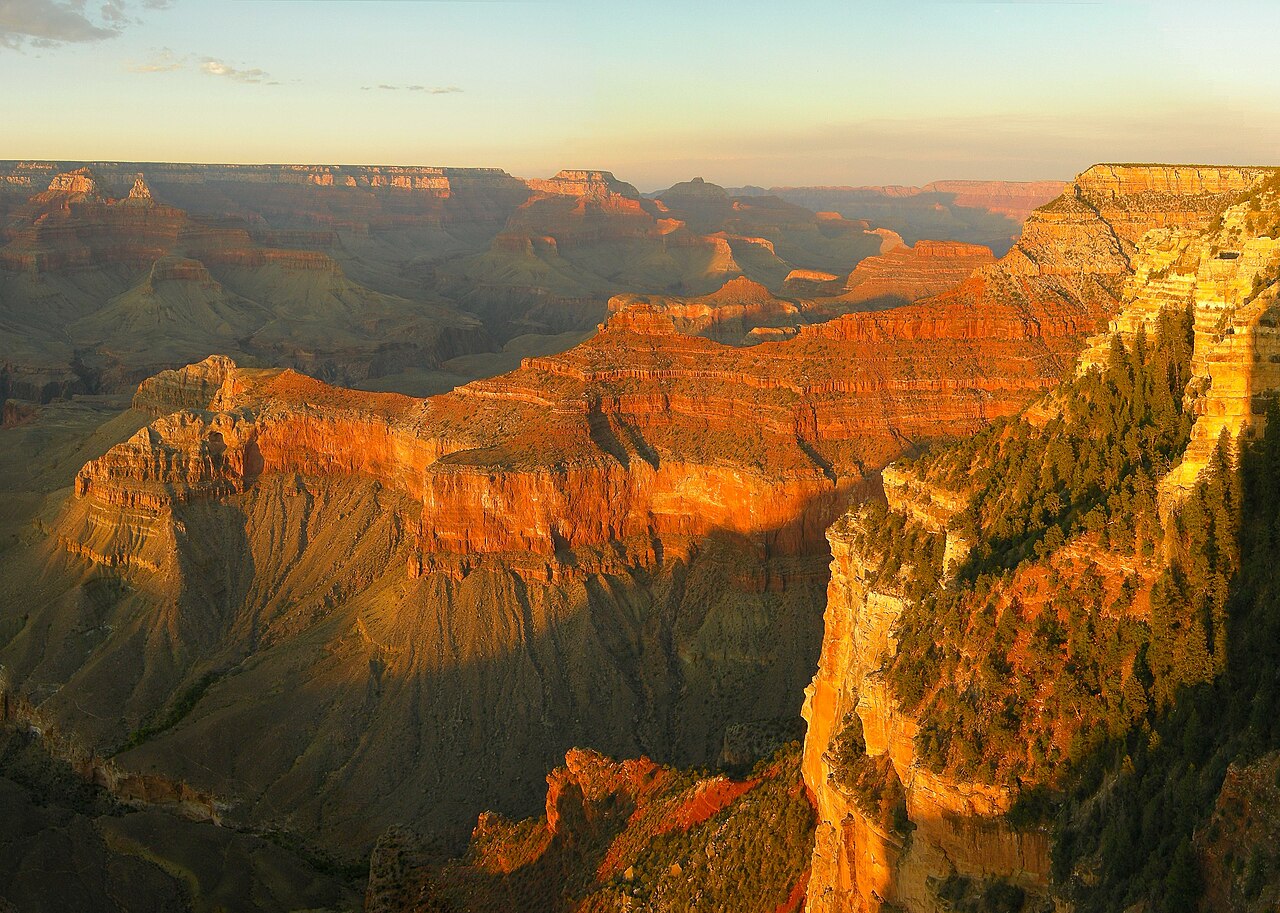
The Grand Canyon is a massive river canyon located in northern Arizona. Carved primarily by the Colorado River, it is internationally recognized for its scale, layered rock exposures and scenic value. The canyon and its surroundings are protected within a United States National Park and have been designated a UNESCO World Heritage Site. The Grand Canyon is often listed among the world’s great natural wonders.
Image gallery
10 Images




Physical characteristics
The canyon stretches roughly 277 miles (446 km) and varies in width, reaching up to about 18 miles (29 km) across at some points. In places the depth exceeds a mile (roughly 6,000 feet or 1.83 km), revealing an extended record of Earth history preserved in stacked rock layers. Nearly two billion years of the planet’s geological past are exposed along its walls and side canyons, giving scientists an accessible cross section of deep time and tectonic events reaching back through much of Earth’s history. The main river system and its smaller tributaries continue to shape the landscape.
Geological development
The canyon is the product of long-term uplift, erosion and river incision. The modern course of the Colorado River through the canyon had largely developed by at least 17 million years ago, after which continued downcutting and side erosion widened and deepened the gorge. Layers visible in the canyon include ancient metamorphic basement rocks near the river and progressively younger sedimentary strata above, each layer recording different environments such as shallow seas, coastal plains and deserts.
Ecology, human presence and use
Although the inner gorge is arid, the Grand Canyon supports a variety of ecosystems from desert scrub on the rims to riparian habitats along the river. Plant and animal communities change with elevation and moisture, creating high biodiversity within a relatively compact region. People have lived in or used parts of the canyon for thousands of years; Indigenous groups have long cultural, spiritual and archaeological connections to the area. Today the canyon is a major destination for recreation, scientific study and cultural tourism, with activities that include hiking, rafting and guided interpretation.
Conservation and challenges
Protection of the canyon focuses on preserving natural processes, cultural sites and scenic values while accommodating visitors. Managing water flows, controlling development near the rims, and addressing the effects of climate variability are ongoing concerns. The balance between access and preservation shapes park policy and regional planning, and research into geology and ecology continues to inform management choices.
Further reading and resources
Questions and answers
Q: Where is the Grand Canyon located?
A: The Grand Canyon is located in Arizona, USA.
Q: What is the Grand Canyon recognized for?
A: The Grand Canyon is a UNESCO World Heritage Site, a National Park of the United States, and one of the Seven Natural Wonders of the World.
Q: How long is the Grand Canyon?
A: The Grand Canyon is 277 miles (446 km) long.
Q: How wide and deep is it in some places?
A: In some places, it can be up to 18 miles (29 km) wide and over 1 mile (1.83 km) or 6000 feet deep.
Q: When did erosion begin forming the canyon?
A: Evidence suggests that erosion began forming the canyon at least 17 million years ago.
Q: What caused erosion to form the canyon? A: Erosion was caused by the Colorado River and its tributaries cutting through layer after layer of rock.
Related articles
Author
AlegsaOnline.com Grand Canyon: geology, landscape, history and significance Leandro Alegsa
URL: https://en.alegsaonline.com/art/40166
Sources
- whc.unesco.org : "Grand Canyon National Park"
- nps.gov : Geologic formations of the Grand Canyon
- nytimes.com : "Grand Canyon still grand but older"
- doi.org : 10.1126/science.1151248
- pubmed.ncbi.nlm.nih.gov : 18323451
- durangobill.com : "Evolution of the Colorado River and its tributaries including the origin and formation of the Grand Canyon. Geologic history of the Grand Canyon"
- academic.brooklyn.cuny.edu : "The hypothesis of differential erosion"