
Google Search: overview, features, history and impact
Comprehensive overview of Google Search: how it works, key features, evolution, search operators, uses, and notable facts about the world's most-used web search engine.
Overview
Google Search is a web search engine developed to find information on the World Wide Web. It indexes billions of pages and returns ranked lists of results in response to user queries. The service forms the core of a suite of products from its parent company; concise official descriptions and technical materials are available from the engine's pages and corporate resources, for example via product information and company sites such as Google's corporate pages. The interface is designed to be fast and simple: users enter keywords or natural-language questions and receive links, snippets, and additional items such as maps, images or direct answers.
Image gallery
4 Images
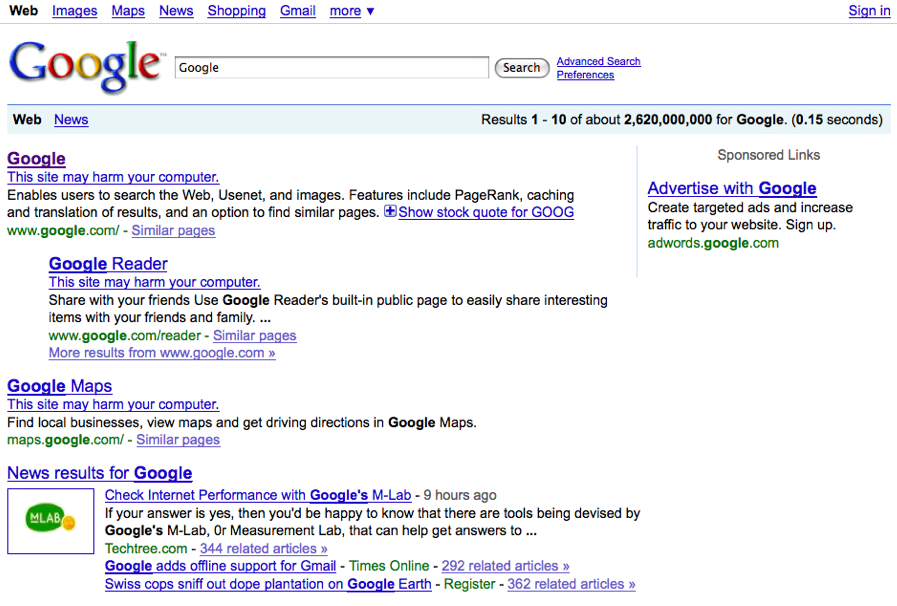


Core components and capabilities
Google Search combines several technical subsystems to return relevant results:
- Crawling and indexing — automated programs (crawlers) visit web pages, follow links, and store representations of page content in large indexes.
- Ranking algorithms — a mixture of signals, including link analysis, content relevance, page quality, and user behavior, are used to score and order results.
- Query processing — user input is parsed, corrected for spelling, expanded for synonyms, and matched to indexed content.
- Special features — direct answers and tools such as calculators, unit conversions, weather, maps, finance quotes, sports scores, and knowledge panels aim to provide immediate information without requiring a click-through.
History and development
Google Search originated in academic research and was developed in the late 1990s by computer scientists working on improved ways to evaluate page importance. Over time it shifted from a simple keyword matcher to an ecosystem of features: improved understanding of language, personalization, mobile-optimized results, and integration with other services. Technology updates have introduced machine learning methods for better interpretation of queries, entity recognition, and contextual results. For detailed historical timelines and milestones, see consolidated histories and technical retrospectives, for example at information resources.
Search operators and customization
Users can refine queries with operators and settings to target results. Common techniques include:
- Using quotes to search for exact phrases ("...").
- Excluding terms with a leading minus sign (-term).
- Logical OR for alternatives (term1 OR term2).
- Site-specific searches (site:example.com) and file-type filters (filetype:pdf).
Advanced search pages and preferences allow language filtering, date-range limits, and safe-search options to tailor results to different needs.
Uses, importance and notable facts
As a gateway to web content, the search engine is used for research, navigation, shopping, local information, entertainment and more. Its direct-answer features reduce time-to-information for straightforward facts, while indexed links connect users to deeper resources. The prominence of a search engine in everyday information-seeking has led to substantial influence on online visibility, advertising markets, and web traffic patterns.
Distinctions and criticism
Google Search is distinguished by scale, speed, and a broad feature set, but it has also been subject to scrutiny concerning personalization, privacy, algorithmic bias, and market dominance. Debates and regulatory reviews have focused on how ranking decisions are made, how user data are handled, and how fair competition is maintained in markets where search results can affect many businesses. Ongoing technical and policy work aims to balance relevance, transparency, and user choice.
For everyday tips, further technical reading, official documentation and help pages, consult the product and company resources linked above and in technical summaries provided by academic and industry observers.
Questions and answers
Q: What is Google Search?
A: Google Search or Google Web Search is a web search engine that is owned by Google Inc. and is the most-used search engine on the World Wide Web.
Q: Who developed Google Search?
A: Google Search was originally developed by Larry Page and Sergey Brin in 1997, based on earlier search-engine designs.
Q: What is the main purpose of Google Search?
A: The main purpose of Google Search is to hunt for text in webpages, as opposed to other data, such as with Google Image Search.
Q: How many special features does Google Search provide?
A: Google Search provides at least 22 special features beyond the original word-search capability.
Q: What are some examples of the special features provided by Google Search?
A: The special features provided by Google Search include synonyms, weather forecasts, time zones, stock quotes, maps, earthquake data, movie showtimes, airports, home listings, and sports results.
Q: What is PageRank?
A: The order of search results (ghits for Google hits) on Google's search-results pages is based, in part, on a priority rank called a "PageRank".
Q: What are some of the customized search options provided by Google Search?
A: Google Search provides many options for customized search, using Boolean operators such as: exclusion ("-xx"), inclusion ("+xx"), alternatives ("xx OR yy"), and wildcard ("x * x").
Related articles
Author
AlegsaOnline.com Google Search: overview, features, history and impact Leandro Alegsa
URL: https://en.alegsaonline.com/art/39692
Sources
- doi.org : 10.1109/MM.2003.1196112