
Good Night, and Good Luck: the film and its examination of McCarthy-era journalism
2005 black-and-white drama directed by George Clooney about Edward R. Murrow’s challenge to Senator Joseph McCarthy and the role of broadcast journalism during the 1950s Red Scare.
Overview
Good Night, and Good Luck. is a 2005 historical drama directed by George Clooney that dramatizes the confrontation between broadcast journalist Edward R. Murrow and Senator Joseph McCarthy. The screenplay, co-written by Clooney and Grant Heslov, follows Murrow and his team as they use the authority of television and radio to criticize McCarthy’s anti-Communist investigations and to probe the ethics of fear-based politics. The film's title takes its name from Murrow's characteristic sign-off line, "Good night—and good luck." 2005 release and George Clooney are commonly cited in discussions of early-21st-century political cinema.
Image gallery
1 Image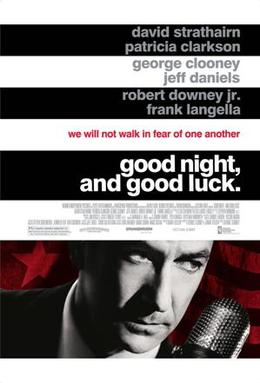
Production and visual style
Although released in black and white to evoke the look and tone of 1950s broadcasts and newsreels, the picture was shot on color film stock and later converted to monochrome in post-production. This deliberate choice emphasizes contrast and atmosphere while preserving modern film techniques. The movie mixes staged dramatic scenes with occasional archival footage and period-style set dressings to recreate the CBS newsroom and the era's television studios. The lead role of Edward R. Murrow was portrayed by David Strathairn, whose restrained performance received particular attention from critics and awards bodies. The film's visual and editorial approach has been discussed in technical articles about film transfer and grading, particularly in relation to post-production decisions and color correction. Technical process
Themes and narrative focus
At its core the film asks questions about journalistic responsibility, the power of broadcast media, and the tension between national security rhetoric and civil liberties. By dramatizing Murrow's broadcasts and private conversations, the screenplay explores how a journalist balances institutional pressures, corporate concerns, and the public interest. The movie portrays not only a public feud with Senator McCarthy but also the internal debates among Murrow's colleagues and executives about when—and how—to speak out. It addresses what can happen when the press chooses to dissent from government policy and when it tests the limits of deference to authority. voice of dissent
Historical context
Set in 1953, the film situates its drama within the larger climate of McCarthyism and postwar anxiety about communism. Senator Joseph McCarthy's aggressive investigations and the work of the Senate Permanent Subcommittee on Investigations are central to the events depicted, and the story connects broadcast journalism to broader debates about Congressional power and American civil liberties. While dramatized for the screen, the narrative rests on real controversies over blacklisting, loyalty hearings, and the public role of news programs in a democracy. For background on the historical figures involved, see references to Edward R. Murrow and Joseph McCarthy, as well as information about McCarthy's home state and political base.
Reception, awards, and legacy
Upon release the film was widely praised for its period authenticity, performances, and its timely interrogation of media ethics. It received multiple Academy Award nominations, including recognition in major categories such as Best Picture and acting and directing honors, and it stirred renewed public conversation about the responsibility of journalists in the face of political pressure. Reviewers and scholars have since used the film as a case study in courses on media ethics, 20th-century American history, and film design.
Notable facts and distinctions
- The film deliberately employs black-and-white imagery to create distance from contemporary networks and to recall the look of early television news.
- It interleaves dramatized sequences with real-world documentary textures, a technique that reinforces its claim to historical relevance.
- Rather than offering a simple hero narrative, the screenplay probes the compromises and conflicts within newsrooms during times of political crisis.
- Because it draws on public record and broadcast transcripts, the film invites viewers to consider how historical media coverage can shape modern civic debates.
For more detailed timelines and production notes, consult dedicated film studies resources and archival collections that document Murrow's broadcasts and the congressional hearings of the period. Senator McCarthy and Edward R. Murrow remain central figures in continuing discussions about free speech, accountability, and the limits of political power in democratic societies. Additional materials and critical essays are available through film archives and academic analyses. Regional political history and director interviews can provide further context for the movie's creation and aims. Film listings and retrospectives often pair the movie with primary-source broadcasts so viewers can compare dramatization and archival record. Voice and media remain central to its lasting resonance.
Questions and answers
Q: Who directed Good Night, and Good Luck?
A: George Clooney directed Good Night, and Good Luck.
Q: When was the movie Good Night, and Good Luck set?
A: Good Night, and Good Luck was set in 1953.
Q: What kind of conflict is portrayed in the movie Good Night, and Good Luck?
A: The conflict portrayed in the movie Good Night, and Good Luck is between veteran radio and television journalist Edward R. Murrow and U.S. Senator Joseph McCarthy of Wisconsin, especially relating to the anti-Communist Senator's actions with the Senate Permanent Subcommittee on Investigations.
Q: How was the movie Good Night, and Good Luck filmed?
A: The movie Good Night, and Good Luck was filmed on color film stock but on a grayscale set.
Q: What is the movie Good Night, and Good Luck about?
A: The movie Good Night, and Good Luck is about media responsibility.
Q: What does the movie Good Night, and Good Luck address?
A: The movie Good Night, and Good Luck addresses what occurs when the media offer a voice of dissent against the government.
Q: Why was the movie Good Night, and Good Luck given its title?
A: The movie Good Night, and Good Luck takes its title from the line with which Murrow routinely closed his broadcasts.
Related articles
Author
AlegsaOnline.com Good Night, and Good Luck: the film and its examination of McCarthy-era journalism Leandro Alegsa
URL: https://en.alegsaonline.com/art/39642