
Goliath: the Philistine champion in the Biblical narrative
Goliath is the giant Philistine warrior in the Hebrew Bible, described as the champion of Gath who was slain by David; the story appears in several textual traditions with differing details.
Overview
Goliath is the name given in the Hebrew Bible to a Philistine warrior who challenges the Israelite forces to single combat and is defeated by the young David. The episode is best known from the account in the book of 1 Samuel and has been read both as a historical memory and as a literary and theological narrative. Goliath functions within the story as a potent adversary whose defeat marks a turning point in David's rise to prominence.
Image gallery
7 Images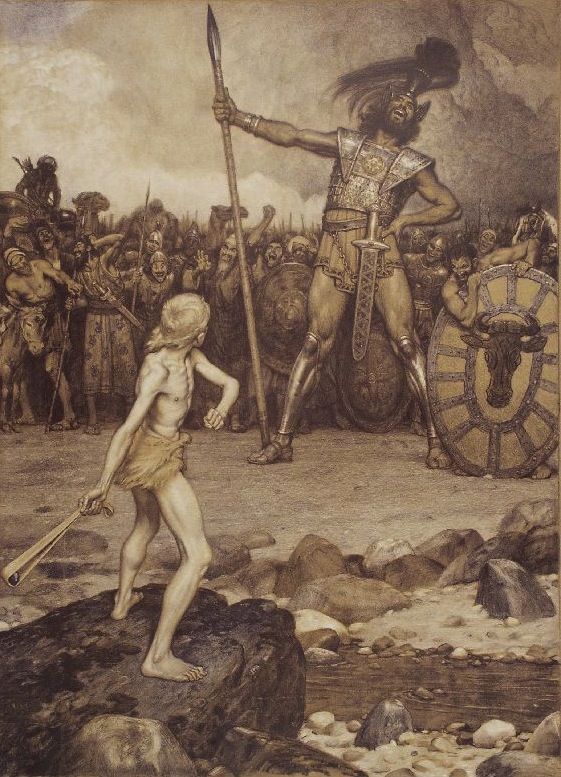



Name and origins
The etymology of the name Goliath is uncertain. The Hebrew form, rendered in scholarly discussions under the heading Hebrew name and forms, has invited comparison with names from the eastern Mediterranean and Anatolia; some proposals link it to non‑Semitic onomastic traditions associated with the Philistines. No single derivation is universally accepted, and the name's origins are treated cautiously in modern scholarship.
Physical description and equipment
The biblical narrative portrays Goliath as unusually large and heavily armed. The Masoretic Text gives an extraordinary stature often translated as "six cubits and a span," while other witnesses, including some Dead Sea Scroll fragments and early translations, read a shorter figure such as "four cubits and a span." These measurements depend on the length assumed for a cubit and on which manuscript tradition is followed; some modern renderings convert these terms into rough metric equivalents but note significant uncertainty. The text also lists military equipment—helmet, coat of mail, greaves, spear and a shield bearer—that emphasize his status as a professional warrior rather than an unarmored combatant. For discussion of terms for armour and arms in the text, see armour descriptions.
Textual witnesses and variants
The story of Goliath survives in several textual traditions. The primary narrative appears in the Hebrew Bible; the Septuagint (a Greek translation) and fragments among the Dead Sea Scrolls sometimes preserve alternate readings. Variant readings affect details such as the reported height, the sequence of actions after Goliath is struck, and minor lexical choices. These differences have led scholars to examine issues of transmission, scribal correction, and translation practice. Summaries of critical editions and interpretive notes are available under textual and interpretive notes and the main biblical account is often referenced at the primary account.
Historical and archaeological context
Goliath is explicitly identified as a champion from Gath, one of the principal Philistine city-states in the southern Levant. Archaeology of the Iron Age in the region has illuminated aspects of Philistine material culture, settlement patterns and contacts with surrounding peoples, though no archaeological evidence confirms the historicity of the specific duel. The broader setting of Israelite–Philistine relations in the early Iron Age is discussed in surveys and regional studies; see Israelite–Philistine relations for general background.
Interpretation and significance
Interpretations of the episode vary across disciplines. Literary and theological readings emphasize themes such as divine support, the reversal of expectations, and the legitimization of leadership through divine favor. Historical-critical readings consider possible historical cores and the role of oral tradition, while folkloric perspectives note the tale's affinity with motifs of the underdog hero and single combat. David's victory is commonly associated with his faith and skill with the sling; biographical and theological discussions of David appear at biographical summaries.
Afterlife and cultural legacy
The encounter of David and Goliath has achieved wide cultural currency. The pair are evoked in art, literature, and public discourse as symbols of an underdog overcoming a more powerful rival; the phrase "David and Goliath" functions as an idiom in many languages. The story has been adapted in painting, sculpture, drama, and modern media, and it continues to be a reference point in rhetoric, sports, and politics where a seemingly weaker party confronts a stronger one. Discussions of how the passage has been received in later traditions and popular culture are treated in many general surveys and commentaries.
Notable points and distinctions
- Goliath is consistently identified with the Philistine city of Gath, a major center of Philistine power in the biblical narrative.
- Measurements of his height differ among manuscript traditions; the longer reading has contributed to his reputation as a "giant," while other witnesses provide a more modest figure.
- The narrative functions on several levels—historical memory, theological demonstration, and literary motif—and is therefore subject to diverse scholarly approaches.
Taken together, the figure of Goliath occupies a place at the intersection of ancient history, textual study and cultural symbolism. The episode that features his defeat by David has remained a durable and versatile story, inviting continuing study of its language, its manuscript history and its reception through the centuries. For readers interested in weaponry terminology and subsequent translation choices see ancient sword references.
Questions and answers
Q: Who was Goliath?
A: Goliath was a Philistine warrior in the Old Testament, who was the champion of the warriors of town of Gath.
Q: What was Goliath's height?
A: Goliath's height was said to be "six cubits and a span" - some 290cm, but the Dead Sea Scrolls say his height was a more credible "four cubits and a span", in modern measurements 202cm.
Q: What was Goliath's fighting style?
A: Goliath fought as an armoured charioteer.
Q: What did Goliath challenge the Israelite warriors to?
A: Goliath challenged the Israelite warriors to a single-handed duel.
Q: Who finally answered the challenge of Goliath?
A: David, who was fourteen years old at the time, finally answered the challenge of Goliath.
Q: How did David win the battle against Goliath?
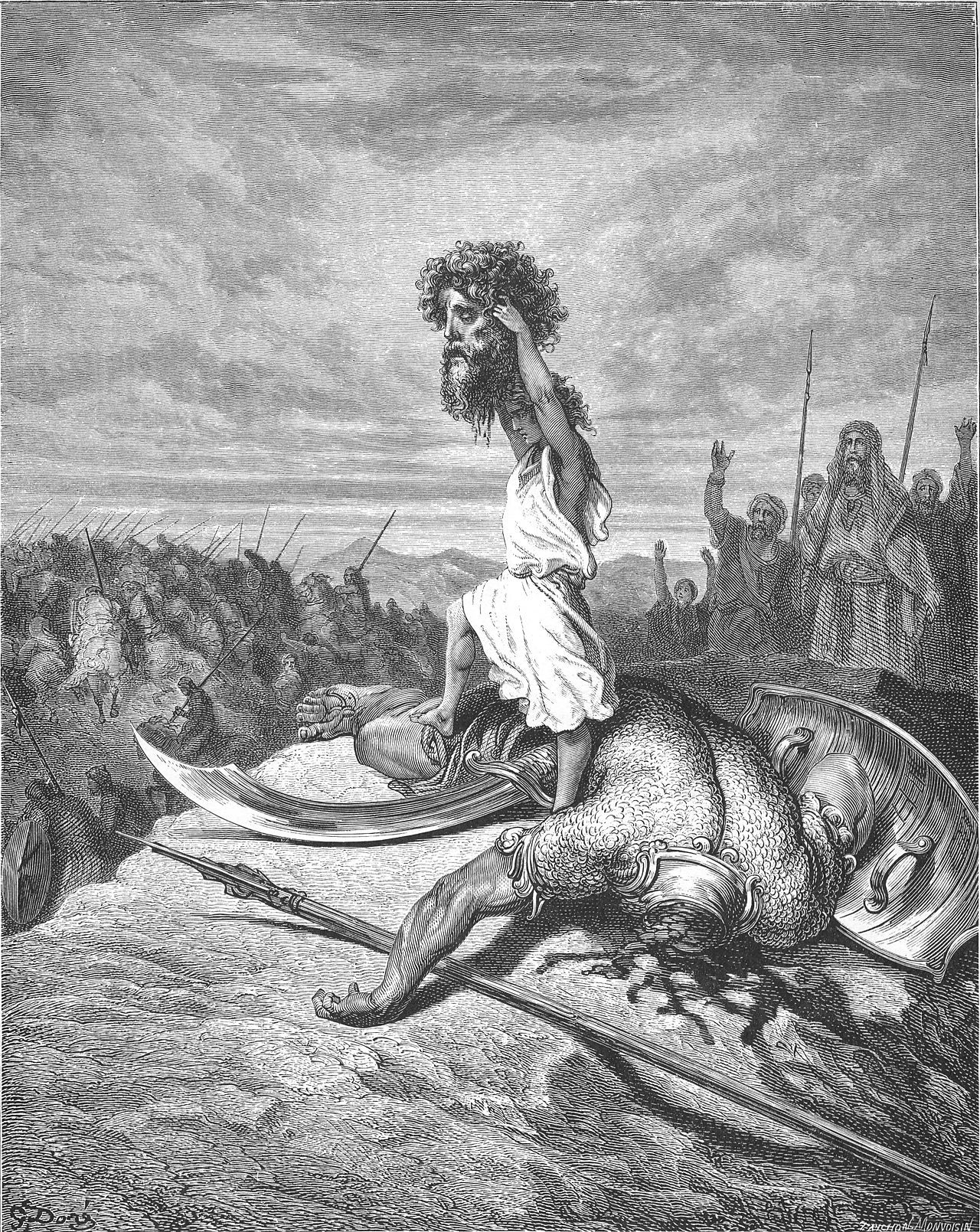
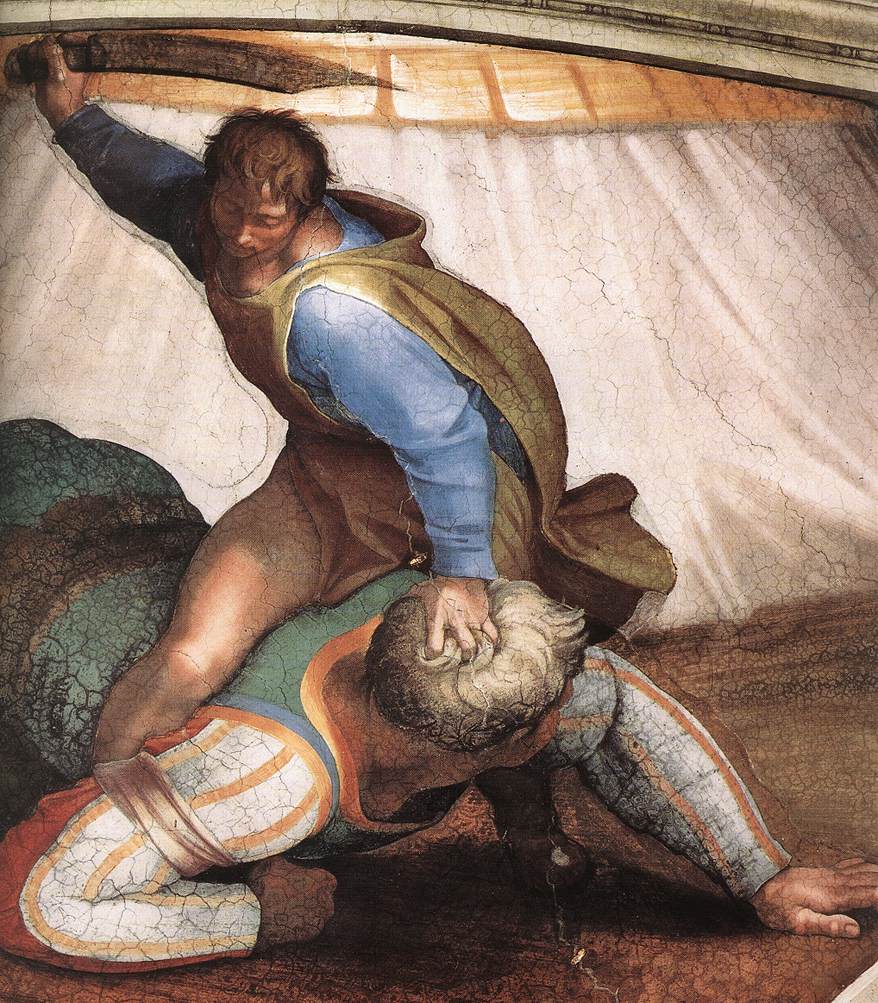
A: David accurately slung a stone on Goliath's forehead, just below his helmet, which knocked Goliath out. David then ran to unconscious Goliath, pulled his sword off the scabbard, and cut his head off.
Q: How did the Philistine army feel after Goliath was killed?
A: Seeing a fourteen-year-old boy killing their champion, the Philistine army demoralized.
Related articles
Author
AlegsaOnline.com Goliath: the Philistine champion in the Biblical narrative Leandro Alegsa
URL: https://en.alegsaonline.com/art/39555