
André-Marie Ampère — pioneer of electrodynamics and namesake of the ampere
French physicist and mathematician (1775–1836) whose work established the relationship between electric currents and magnetic effects; the SI unit ampere bears his name.
André-Marie Ampère (20 January 1775 – 10 June 1836) was a French physicist and mathematician whose investigations in the early 19th century helped create the field of electrodynamics. He is best known for showing that steady electric currents produce magnetic forces and for laying theoretical foundations that linked electricity and magnetism. The SI unit of electric current, the ampere, is named in his honour.
Image gallery
2 Images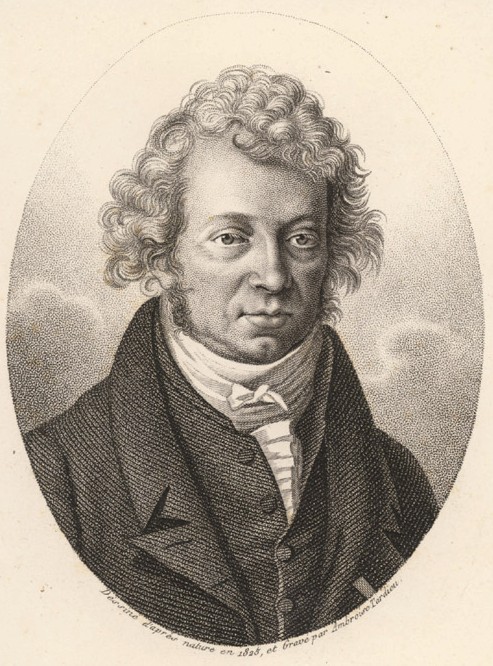

Key contributions
Ampère designed experiments and mathematical descriptions that clarified how currents interact: two parallel conductors carrying currents experience mutual attraction or repulsion depending on the direction of the currents. From such observations he formulated relations now summarized by Ampère's law, which connects magnetic fields around a closed loop to the electric current passing through that loop. He also introduced the term and concepts of electrodynamics, aiming to treat magnetic effects by mathematical principles rather than purely descriptive laws.
Context and development
His work built on and responded to contemporary discoveries: in 1820 Hans Christian Ørsted had shown that currents affect magnetic needles, and others such as Biot and Savart were quantifying magnetic effects of currents. Ampère extended these findings with mathematical models and published influential memoirs in the 1820s that shaped subsequent theory and experiment in electromagnetism. He became a leading figure in French scientific life and taught generations of students.
Mathematics and methods
Aside from physical experiments, Ampère applied mathematical analysis to physical problems. He used geometry and calculus to express laws of force and to deduce consequences for circuitry and magnetism. His approach exemplified the 19th-century trend of uniting rigorous mathematics with experimental science and influenced later formalizations of electromagnetic theory.
Uses, importance and legacy
- Practical: Ampère's ideas underpin technologies that rely on magnetic fields produced by currents — motors, generators and electromagnets central to electrical engineering.
- Scientific: Ampère's formulations are part of the foundation that later allowed James Clerk Maxwell and others to develop a unified electromagnetic theory.
- Commemorations: his name appears in the SI unit ampere and in many institutions and place names; his writings are still cited in histories of physics and mathematics.
For further reading on Ampère's life and works see biographical sketches and collections of his papers, which discuss both his experiments and the mathematical expositions he used to argue for the laws of electrodynamics (selected writings).
Questions and answers
Q: Who was André-Marie Ampère?
A: André-Marie Ampère was a French physicist and mathematician.
Q: What did Ampère help discover?
A: Ampère helped discover electromagnetism.
Q: What is an electrical unit named after Ampère?
A: The ampere is an electrical unit that is named after Ampère.
Q: When was Ampère born and when did he die?
A: Ampère was born on January 20, 1775, and he died on June 10, 1836.
Q: What is the significance of Ampère's contributions to science?
A: Ampère's contributions to science include his discovery of electromagnetism and the naming of an electrical unit after him.
Q: How is electromagnetism relevant in modern times?
A: Electromagnetism is relevant in modern times as it is used in a variety of technologies, including electric power transmission and electronic devices.
Q: What is the importance of studying historically significant scientists like Ampère?
A: Studying historically significant scientists like Ampère allows us to learn about the development of scientific knowledge and the impact of scientific discoveries on society.
Related articles
Author
AlegsaOnline.com André-Marie Ampère — pioneer of electrodynamics and namesake of the ampere Leandro Alegsa
URL: https://en.alegsaonline.com/art/3950