
Golden dart frog (Phyllobates terribilis)
A highly toxic poison-dart frog from Colombia's Pacific lowland rainforests, known for its bright coloration, batrachotoxin defenses, dietary origin of toxins, and cultural uses as dart poison.
Overview
The golden dart frog, Phyllobates terribilis, is a member of the poison-dart frog group and one of the best-known species in the family Dendrobatidae. Native to a restricted area along the Pacific coast of Colombia, it is famous for its vivid coloration and extreme toxicity. Commonly called the golden poison frog or golden dart frog, the species is a striking example of aposematism — bright colors that warn potential predators of chemical defenses.
Image gallery
10 Images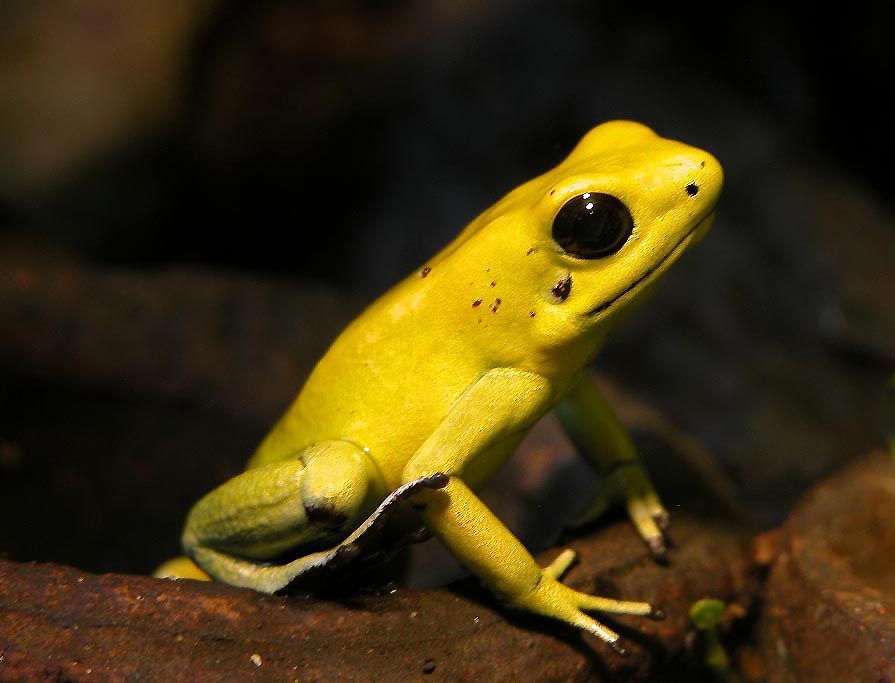



Description and behaviour
Adult golden dart frogs are relatively small, with a compact body and smooth, often uniformly golden or yellow skin, though regional color variants exist. They are diurnal, active during daylight hours, and rely on visual signals as much as vocal calls. As an amphibian, Phyllobates terribilis exhibits typical life stages: eggs laid on land and aquatic tadpole development. Adults of this species additionally show parental care: after eggs hatch, a parent will transport individual tadpoles to small pools or phytotelmata where they continue development. Because Phyllobates terribilis is considered one of the most poisonous vertebrate species, encounters are treated with caution by researchers and local people alike.
Toxicity and chemical action
The principal toxins found in P. terribilis are batrachotoxins, powerful alkaloids that interfere with nerve and muscle function by permanently activating certain sodium channels. These compounds make the frog dangerous to handle if toxins are transferred to cuts or mucous membranes. Studies cited in the scientific literature have measured batrachotoxin potency using small mammals as test subjects: minimal lethal doses in mice are extremely low, and early analyses estimated that the total alkaloid load of an individual frog could, in principle, be enough to kill many mice. Extrapolating toxicity across species is imprecise, but such figures underline the potency of the frog's chemical defenses. Oral exposure is generally less effective than injection, which helps explain why people who traditionally used poison-tipped darts could consume animals captured with those darts with little risk after preparation and cooking.
Dietary origin of toxins
Unlike some toxic animals that synthesize their own poisons, golden dart frogs acquire batrachotoxins from their diet in the wild. Researchers have linked the frog's toxicity to certain arthropods consumed in its environment. Small beetles and other insects are suspected sources of the alkaloids; in particular, beetles in the family Melyridae have been identified as producing compounds chemically similar to batrachotoxins. In general, wild frogs feeding on local small insects and other arthropods accumulate and sequester these toxins in skin glands. In contrast, frogs reared in captivity on captive-bred diets lacking those specific arthropods do not develop the same toxicity, which is why captive specimens are generally non-poisonous.
Habitat, distribution and conservation
Phyllobates terribilis inhabits lowland tropical rainforest on Colombia's Pacific slope, an area characterized by high rainfall, warm temperatures, and dense understory vegetation. Its range is limited, and habitat loss, fragmentation, and collection for the pet trade have contributed to conservation concern. Because of their small distribution and specialized needs, golden dart frogs are monitored by conservation organizations and are the subject of captive-breeding programs intended to reduce pressure on wild populations and preserve genetic diversity.
Human interactions and notable facts
Indigenous peoples of the region historically used the frog's toxins to tip hunting darts, taking advantage of its contact-active toxins to immobilize prey. Modern handling follows strict safety practices: field researchers wear gloves and avoid transferring skin secretions to their own bodies. The species has attracted attention from ecologists, chemists and educators because of its striking appearance and the biochemical complexity of its defenses. While it is sometimes kept by experienced hobbyists and in zoos, captive individuals do not possess the same level of toxicity as their wild counterparts because the necessary dietary sources are absent. The golden dart frog thus remains both a biological curiosity and a conservation priority, illustrating connections between diet, chemical ecology and the fragile ecosystems of tropical rainforests.
- Distinctive features: bright coloration, potent skin alkaloids, parental care of tadpoles.
- Scientific importance: model for studies of chemical ecology, aposematism, and toxin pharmacology.
- Conservation note: restricted range makes the species vulnerable to habitat loss and illegal collection.
For further introductory background see general resources on poison dart frogs and regional fauna of the Pacific coast of Colombia. Additional scientific discussions address the biochemical nature of batrachotoxins, ecological sources of alkaloids, and strategies used by local communities and conservationists to protect this remarkable species.
Questions and answers
Q: What type of frog is the Phyllobates terribilis?
A: The Phyllobates terribilis is a poison dart frog.
Q: Where does the P. terribilis live?
A: The P. terribilis lives in the Pacific coast of Colombia.
Q: Is it poisonous in captivity?
A: No, in captivity poison dart frogs are not poisonous. It is only in the wild where they are poisonous because of what they eat.
Q: How much toxin does one frog contain?
A: One P. terribilis contains about 1100 µg of toxins which is enough to kill more than 20,000 mice when injected subcutaneously.
Q: Can humans be poisoned by eating animals captured by their darts?
A: No, humans cannot be poisoned by eating animals captured by their darts because the oral potency of batrachotoxin is much lower and most importantly cooking may also destroy the toxins although not all toxins are heat labile.
Q: What family do these beetles belong to that produce the same toxin found in P. terribilis?
A: These beetles belong to the family Melyridae and their relatives in Colombian rainforests could be the source of batrachotoxins found in highly toxic Phyllobates frogs from that region.
Q: What may be responsible for high toxicity levels found in P. terribilis? A:The high toxicity levels found in P .terribilis may be due to eating small insects or other arthropods and one of these may truly be the most poisonous creature on Earth
Related articles
Author
AlegsaOnline.com Golden dart frog (Phyllobates terribilis) Leandro Alegsa
URL: https://en.alegsaonline.com/art/39486
Sources
- atlas.drpez.org : Atlas Dr. Pez :: Phyllobates terribilis
- asanltr.com : Dart poison frogs and their toxins The ASA Newsletter 1999
- chm.bris.ac.uk : chm.bris.ac.uk/motm/batrachotoxin/batrah.htm