
Goblin shark (Mitsukurina owstoni)
A rare deep‑sea shark notable for its elongated snout and protrusible jaws. The goblin shark inhabits deep continental slopes worldwide and remains poorly known because it is infrequently encountered.
Overview
The goblin shark, Mitsukurina owstoni, is a seldom-seen deep-water shark sometimes described as a "living fossil" because of its unusual, archaic appearance and the isolated position of its family, Mitsukurinidae. Scientists know little about its life history because most information comes from stranded or bycatch specimens rather than observations in its natural habitat. It is widely regarded as a rare and enigmatic deep-sea species, and popular accounts often repeat the "living fossil" label to emphasize its distinctive morphology.
Image gallery
5 Images


Physical characteristics
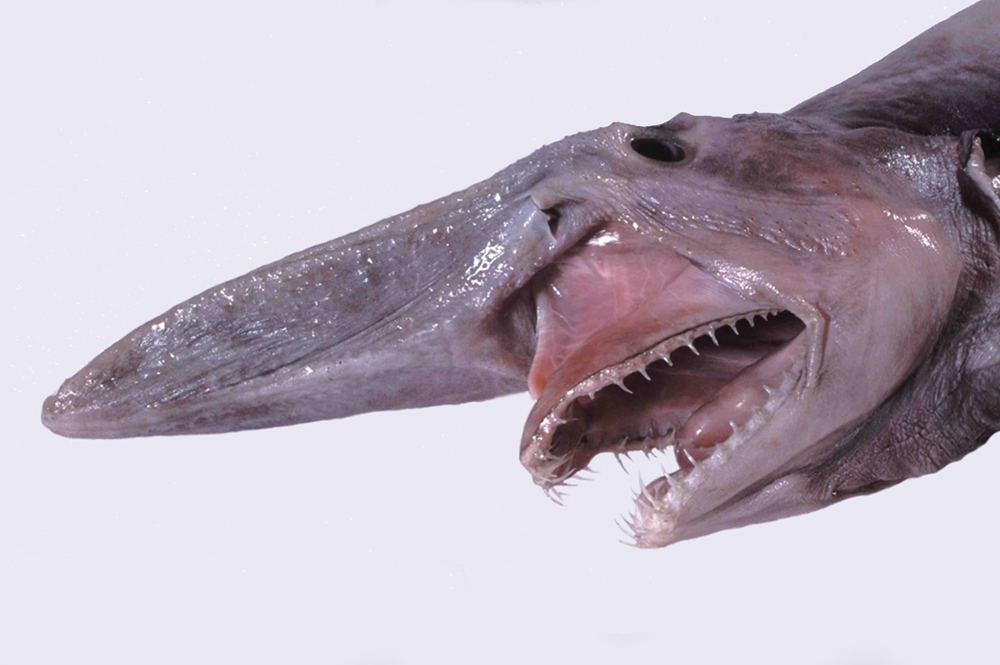
Goblin sharks are unmistakable due to their long, flattened snout and highly protrusible jaws. Their body is relatively soft and flabby, and the skin often appears pinkish because underlying blood vessels show through. Key features include:
- an elongated, blade-like rostrum equipped with electroreceptive organs that help detect prey in low light;
- a pair of jaws that can be rapidly extended forward to seize prey, revealing long, narrow teeth suited for gripping slippery animals;
- a generally sluggish, deep-sea form with small eyes and reduced musculature compared with fast-swimming coastal sharks.
Size, diet and behavior
Adult goblin sharks may reach lengths of around 3.5–3.8 metres (about 11–13 feet) in reported specimens, and some large individuals have weighed hundreds of kilograms. They are believed to feed on midwater and benthic fishes, cephalopods and crustaceans. Because the species lives in deep, dark environments, it likely relies on a combination of electroreception and jaw projection to capture prey rather than high-speed pursuit.
Habitat, distribution and encounters
The goblin shark is found on continental slopes and around seamounts at great depths, commonly reported to around 1,300 metres but occasionally caught from shallower to deeper waters. Records exist from the Atlantic, Indian and Pacific Oceans, indicating a broad but patchy global distribution. Most specimens are recovered from deep trawl or longline bycatch; live behavior and population size remain poorly documented.
Biological significance and conservation
Because the goblin shark is infrequently encountered, its reproductive biology, growth rates and population trends are not well known. It is of interest to scientists as an example of specialized deep-sea adaptation and as a member of an isolated evolutionary lineage. Human interactions are usually incidental (bycatch), and the shark’s deep habitat provides some protection from coastal threats, though deep-sea fisheries and habitat disturbance could affect local populations. Conservation assessment is hampered by limited data and sporadic records.
Notable facts
- Its protrusible jaws are one of the most dramatic feeding adaptations among sharks and are often shown in museum specimens and photographs.
- The distinctive snout is loaded with electroreceptors that help locate buried or hidden prey in near-darkness.
- Most scientific knowledge comes from individual specimens, so many aspects of its natural history remain uncertain.
For further reading and specimen records, consult specialized deep-sea shark resources and museum collections that catalogue observations of this unusual shark.
Questions and answers
Q: What is a goblin shark?
A: A goblin shark is a rare, deep-sea shark and the only living species in the family Mitsukurinidae.
Q: How is a goblin shark identified?
A: A goblin shark can be easily identified by its long, flattened snout.
Q: What is the maximum length for male and female goblin sharks?
A: Male goblin sharks can reach up to lengths of 12.6 feet (3.8 meters), and females can reach up to lengths of 12.2 feet (3.7 meters).
Q: What is the heaviest weight ever recorded for a goblin shark?
A: The heaviest Goblin shark ever found weighed 210 kg (460 pounds).
Q: Where are goblin sharks found?
A: Goblin sharks are bottom-dwelling sharks found in waters as deep as 4,265 feet (1,300 meters) in the Atlantic, Indian, and Pacific Ocean.
Q: What is the goblin shark sometimes called and why?
A: The goblin shark is sometimes called a "living fossil" because it is a rare and poorly-known species that has changed very little over time.
Q: What is unique about the family Mitsukurinidae?
A: The family Mitsukurinidae, to which the goblin shark is the only living species, is a unique family of sharks that has not evolved much over the course of millions of years.
Related articles
Author
AlegsaOnline.com Goblin shark (Mitsukurina owstoni) Leandro Alegsa
URL: https://en.alegsaonline.com/art/39366
Sources
- iucnredlist.org : "Mitsukurina owstoni"
- doi.org : 10.2305/IUCN.UK.2004.RLTS.T44565A10907385.en
- flmnh.ufl.edu : "FLMNH Ichthyology Department:Goblin shark"
- bioexpedition.com : "Goblin Shark-Animal Facts and Information"
- marinebio.org : "Goblin Sharks, Mitsukurina owstoni~MarineBio.org"