
Glaucophytes: primitive freshwater algae and early plastid-bearing lineage
Glaucophytes are a small group of freshwater microscopic algae whose plastids retain a peptidoglycan wall. They form one branch of the Archaeplastida and are important for studying the origin of plastids.
Overview
Glaucophytes (Glaucophyta) are a small assemblage of mostly microscopic, freshwater photosynthetic organisms. They are part of the Archaeplastida, the major eukaryote group that also includes red algae and the clade that contains green algae and land plants (Viridiplantae). Because glaucophytes retain several primitive features in their plastids, they attract interest from researchers investigating how photosynthetic organelles first became established in eukaryotes. Many common descriptions emphasize their simple, unicellular or colonial forms and their strictly freshwater habitats; they are not a conspicuous part of most aquatic ecosystems, but they play a distinctive role in studies of evolution.
Image gallery
1 Image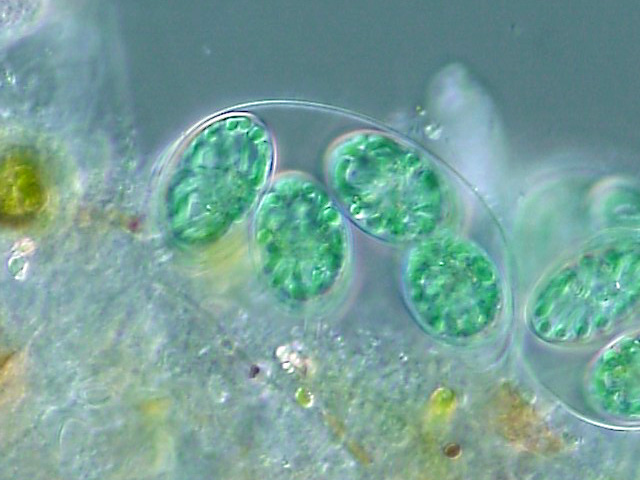
Characteristics and cell structure
Glaucophyte cells are typically small and simple in organization. Some genera are solitary while others form small colonies. In contrast to most green algae and many red algae, glaucophyte plastids — called cyanelles or muroplasts — retain a thin peptidoglycan layer between their two envelope membranes, a trait reminiscent of their cyanobacterial ancestors. Their light-harvesting apparatus commonly includes phycobiliproteins, similar to those found in cyanobacteria and red algae, and they use chlorophyll a for photosynthesis.
Evolutionary significance
Glaucophytes are important because they preserve anatomical and biochemical features that illuminate the early stages of primary endosymbiosis, the event in which a eukaryotic host captured a cyanobacterium that became the plastid. Comparative studies of their plastids, genomes, and pigment systems help scientists reconstruct steps in plastid integration and diversification. Phylogenetic analyses consistently place glaucophytes with red and green plastid-bearing lineages within Archaeplastida, but the exact branching order and early relationships remain active areas of research.
Ecology, distribution and uses
These algae are primarily found in freshwater habitats such as ponds, streams and moist soils. They contribute to primary production at microscopic scales and serve as models for laboratory work on cell biology and photosynthesis. Because glaucophytes are relatively rare and often overlooked in routine surveys, most knowledge about them comes from cultured strains and targeted molecular sampling rather than broad ecological monitoring.
Distinguishing features and notable facts
- Plastids known as cyanelles retain a peptidoglycan wall, a rare ancestral trait among eukaryotes.
- Possess phycobiliprotein-based light-harvesting similar to cyanobacteria and red algae.
- Mostly unicellular or colonial, and largely restricted to freshwater environments; they are not a large or diverse group compared with other algal lineages.
Research context
Glaucophytes are studied mainly for what they reveal about the origin and early evolution of plastids and photosynthetic eukaryotes. Cultured strains and molecular data provide key comparisons against freshwater microscopic algae more broadly, informing hypotheses about ancestral plastid features and the sequence of genetic and cellular changes that produced modern photosynthetic lineages. Ongoing sampling and genomic work continue to refine their position within Archaeplastida and to clarify which traits are ancestral versus derived.
Questions and answers
Q: What are glaucophytes?
A: Glaucophytes are a small group of freshwater microscopic algae.
Q: Which groups form the Archaeplastida?
A: The Archaeplastida is formed by the glaucophytes, red algae (Rhodophyta), and green algae plus land plants (Viridiplantae or Chloroplastida).
Q: What is the importance of glaucophytes?
A: Glaucophytes are of interest because they may be similar to the original algal type that led to green plants and red algae.
Q: What is the relationship between glaucophytes, green algae, and red algae?
A: The relationships between these groups are not yet clear and require further study.
Q: Are glaucophytes common in the environment?
A: Glaucophytes are a small group of freshwater microscopic algae and are not common in the environment.
Q: Where are glaucophytes typically found?
A: Glaucophytes are typically found in freshwater environments.
Q: What can be learned from studying glaucophytes?
A: Studying glaucophytes can help to understand the evolution of green plants and red algae.
Related articles
Author
AlegsaOnline.com Glaucophytes: primitive freshwater algae and early plastid-bearing lineage Leandro Alegsa
URL: https://en.alegsaonline.com/art/39140
Sources
- amjbot.org : "Diversity and evolutionary history of plastids and their hosts"
- doi.org : 10.3732/ajb.91.10.1481
- pubmed.ncbi.nlm.nih.gov : 21652304
- plosone.org : "EEF2 analysis challenges the monophyly of Archaeplastida and Chromalveolata"
- doi.org : 10.1371/journal.pone.0002621
- ncbi.nlm.nih.gov : 2440802
- pubmed.ncbi.nlm.nih.gov : 18612431
- amjbot.org : "The plant tree of life: an overview and some points of view"
- doi.org : 10.3732/ajb.91.10.1437
- pubmed.ncbi.nlm.nih.gov : 21652302
- cfb.unh.edu : Glaucocystis