
Glass frog (family Centrolenidae): appearance, behavior and conservation
Small, mostly green arboreal frogs whose bellies are often translucent. Glass frogs (Centrolenidae) are known for visible internal organs, leaf-laid eggs, nocturnal habits and conservation concerns.
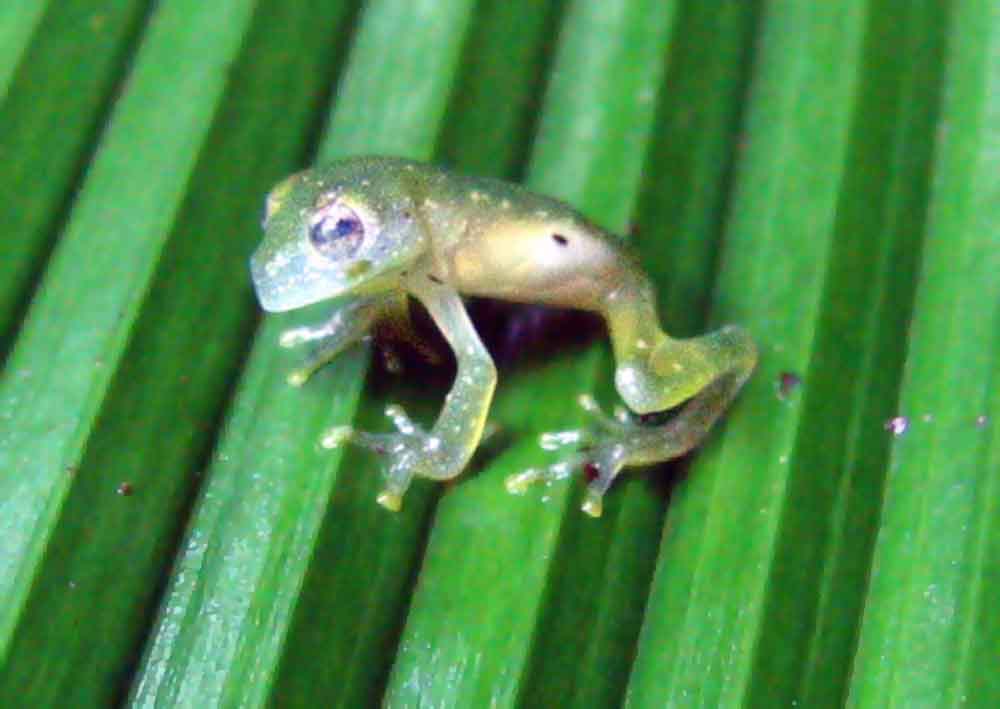
The glass frog is the common name for members of the amphibian family Centrolenidae. These small, mostly arboreal frogs are best known for a translucent or semi-transparent ventral skin that can make some internal organs faintly visible, a trait that inspired the name "glass" frog. Not all species are equally transparent; many have a vivid lime-green dorsal surface that helps them blend with foliage.
Image gallery
6 Images



Physical characteristics
Glass frogs are generally diminutive and lightweight, with long limbs and expanded toe pads for climbing. Distinctive features include:
- Translucent belly: In several species the abdominal skin is thin enough to reveal the heart, liver and digestive tract; other species retain more opaque markings over the organs.
- Dorsal coloration: Many are bright green, sometimes with spotting or iridescent flecks that aid camouflage on leaves.
- Skeleton and pigments: Greenish bones, caused by bile pigments like biliverdin, are visible in some species and contribute to their overall coloration.
Distribution, habitat and behavior
Glass frogs occur in the Neotropics, from southern Mexico through Central America and into South America. They favor humid forests and are often found on vegetation overhanging streams, which is important for reproduction. Most are nocturnal insectivores, feeding on small arthropods they find on leaves and branches.
Reproductive behavior is notable: males typically call to attract females from leaves above flowing water. After eggs are deposited on the undersides of leaves, some males guard the clutch until tadpoles hatch and drop into the stream below. This form of parental care is one of the better-known behaviors among glass frogs.
Taxonomy, research and importance
Centrolenidae contains a diversity of genera and species (roughly on the order of a few hundred named species across the family). Scientists study glass frogs for their unusual transparency, their reproductive strategies and their sensitivity to environmental change. The see-through belly and green bones have prompted research into camouflage, pigment biology and evolutionary adaptation.
Conservation and notable facts
- Threats: Habitat loss, pollution, disease (including chytridiomycosis) and stream degradation affect many populations.
- Conservation: Protecting forest corridors and clean waterways is vital for their survival; several species are assessed by conservation organizations.
- Interesting point: Transparency varies by species and life stage, and it should not be assumed that all glass frogs show fully visible organs.
For taxonomic resources and species accounts, see family-level treatments and field guides: family overview, amphibian references, and genus- or species-focused pages such as Hyalinobatrachium or Centrolene. General information and conservation updates are available through databases and research portals: research portals and conservation listings.
Questions and answers
Q: What is the glass frog?
A: The glass frog is a type of frog in the amphibian family Centrolenidae.
Q: What color are most glass frogs?
A: Most glass frogs are a lime green color.
Q: What is transparent on some glass frogs?
A: The skin on the stomach area of some glass frogs is transparent.
Q: What can be seen through the skin of some glass frogs?
A: The insides, including the heart, liver, and gastrointestinal tract can be seen through the skin of some glass frogs.
Q: Why is the glass frog called that name?
A: The glass frog is called that name because the transparent skin on the stomach area allows the insides to be seen through the skin, giving the appearance of glass.
Q: What is the scientific name of the glass frog?
A: The glass frog belongs to the amphibian family Centrolenidae.
Q: Do all glass frogs have transparent skin on their stomach area?
A: No, only some glass frogs have transparent skin on their stomach area.
Related articles
Author
AlegsaOnline.com Glass frog (family Centrolenidae): appearance, behavior and conservation Leandro Alegsa
URL: https://en.alegsaonline.com/art/39121
Sources
- commons.wikimedia.org : Centrolenidae