
Glans penis: anatomy, function, development, and clinical notes
The glans penis is the sensitive, rounded tip of the penis. This article explains its anatomy, embryology, role in sexual function, common variations, and clinical conditions in clear, neutral terms.
The glans penis, often shortened to the glans, is the rounded, highly sensitive tip of the penis. It forms the distal cap of the spongy tissue that surrounds the urethra and contains the external opening called the urethral meatus. In common speech the glans is also called the "head" of the penis, and various informal names exist; see also slang references.
Image gallery
3 Images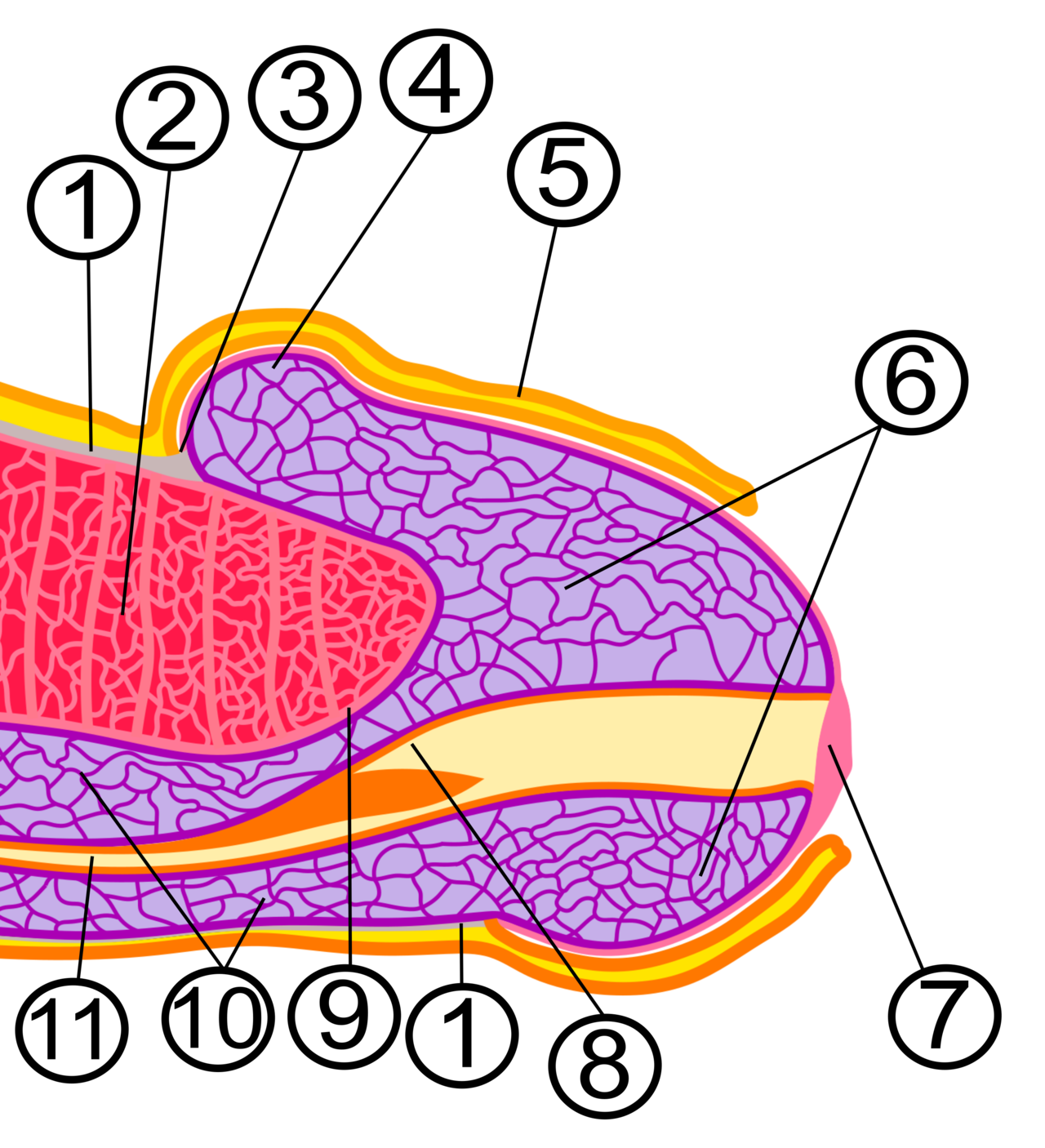


Anatomy and structure
Structurally, the glans is an expansion of the corpus spongiosum and is covered by a mucous-type epithelium. It receives a dense supply of sensory nerve endings and blood vessels, which contribute to its sensitivity. The surface may be smooth or show folds and a ridge (the corona) where it joins the shaft.
Function and importance
The glans plays a primary role in sexual sensation and stimulation. It helps channel ejaculate and urine through the external meatus and provides a lubricated surface during intercourse. The foreskin, when present, normally covers and protects the glans; removal of the foreskin through circumcision exposes the glans permanently, producing changes in surface texture over time.
Development and variation
During embryonic development the glans arises from the genital tubercle. Size, shape, and coloration vary between individuals and populations. In many males the glans remains covered by the foreskin (foreskin) until it retracts spontaneously or is surgically removed. Cultural and medical practices influence how it is treated.
Clinical notes and common conditions
- Inflammation of the glans is called balanitis; it can result from infection, irritation, or poor hygiene.
- Phimosis involves inability to retract the foreskin and can affect hygiene or cause symptoms.
- Less commonly, lesions or malignancies can occur and should be evaluated by a clinician.
For introductory anatomical references and consensual medical overviews see general anatomy texts or educational resources (anatomy overview). For practical guidance on hygiene, variations, and when to seek medical advice consult a qualified health professional rather than purely informal sources (slang and popular discussions are not substitutes). Additional general information about penile structure and care can be found in public health materials (foreskin topics) and clinical guidelines (circumcision considerations).
Questions and answers
Q: What is the glans penis?
A: The glans penis is the sensitive tip of the penis, also referred to as the "head" of the penis.
Q: What are some slang names for the glans penis?
A: Some slang names for the glans penis are "helmet" and "bell end".
Q: What is the usual covering for the glans penis?
A: The glans penis is usually covered by the foreskin.
Q: Are there any exceptions to the glans penis being covered by the foreskin?
A: Yes, the glans penis is not covered by the foreskin in men who have been circumcised.
Q: Why is the glans penis considered sensitive?
A: The glans penis is considered sensitive because it has a high concentration of nerve endings.
Q: What is the function of the glans penis?
A: The function of the glans penis is to provide pleasurable sensations during sexual activity.
Q: Can the glans penis become irritated or inflamed?
A: Yes, the glans penis can become irritated or inflamed due to various conditions such as infection or allergic reactions.
Related articles
Author
AlegsaOnline.com Glans penis: anatomy, function, development, and clinical notes Leandro Alegsa
URL: https://en.alegsaonline.com/art/39100
Sources
- cirp.org : "Balanitis and balanoposthitis: a review"
- doi.org : 10.1136/sti.72.3.155
- ncbi.nlm.nih.gov : 1195642
- pubmed.ncbi.nlm.nih.gov : 8707315
- doi.org : 10.1016/S0022-3476(47)80098-8
- pubmed.ncbi.nlm.nih.gov : 8244363
- ↑
- doi.org : 10.1136/bmj.320.7249.1592
- pubmed.ncbi.nlm.nih.gov : 10845974