
Giant's Causeway — the basalt column landscape of County Antrim
A naturally occurring expanse of interlocking basalt columns on Northern Ireland’s northeast coast, formed by ancient volcanic activity and known for distinctive hexagonal pillars and cultural legend.
Overview
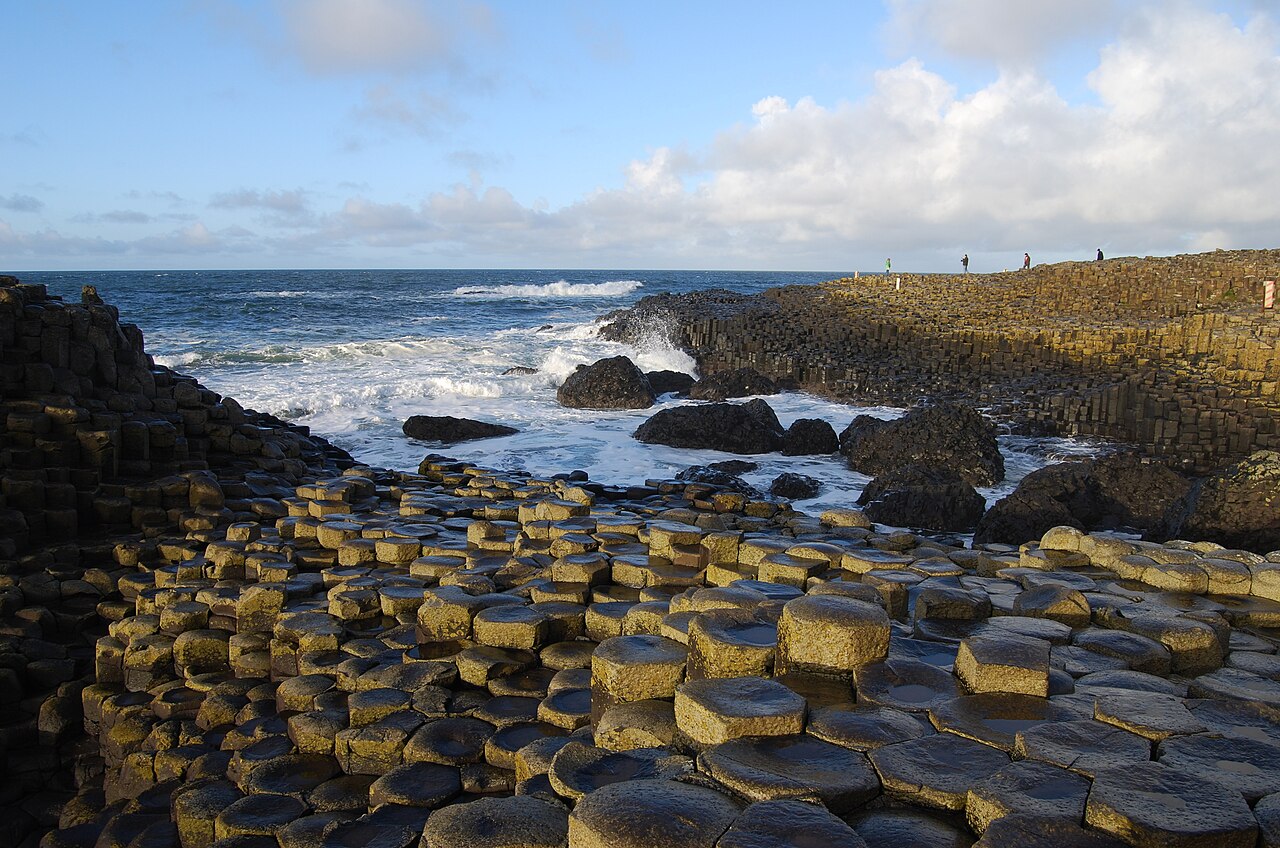
The Giant's Causeway is a coastal area of tightly packed basalt pillars on the northeast coast of Northern Ireland, in County Antrim. The site contains roughly 40,000 interlocking columns that form a paved surface stretching from the cliff foot into the sea. It has international recognition as a UNESCO World Heritage Site and is protected as a National Nature Reserve. The site is owned and managed by the National Trust, which receives many visitors each year.
Image gallery
10 Images





Geology and formation
The columns were created during intense volcanic activity in the early Paleogene period, about 50–60 million years ago, when thick lava flows cooled and contracted. Cooling produced a network of fractures that propagated downward and produced predominantly hexagonal columns, a common outcome of the physical process called columnar jointing. The process is a striking example of how heat, cooling rate and chemistry combine to produce regular polygonal patterns in igneous rock. Modern geological descriptions of this process can be found through dedicated geology resources and field guides.
Physical characteristics
Most of the columns are hexagonal, though polygons with four, five, seven or eight sides also occur. Column heights vary: some rise only a little above the shore while the tallest reach roughly 12 metres. In places the solidified lava in the coastal cliffs is reported to be near 28 metres thick. The interlocking tops form a series of stepping-stone surfaces that appear to lead out into the sea, creating a dramatic natural pavement of dark basalt.
Legend, history and cultural importance
Local folklore gives the Giant's Causeway an imaginative human history. One popular legend describes the Irish giant Fionn mac Cumhaill (Finn McCool) building a causeway to Scotland to challenge a rival giant. Such stories have been part of the place’s cultural appeal for centuries and have shaped visitor interpretations alongside scientific explanations. In modern times the Causeway has been celebrated in art, literature and tourism and was placed on several lists of notable natural attractions in the United Kingdom.
Conservation, access and tourism
Because of its scientific, aesthetic and cultural value the area is managed to balance visitor access with protection of fragile rock surfaces and coastal ecology. Designations as a World Heritage Site and a National Nature Reserve help guide conservation measures. Facilities for visitors, interpretation centres and guided walks are provided by site managers; these resources explain the geology, ecology and folklore while seeking to limit erosion and damage from foot traffic.
Notable facts and further reading
Key points to remember: the Causeway is a classic example of columnar jointing in basalt; it contains tens of thousands of mostly hexagonal columns; it is an internationally important geological and cultural site. For more detailed technical descriptions, historical background and visitor information, consult specialist geology texts and official site resources linked below.
- Basalt columns and geology overview
- Formation processes and cooling joints
- Volcanic history of the region
- County Antrim information
- Northern Ireland tourism resources
- UNESCO World Heritage listing
- UNESCO documentation and criteria
- Public polls and popular recognitions
- Natural wonders listings
- United Kingdom natural sites
- Geometry of polygonal columns
- National Trust site management
Questions and answers
Q: What is the Giant's Causeway?
A: The Giant's Causeway is an area of about 40,000 interlocking basalt columns that resulted from an ancient volcanic eruption.
Q: Where is the Giant's Causeway located?
A: The Giant's Causeway is located in County Antrim on the northeast coast of Northern Ireland.
Q: What is the status of the Giant's Causeway by UNESCO?
A: The Giant's Causeway is a World Heritage Site by UNESCO.
Q: When was the Giant's Causeway named a National Nature Reserve?
A: The Giant's Causeway was named a National Nature Reserve in 1987 by the Department of the Environment for Northern Ireland.
Q: How tall are the tallest columns of the Giant's Causeway?
A: The tallest columns of the Giant's Causeway are about 12 meters (36 ft) high.
Q: Who owns and manages the Giant's Causeway today?
A: The Giant's Causeway is owned and managed by the National Trust.
Q: What is the Giant's Causeway's status as a tourist attraction?
A: The Giant's Causeway is the most popular tourist attraction in Northern Ireland.
Related articles
Author
AlegsaOnline.com Giant's Causeway — the basalt column landscape of County Antrim Leandro Alegsa
URL: https://en.alegsaonline.com/art/38720
Sources
- logainm.ie : "Clochán an Aifir / Giant's Causeway - Placenames Database of Ireland"
- highbeam.com : The Crack: Yin giant step for mankind
- logainm.ie : Placenames Database of Ireland
- whc.unesco.org : "Giant's Causeway and Causeway Coast"
- news.bbc.co.uk : Report of poll result
- nitb.com : "Giant's Causeway remains Northern Ireland's Top Attraction"
- sciencedaily.com : "University of Toronto (2008, December 25). Mystery Of Hexagonal Column Formations"
- www3.interscience.wiley.com : "Brittle tectonism in relation to the Palaeogene evolution of the Thulean/NE Atlantic domain: a study in Ulster"
- doi.org : 10.1002/(SICI)1099-1034(199609)31:3<259::AID-GJ711>3.0.CO;2-8