
Gharial (Gavialis gangeticus) — long-snouted river crocodilian
A long-snouted, fish-eating crocodilian native to South Asian rivers. The gharial is notable for its narrow jaws and the male's bulbous nasal growth; it is endangered and survives in a few fragmented river systems.
Overview
The gharial (Gavialis gangeticus) is a distinctive river-dwelling crocodilian known for an extremely narrow snout adapted for catching fish. It is one of the surviving members of the family Gavialidae and is sometimes called the Indian gharial or gavial. Historically widespread across major rivers of the Indian subcontinent, the species now persists in only a few fragmented populations.
Image gallery
10 Images


Description and adaptations
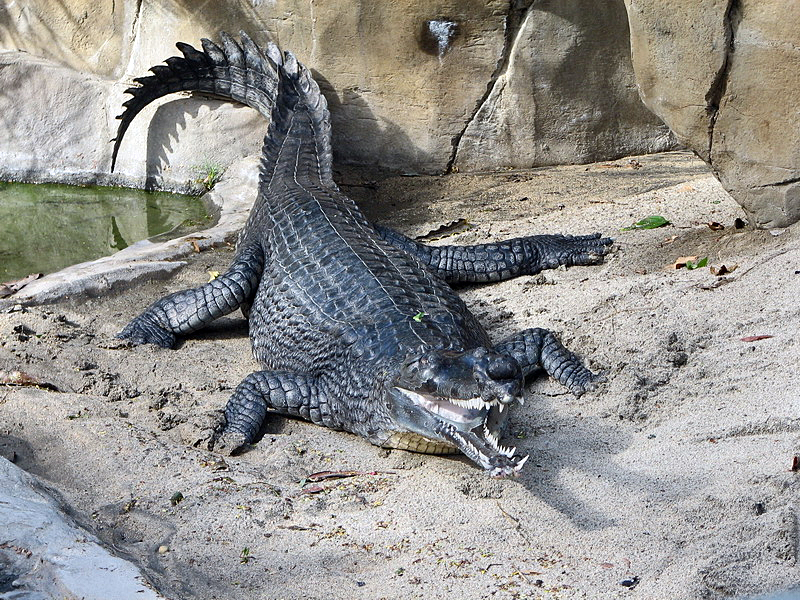
Gharials are among the longest living crocodilians; large males may approach six metres in length, making them exceeded in size only by some individuals of the saltwater crocodile and the Nile crocodile. Their most obvious feature is the long, slender snout lined with interlocking, needle-like teeth ideal for seizing small, agile fish. Adult males develop a hollow bulbous growth at the tip of the snout called a "ghara," which functions in vocalization and courtship displays. Their bodies are streamlined and largely aquatic, with legs adapted for swimming and a powerful, laterally compressed tail.
Taxonomy and relatives
The gharial belongs to a lineage of long-snouted, piscivorous reptiles often described as crocodile-like reptiles. Modern systematics place it within Gavialidae, a small group distinct from other crocodilians. Although taxonomic debates have occurred about close relatives, the gharial's morphology and ecology are specialized compared with broader-bodied crocodiles and alligators.
Distribution, habitat and behavior
Gharials inhabit large, deep, fast-flowing rivers with sandy banks suitable for nesting. They are highly aquatic, spending most of their life in water and emerging chiefly to bask or to nest on exposed sandbars. Their diet is overwhelmingly piscivorous, and they capture prey with rapid lateral movements of the head and jaw. Reproduction involves egg-laying in nests on riverbanks; hatchlings move quickly to the water where parental presence can increase survival.
Conservation status and threats
The species is endangered in the wild; populations declined steeply during the 20th century due to habitat loss, damming and river modification, sand mining, accidental capture in fishing nets, pollution, and egg and juvenile collection. Current conservation measures include protected river stretches, captive breeding and reintroduction programs, and community-based nest protection. International and local efforts aim to restore river habitats and reduce direct threats to improve survival prospects.
Notable facts and human interactions
- Male ghara is named for the hollow nasal protuberance used in display.
- They are largely harmless to humans because their slender jaws are adapted for fish rather than large mammals.
- Conservation requires integrated river management and cooperation across borders.
For more general context on related groups see reptiles and broader discussions of Gavialidae and other crocodilians. Comparative references often mention large species such as the saltwater crocodile and the Nile crocodile when describing size and ecological differences.
Further reading and conservation updates can be found through specialist sources and conservation organizations focusing on South Asian riverine wildlife. See also regional recovery projects and scientific assessments that monitor remaining gharial populations and habitat quality.
Questions and answers
Q: What is a gharial?
A: A gharial is a type of crocodile-like reptile with long, narrow jaws.
Q: What is the scientific name of a gharial?
A: The scientific name of a gharial is Gavialis gangeticus.
Q: How long can a large male gharial be?
A: A large male gharial can be nearly six meters in length.
Q: What is the family name of the gharial?
A: The family name of the gharial is Gavialidae.
Q: How does the size of a gharial compare to other crocodilians?
A: The gharial is the second-longest of all living crocodilians, with only saltwater crocodiles and Nile crocodiles growing larger.
Q: What other names are gharials sometimes called?
A: Gharials are sometimes called the Indian gharial, common gharial or gavial.
Q: How would you describe the jaws of a gharial?
A: The jaws of a gharial are long and narrow.
Related articles
Author
AlegsaOnline.com Gharial (Gavialis gangeticus) — long-snouted river crocodilian Leandro Alegsa
URL: https://en.alegsaonline.com/art/38619
Sources
- flmnh.ufl.edu : Crocodilian species - Gharial
- iucnredlist.org : "Choudhury, B.C., Singh, L.A.K., Rao, R.J., Basu, D., Sharma, R.K., Hussain, S.A., Andrews, H.V., Whitaker, N., Whitaker, R., Lenin, J., Maskey, T., Cadi, A., Rashid, S.M.A., Choudhury, A.A., Dahal, B., Win Ko Ko, U., Thorbjarnarson, J & Ross, J.P. 2007. Gavialis gangeticus. In: IUCN 2007. 2007 IUCN Red List of Threatened Species. <www.iucnredlist.org>>"
- timesofindia.indiatimes.com : “At 200, gharials now on critically-endangered list” by Neelam Raaj, TNN, The Times of India, 13 Sep 2007
- iucnredlist.org : Gavialis gangeticus