
German-speaking Community of Belgium
Smallest of Belgium's three constitutional communities, the German-speaking Community occupies the East Cantons and has competence in culture, education and language policy within Wallonia and Liège province.
Overview
The German-speaking Community of Belgium (Deutschsprachige Gemeinschaft) is one of the country’s three constitutional communities and the smallest by population. It is a distinct linguistic entity inside the Belgian state (Belgium) and covers an area commonly given as 854 km² (329.7 sq mi). The resident population numbers in the tens of thousands, with the vast majority using German as their primary language; many inhabitants also speak regional Ripuarian dialects alongside standard German (Ripuarian).
Image gallery
7 Images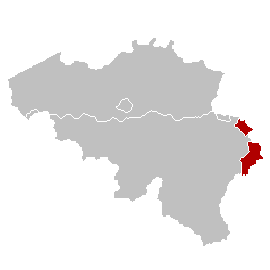


Geography and municipalities
The community’s administrative capital is Eupen. It lies within the Belgian province of Liège and shares borders with the Netherlands, Germany and Luxembourg, which gives the area a strong cross-border dynamic in everyday life and commerce. The historic grouping known as Eupen-Malmedy originally referred to a larger territorial unit that today includes the municipalities of the German-speaking Community together with Malmedy and Waimes (Weismes), the latter two now belonging to Belgium’s French-speaking Community.
Historical background
Before the First World War the East Cantons formed part of the Rhine Province of Prussia. After Germany's defeat in World War I, the postwar settlement formalized by the Treaty of Versailles resulted in the transfer of the territory to Belgium in 1920. The process of integrating the area was controversial: the political arrangements and local consultations that followed were criticized for failing to meet standards of secret suffrage, and they left a legacy of local unease.
During the Second World War the cantons were reoccupied by Germany in 1940 and remained under German control until the end of the conflict in 1945. After the war they were returned to Belgium. Over the following decades the Belgian state gradually reformed itself to accommodate linguistic diversity, including changes in the early 1960s that divided the country into language areas (early 1960s) and later institutional reforms culminating in separate communities and regions in 1973.
State reform and political status
As part of Belgium’s federalisation, the German-speaking Community obtained its own elected council (the Rat der Deutschsprachigen Gemeinschaft) and executive. The community has legislative and executive powers for cultural affairs, education, some aspects of social policy and language use. Although it enjoys self-government in these domains, the territory remains administratively part of the Walloon Region (Wallonia) and the province of Liège. Political debate inside the community ranges from proposals for expanded regional competences to arguments for maintaining close institutional ties within the existing federal framework.
Government, institutions and public services
The German-speaking Community operates its own parliament and government institutions which manage schools, cultural funding, media policy for German-language broadcasting, and certain welfare and youth policies. Local municipalities cooperate with regional authorities to deliver services; cross-border arrangements with neighbouring states facilitate emergency services, transport links and professional exchanges. Institutional actors include representatives at municipal, community and regional levels, and public administration emphasizes bilingual or multilingual interfaces when communicating beyond the German-language area.
Language, education and culture
Education in the German-speaking Community is delivered in German. School curricula follow regional and national norms adapted to the linguistic context, and teacher training, cultural subsidies and libraries are managed at the community level. Cultural life draws on German-language literature, theatre and festivals, as well as on local traditions tied to the Ardennes landscape. Museums and local archives preserve the particular history of the East Cantons and provide resources for researchers and visitors alike.
Economy and cross-border relations
The local economy is a mix of small and medium-sized enterprises, services, agriculture and tourism. Proximity to three neighbouring countries encourages commuting and cross-border trade; many residents work or study across borders and benefit from cooperative arrangements in transport and vocational training. Regional economic development strategies often emphasize sustainability, rural development and leveraging cultural heritage to attract visitors to towns like Eupen and nearby attractions.
Demographics and society
Population figures fluctuate with migration and demographic change, but the community remains small by national standards. Social life is shaped by multilingualism at the margins, family networks, and the presence of regional dialects. While most residents identify with the German-speaking cultural space, many also participate in francophone or Dutch-language contexts for work, education or commerce.
Contemporary issues and prospects
Key contemporary questions include the scope of self-government, cross-border cooperation, demographic challenges and the maintenance of services in rural municipalities. Political leaders, civil society groups and citizens debate options that range from seeking enhanced regional powers to deepening practical cooperation with neighbouring regions in Germany, the Netherlands and Luxembourg. The community’s arrangements form an instructive example of minority-language accommodation in a federal, multilingual state.
Further reading and resources
Official publications and community communications provide up-to-date information on institutions, cultural programs and administrative procedures (official community portal). Historical studies examine the transfer of the East Cantons after World War I and the region’s experience during World War II. Works on Belgian federalism describe the broader process of reform that included the language-area divisions for Dutch (Flemish), French, bilingual Brussels and the German-speaking area.
- Historic affiliation: Prussian Rhine Province
- Transfer to Belgium: Treaty of Versailles and 1920
- Reoccupation: 1940 and liberation 1945
- Language-area reforms: early 1960s and institutional changes in 1973
- Regional context: Liège, Wallonia and the historic Eupen-Malmedy
For specific local information consult municipal sites and regional cultural institutions in Eupen, the museums in Malmedy and Waimes, and cross-border cooperation platforms that foster links with Germany, the Netherlands and Luxembourg.
Questions and answers
Q: What is the German-speaking Community of Belgium?
A: The German-speaking Community of Belgium (DGB) is one of the three federal communities in Belgium. It has an area of 854 km2 and a population of over 73,000, with almost 100% speaking German (traditionally Ripuarian-speaking). It is made up of the German-speaking Community and the municipalities of Malmedy and Waimes (Weismes), which belong to the French-Speaking Community of Belgium.
Q: How did it become part of Belgium?
A: The East Cantons were part of the Rhine Province in Prussia until 1920 but were annexed by Belgium following Germany's defeat in World War I and the subsequent Treaty of Versailles. This process was known as "questioning" where locals had to register their full name and address if they did not want to become Belgian.
Q: When was it taken back by Germany during WWII?
A: In 1940, during World War II, the new cantons were retaken by Germany. They had only been in Belgium for 20 years at that time so many people still thought of themselves as German.
Q: When was it returned to Belgian control after WWII?
A: Following Germany's defeat in 1945, the cantons were once again taken over by Belgium.
Q: What language areas are there now in Belgium?
A: In the early 1960s, four language areas were established within Belgium - Dutch speaking Flemish area, French speaking area, bilingual capital Brussels and German speaking area in East Cantons.
Q: What autonomy does this community have today? A: Today,the German-speaking Community has a degree self government especially in language and cultural matters but remains part Wallonia which is French speaking.
Q: Who wants this community to be its own region? A: The current Minister President Karl Heinz Lambertz wants this community to be its own region.
Related articles
Author
AlegsaOnline.com German-speaking Community of Belgium Leandro Alegsa
URL: https://en.alegsaonline.com/art/38471