
Ancient Greek boxing: practice, equipment, and cultural role
A concise, well-organized overview of boxing in ancient Greece: its form, equipment, cultural context, and legacy, drawing on literary and archaeological evidence.
Overview
Ancient Greek boxing was a formalized combat sport practiced in mainland Greece and the islands from the early Iron Age onward. It appears in early literary sources and in later artistic and archaeological remains, and it formed one of the main heavy-contact events in Greek athletics. The activity varied between regions and over centuries, but shared the same basic concept: two competitors struck one another with wrapped hands until one could not continue. Scholars and popular accounts often refer to it by the Greek term pygme or pygmachia in modern reconstructions; primary literary mentions include epic poetry and later athletic descriptions. Important modern summaries and introductions to the topic can be found in general surveys of ancient sports.
Image gallery
10 Images


Characteristics and equipment
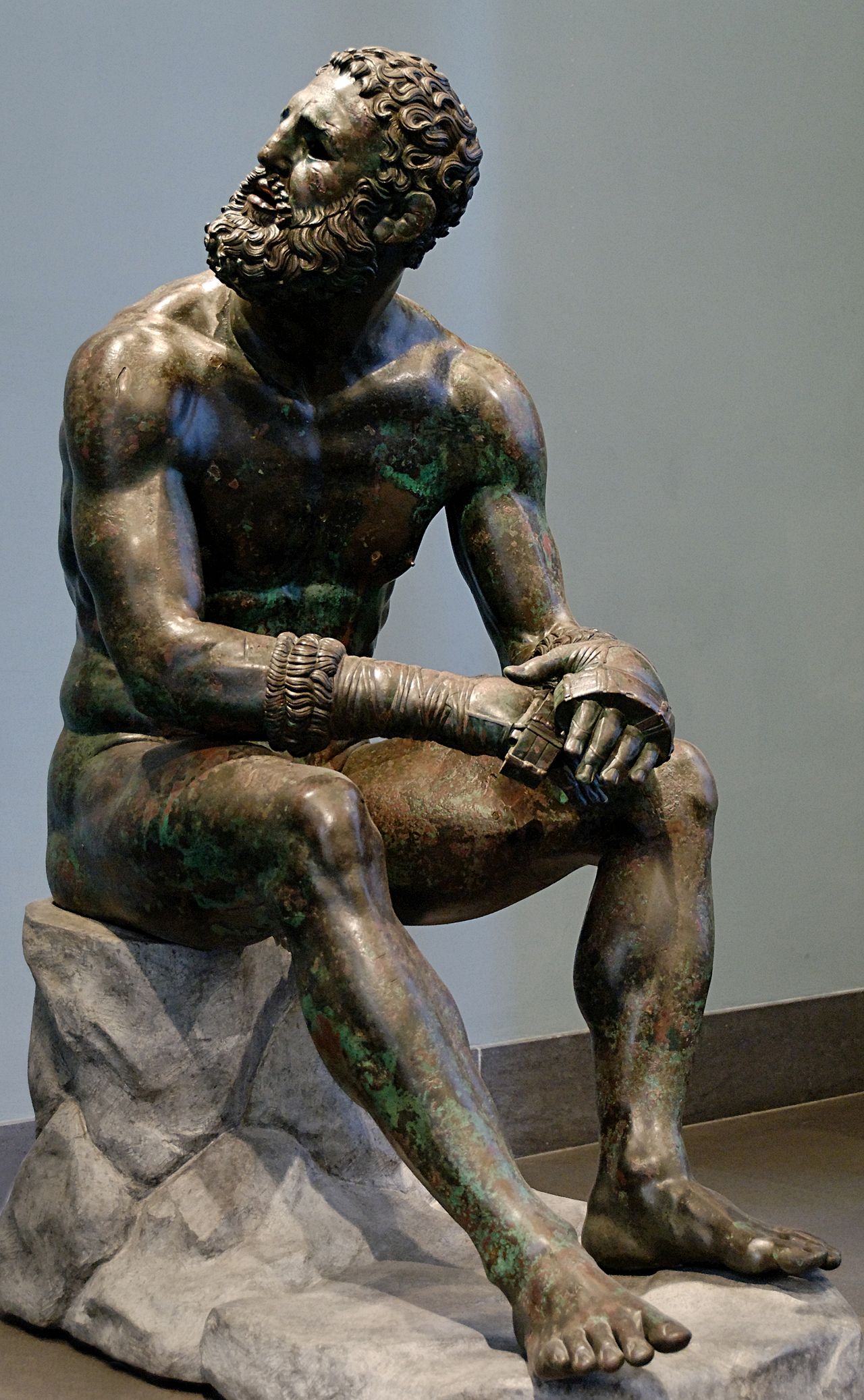
Boxers did not use modern padded gloves. Instead they secured strips of leather around the knuckles and wrist. These hand-wraps are commonly called himantes in ancient sources; later variants and more heavily padded styles also developed. The wraps changed the character of striking, concentrating force and protecting the wrist, but they could also cause severe cuts and abrasions. Fighters competed without weight classes and often relied on reach, technique, and stamina. Official contests were typically overseen by judges who intervened if a combatant was unable to continue.
- Hand protection: leather thongs and padded forms were used rather than modern gloves; see reconstructions of ancient hand-wraps.
- Rules: blows to the head and body were permitted; matches usually ended when one fighter gave up or was incapacitated.
- Competition format: events could be single bouts within festival games, and no formal weight divisions are attested in early evidence.
History and cultural context
References to boxing appear in archaic Greek poetry and myth. The epic tradition describes combat sports as part of funeral games; for example, the poet Homer recounts competitive fighting episodes in the Iliad. Archaeological finds — vase paintings, sculpture, and inscriptions — show boxers in training and in competition across different city-states, reflecting regional styles and emphases. In the polis system of ancient Greece, local customs affected how contests were organized: some city-states promoted training for civic defense and festival display, while others emphasized the prestige of victors in pan-Hellenic gatherings.
By the later Archaic and Classical periods the sport had become an established feature of major athletic festivals, including the Panhellenic games. Literary and inscriptional evidence survives only in fragments in many cases, and much of what we know comes from combining texts with visual art and material culture. Because primary accounts are often incomplete or legendary in tone, historians approach reconstructions cautiously; see discussions of fragmented evidence in studies of Greek athletic sources and legendary episodes (myth and tradition).
Uses, social role, and legacy
Boxing served several roles in ancient Greek life. It was a test of personal courage and endurance, an element of elite education and military preparation for some men, and a vehicle for honor and prize-winning at festivals. Successful boxers could attain public recognition and sometimes substantial rewards from their home communities. Artistic depictions and grave markers attest to the social prestige associated with athletic achievement.
The long-term legacy of ancient Greek boxing appears in later Mediterranean and European combat sports traditions and in modern reenactments and scholarship. Museums and publications show reconstructed gear and describe training methods; for overviews of the cultural background and material finds, consult general works on ancient Greek athletics and specific treatments of combat sports (city-state practices). For introductory reading aimed at non-specialists, see accessible syntheses of the topic and museum guides (regional studies, literary surveys).
Notable distinctions and facts
- Evidence is fragmentary: many textual sources survive only in part, so rules and procedures are reconstructed from multiple types of evidence and cautious inference (fragmentary sources).
- Different city-states had distinct traditions, meaning that a single, uniform "Greek boxing" did not exist across all regions (local variants).
- Iconography and archaeology provide important complements to written reports; museums and catalogs illustrate variations in posture, equipment, and context (visual sources, artifact studies).
Because our picture of ancient Greek boxing rests on a mix of epic narrative, athletic records, and material culture, reconstructions remain interpretive. Ongoing finds and interdisciplinary work continue to refine how historians and archaeologists understand this enduring and influential sport.
Questions and answers
Q: What is ancient Greek boxing?
A: Ancient Greek boxing is a very old sport that has been practiced since the eighth century BC.
Q: Who wrote about ancient Greek boxing?
A: Homer wrote about ancient Greek boxing in his poem Iliad.
Q: How many city-states was Greece made up of during the time of ancient Greek boxing?
A: Greece was made up of many city-states that were independent during the time of ancient Greek boxing.
Q: Did each city-state have its own version of the sport?
A: Yes, each city-state seems to have had its own version of the sport.
Q: What are most of the sources that talk about Greek boxing?
A: Most of the sources that talk about Greek boxing are either legends or fragmentary.
Q: What does it mean when a source is fragmentary?
A: When a source is fragmentary, it means that part of the text has been lost or is missing.
Q: Was boxing with gloves an important part of the Greek athletic culture of the time?
A: Yes, several details are missing, but it seems boxing with gloves was an important part of the Greek athletic culture of the time.
Tags
Related articles
Author
AlegsaOnline.com Ancient Greek boxing: practice, equipment, and cultural role Leandro Alegsa
URL: https://en.alegsaonline.com/art/3843