
Georg Holtzendorff — 19th-Century German Landscape Painter and Porcelain Designer
German landscape painter from Saxony who relocated to England during the Franco-Prussian War; worked for Royal Crown Derby and decorated the Gladstone Dessert Service presented to Prime Minister Gladstone in 1883.
Overview
Georg Holtzendorff was a German artist active in the latter half of the 19th century, known primarily for his landscape work and his contributions as a designer for porcelain. Born in Saxony, he left continental Europe during the upheavals surrounding the Franco-Prussian War and established himself in England, where he combined traditional watercolour practice with applied decorative commissions. Contemporary documentation of his life is limited; what survives most clearly are his sketches and designs used in ceramic production.
Image gallery
1 Image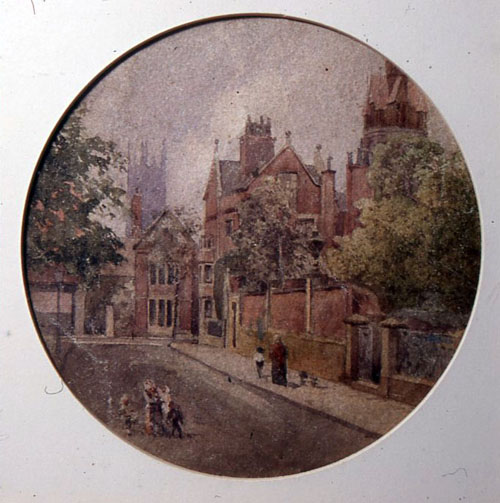
Artistic focus and technique
Holtzendorff's practice centered on landscape studies rendered in delicate washes and detailed sketches. These studies functioned both as finished watercolours and as working designs for transfer patterns and painted decoration on ceramics. His approach emphasized local topography and architecture, translating motifs from country scenes into compositional elements suited to porcelain panels and borders. In England he adapted his palette and scale to suit the demands of manufacturers while retaining an eye for atmospheric detail common to Saxon and wider Germanic landscape traditions.
Move to England and work for Royal Crown Derby
Following his relocation, Holtzendorff found employment with the Royal Crown Derby Porcelain Company, a major English manufacturer noted for high-quality tableware and decorative services. There he produced sketches of Derbyshire and other local scenes; these drawings were adapted into designs for decoration on porcelain objects. Working in a factory context required collaboration with painters and engravers who converted his sketches into transfer prints and hand-painted motifs, integrating his landscapes into the visual vocabulary of Derby porcelain.
Gladstone Dessert Service
Holtzendorff's most prominent documented commission was his role in decorating the Gladstone Dessert Service, a presentation piece given by the Liberal Working Men of Derby to Prime Minister William Ewart Gladstone in 1883. The service combined figural and landscape imagery to celebrate civic pride and political gratitude. Surviving material linked to this project includes at least one watercolour study that shows Becket Street in Derby with the Derby Museum and Art Gallery in the background; that sheet is the principal paper study still identified as associated with the service.
Legacy and significance
Although Holtzendorff is not widely recorded in mainstream art histories, his surviving designs illustrate the cross‑over between fine art and industrial decoration in the Victorian era. His work exemplifies how itinerant European artists contributed to English ceramic design and how local imagery was harnessed for public and commemorative objects. The Gladstone service remains a useful example of the period's civic gift culture and of collaboration between individual artists and established manufactories.
Further reading and links
- Biographical note on Georg Holtzendorff
- Examples of landscape work and sketches
- Records of porcelain artists
- Context: Saxony and 19th-century German art
- Migration of artists to England
- Background on the Franco-Prussian War and its effects
- Derbyshire landscapes and subjects
- Porcelain design and transfer techniques
- The Liberal Working Men of Derby and civic gifts
- William Ewart Gladstone: the recipient
- Watercolour studies and conservation
- Derby Museum and Art Gallery connections
Questions and answers
Q: Who was Georg Holtzendorff?
A: Georg Holtzendorff was a 19th-century German landscape painter from Saxony.
Q: Why did Georg Holtzendorff move to England?
A: Georg Holtzendorff moved to England because of the Franco-Prussian War.
Q: What job did Georg Holtzendorff have in England?
A: Georg Holtzendorff worked for the Royal Crown Derby Porcelain Company.
Q: What was Georg Holtzendorff's main work for the Gladstone Dessert Service?
A: Georg Holtzendorff's main work was the decoration of the Gladstone Dessert Service, presented by the Liberal Working Men of Derby to Prime Minister William Ewart Gladstone in 1883.
Q: What did Georg Holtzendorff sketch for the Royal Crown Derby Porcelain Company?
A: Georg Holtzendorff sketched the landscape of Derbyshire and these were used as designs for porcelain.
Q: What is the only remaining study on paper linked to the Gladstone service?
A: The only remaining study on paper linked to the Gladstone service is a watercolour by Holtzendorff, with a view of Becket Street, Derby, with the Derby Museum and Art Gallery in the background.
Q: How does the Gladstone Dessert Service relate to Georg Holtzendorff's work?
A: Georg Holtzendorff's main work was the decoration of the Gladstone Dessert Service.
Related articles
Author
AlegsaOnline.com Georg Holtzendorff — 19th-Century German Landscape Painter and Porcelain Designer Leandro Alegsa
URL: https://en.alegsaonline.com/art/38162
Sources
- books.google.com : Royal Crown Derby
- books.google.com : The Annual register of world events
- artfund.org : "Becket Street, Derby"