
Geoffroea decorticans (chañar): a drought‑tolerant South American tree
Geoffroea decorticans, commonly called chañar, is a small deciduous tree of the pea family from arid southern South America, known for its peeling bark, sweet edible pods and traditional medicinal uses.
Overview
Geoffroea decorticans, often called chañar, is a small to medium deciduous tree in the pea family (Fabaceae). It grows naturally in very dry regions of southern South America and is notable for surviving prolonged droughts by shedding its leaves. The species name decorticans refers to its characteristic peeling bark.
Image gallery
4 Images

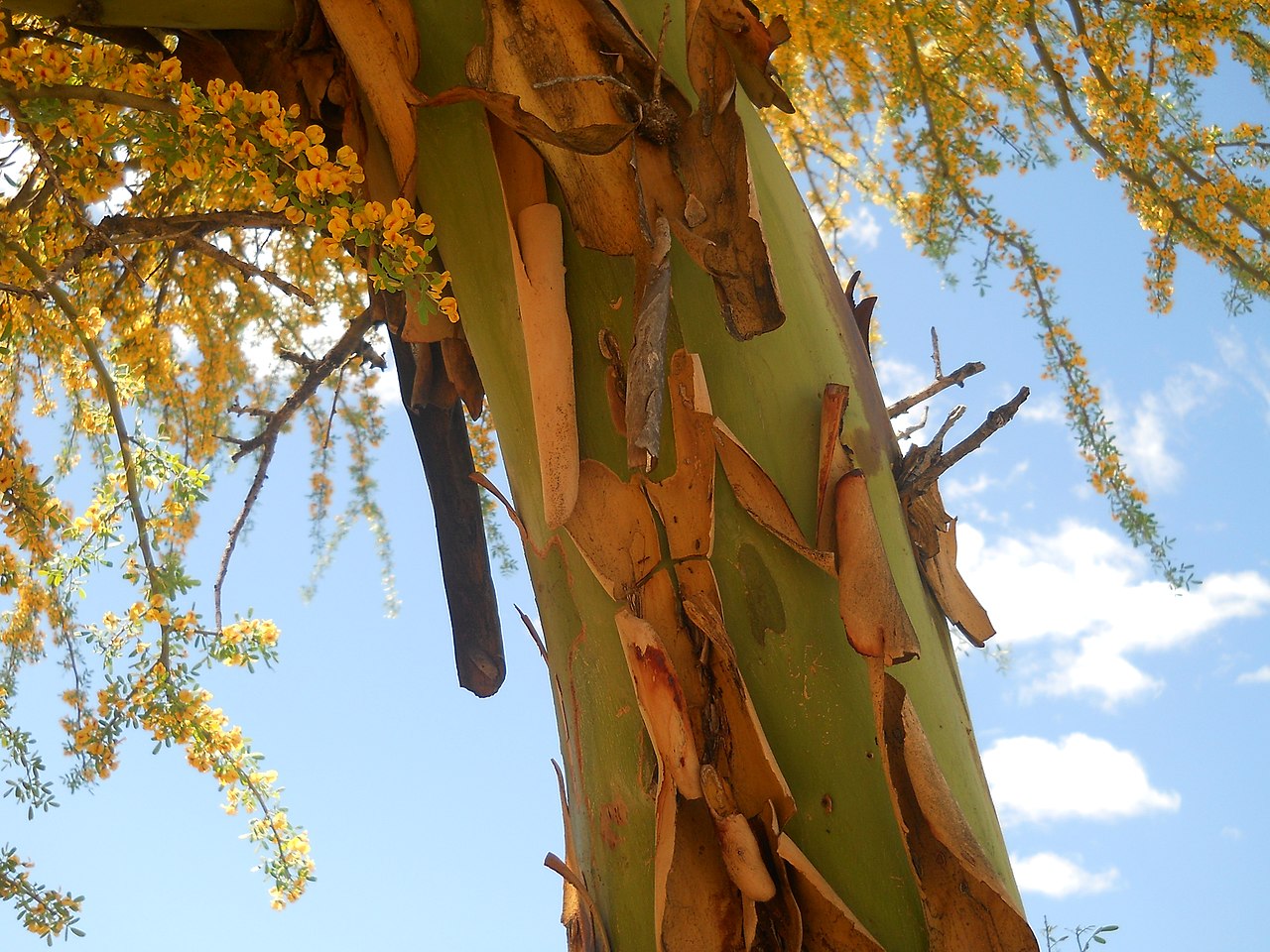

Appearance and adaptations
The chañar typically presents a twisted trunk, smooth bark that peels in thin strips, and pinnate leaves that are lost seasonally. It produces scented, yellow-orange flowers and later fleshy, oblong pods containing a sweet, nutritious pulp. Plants are drought-deciduous, dropping foliage in cold winters or in summer during water stress; deep roots and water-conserving leaves are among its adaptations to arid environments.
Distribution and habitat
This species occurs across arid and semi-arid zones of southern South America, principally in parts of Argentina and Chile and extending into neighboring regions. It favors well-drained soils, rocky slopes and riverbeds where groundwater can be accessed episodically. Its tolerance of heat and low rainfall makes it a fixture of xeric woodlands and scrublands.
Uses, cultural importance and examples
- Food: the sweet pulp of the pods is eaten fresh or processed into syrups, jams and traditional confections.
- Medicine: various communities have used extracts and infusions for respiratory ailments and topical remedies; these uses are traditional rather than universally clinically validated.
- Practical: wood and charcoal have been used for fuel and small construction; the tree is sometimes planted as a drought-tolerant ornamental or windbreak.
Conservation and cultivation
While not generally classified as endangered, local populations can be affected by land use change and overharvesting of wood or fruit. The chañar is valued for restoration and agroforestry in dryland projects because of its resilience. Cultivation requires attention to drainage and tolerance for poor soils; plants respond well to full sun.
Notable facts and further reading
The chañar plays a role in local culture and cuisine and supports pollinators when in flower. For more botanical details and regional information see resources on the species: regional flora, ethnobotany and conservation.
Questions and answers
Q: What is the Geoffroea decorticans?
A: The Geoffroea decorticans is a small tree in the pea family, Fabaceae.
Q: Where is the tree found?
A: The tree is found in very arid places in southern South America.
Q: Does the tree lose its leaves?
A: Yes, the tree is a deciduous tree that loses its leaves in winter with the cold and also in summer if it gets too dry.
Q: What family does the tree belong to?
A: The tree belongs to the pea family, Fabaceae.
Q: What is the common name of Geoffroea decorticans?
A: The common name of Geoffroea decorticans is Chañar.
Q: How does the tree adapt to its environment?
A: The tree is adapted to the arid environment of southern South America by being deciduous and losing its leaves in winter and summer to conserve water.
Q: Is the Chañar found in other parts of the world?
A: No, the Chañar is only found in very arid places of southern South America.
Related articles
Author
AlegsaOnline.com Geoffroea decorticans (chañar): a drought‑tolerant South American tree Leandro Alegsa
URL: https://en.alegsaonline.com/art/38120
Sources
- doi.org : 10.1017/S0960428600001293
- eol.org : "Geoffroea decorticans - Common names"
- eol.org : "Geoffroea decorticans - Distribution"
- npgsweb.ars-grin.gov : "Taxon: Geoffroea decorticans (Gillies ex Hook. & Arn.) Burkart"
- pgrc3.agr.ca : "Taxon: Geoffroea decorticans (Gillies ex Hook. & Arn.) Burkart"
- chilebosque.cl : "Geoffroea decorticans - Chañar"