
General intelligence (g): concept, measurement, history, and debates
The general intelligence factor (g) is a summary measure that emerges from cognitive test correlations. This article explains its origin, models, measurement, applications, and major controversies.
The general intelligence factor, commonly called "g," names a broad ability that emerges when scores from many different cognitive tests are correlated. As a theoretical construct it stands for shared variation across tasks such as reasoning, memory, vocabulary and problem solving. Researchers use g to summarize patterns found in test batteries and to compare different models of mental abilities. For an introductory overview see this resource.
Image gallery
2 Images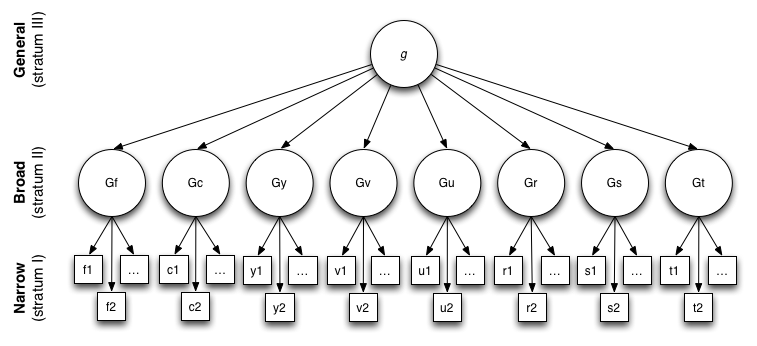

Historical origin and definition
The concept of g traces to early 20th-century work by Charles Spearman, who used factor analysis to show that children’s school marks and ability-test scores tended to covary. Spearman proposed a two-factor model: task-specific abilities (s factors) plus a single general factor (g) that influenced performance across tasks. This statistical finding, rather than a single agreed biological mechanism, is what the label g denotes. For background on intelligence testing and measurement methods see related methodological summaries.
Characteristics and models
- Statistical basis: g is a latent factor inferred from correlations among diverse cognitive tests.
- Hierarchical models: Later work proposed multi-level structures in which g sits atop group factors (e.g., verbal, spatial, memory).
- Alternative conceptions: Some theories emphasize multiple primary abilities rather than a dominating single factor.
Researchers such as Thurstone, Cattell and later proponents of the Cattell–Horn–Carroll (CHC) framework expanded and refined how general and specific abilities are organized. Distinctions like fluid versus crystallized intelligence capture different components that feed into broader models of cognitive functioning.
Measurement and predictive value
g is typically estimated from standardized test batteries using factor analysis or principal components analysis. Scores representing g correlate with many real-world outcomes: school performance, certain occupational achievements, and some health-related measures. However, g is a probabilistic predictor, not a deterministic one; individual life paths reflect many environmental, educational and motivational influences. For practical testing guidance consult testing overviews.
Debates, limitations, and controversies
Important debates concern what g actually represents (a biological capacity, a measure of task-learning, or simply a statistical summary), how much it is shaped by genes versus environment, and whether tests measuring g are culturally fair. Critics warn against reifying g—that is, treating a statistical construct as a single, unitary entity—while supporters point to its stability and predictive utility. Discussions of group differences and policy implications remain sensitive and contested; for an exploration of controversies see further discussion.
Contemporary research combines psychometrics with neuroscience to investigate brain correlates of general cognitive ability and to refine how cognitive tests are structured. Ongoing work seeks to clarify relationships between g, learning, brain networks and real-world functioning while recognizing measurement limits and ethical considerations in applied settings. For more general reading see overview and measurement sources.
Questions and answers
Q: What is the general intelligence factor?
A: The general intelligence factor, also known as g, is a construct from psychology that is the common factor in intelligence tests.
Q: Who first identified the general intelligence factor and how?
A: Charles Spearman, an early statistician and psychologist, first identified the general intelligence factor. He found that school children's grades across unrelated subjects were strongly related to each other and proposed that these relationships reflected the influence of a dominant factor, which he called g for "general" intelligence.
Q: What is the result of measuring intelligence in different ways?
A: Measuring intelligence in different ways results in the general intelligence factor, or g, which is the common factor in intelligence tests.
Q: What factors explain all variation in intelligence test scores according to Spearman's model?
A: According to Spearman's model, all variation in intelligence test scores can be explained by two factors: the factor specific to an individual mental task and g, a general factor that governs performance on all cognitive tasks.
Q: How long has g been a meaningful measure in cognitive testing?
A: After 120 years of cognitive testing, g's central role is still a meaningful measure.
Q: Have other models been proposed to explain intelligence test scores?
A: Yes, other models have also been proposed to explain intelligence test scores.
Q: Is there controversy surrounding g and its alternatives?
A: Yes, there is significant controversy about g and its alternatives.
Related articles
Author
AlegsaOnline.com General intelligence (g): concept, measurement, history, and debates Leandro Alegsa
URL: https://en.alegsaonline.com/art/37950
Sources
- lrainc.com : lrainc.com/swtaboo/taboos/apa_01.html