
Gecko: biology, behavior, adhesion, and relationship with people
Overview of geckos—small to medium lizards (roughly 1,200 species) notable for vocalizations, adhesive toe pads, nocturnal habits, and close association with human dwellings.
Overview
Geckos are a diverse group of small to medium-sized lizards found mainly in warm regions around the world. There are roughly 1,200 described species, most placed in the suborder Gekkota. Many geckos are nocturnal and have adapted to a wide range of habitats, from arid deserts and tropical forests to human homes. For a general classification and size range see classification and size. Common house-dwelling species are often observed near lighting that attracts insects; an example frequently reported near people is the common house gecko (Hemidactylus spp.) referenced at house geckos.
Image gallery
4 Images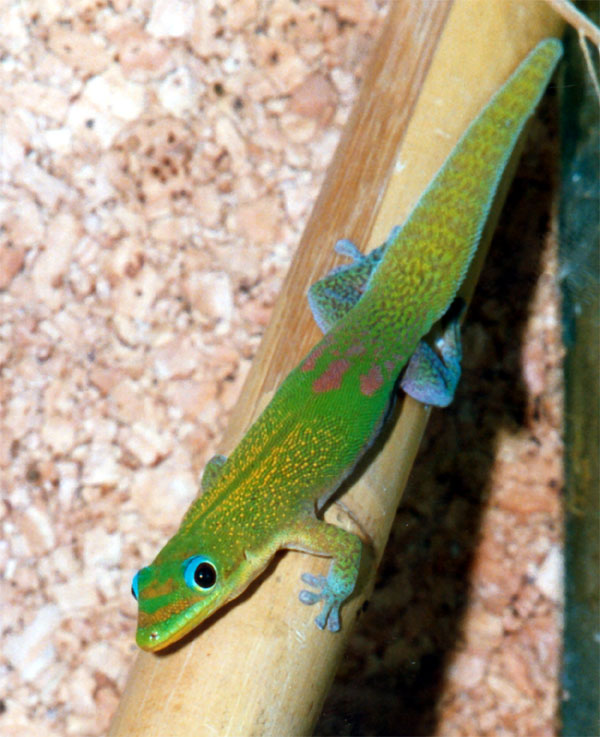


Physical characteristics and senses
Geckos show several unusual features among lizards. Many lack movable eyelids and instead have a transparent spectacle over the eye; they clean this membrane by licking it with their tongue (eye-cleaning behavior) and this trait is discussed at eyelid and spectacle. Their skin is covered by tiny scales and often minute hairs that help repel water and, in some species, reduce bacterial survival (antibacterial skin).
Unlike many reptiles, geckos are frequently vocal. Their calls vary by species and can resemble chirps, clicks, or barking sounds—names in some languages reflect these calls. They also retain other typical lizard traits: periodic shedding of skin, the ability to regenerate a lost tail which serves for balance and fat storage, and continual replacement of teeth over time.
Toe pads and adhesion
One of the most striking features is their capacity to climb smooth vertical surfaces and even move across ceilings. This ability is produced by specialized toe pads covered in microscopic hair-like structures called setae; each seta branches into thousands of tiny tips known as spatulae. Under magnification these structures can be seen clearly (microscopic structure). The attachment is explained by close-range intermolecular forces (commonly described as van der Waals forces), which create a reversible bond between the spatulae and the surface (molecular adhesion, van der Waals explanation). The combination of many contact points allows secure adherence while enabling rapid detachment when the gecko moves.
Reproduction, behavior, and ecology
Most gecko species are oviparous, laying small clutches of eggs in protected locations; some species, however, give birth to live young—viviparity occurs in a few lineages (egg-laying, live-bearing examples). Geckos are often insectivorous and can be beneficial in controlling pest insects around homes and farms. Their activity patterns, territorial behaviors, and breeding systems vary widely by species.
Human interactions and notable facts
People commonly tolerate or encourage geckos in and around houses because they reduce populations of mosquitoes, flies, and other small invertebrates. Some species have become commensal with humans and spread globally through shipping and trade. Researchers study geckos for insights into biomimetic adhesives, antimicrobial skin properties, and regenerative biology.
- Distribution: Tropical and warm temperate regions worldwide.
- Adhesion mechanism: Setae and spatulae creating molecular contact (setae).
- Reproduction: Mostly egg-laying, some live-bearing (eggs, viviparity).
- Human relevance: Pest control and inspiration for adhesive technology (house geckos, adhesion studies).
For additional reading and images see resources on general anatomy, behavior, and microscopy (overview, microscopy). Further material about specialized traits and conservation can be consulted through species-specific pages and field guides (eye adaptations, cleaning behavior, skin properties).
Questions and answers
Q: How many species of geckos are there?
A: There are 1196 different species of geckos.
Q: What is the common house gecko called?
A: The common house gecko is called Hemidactylus frenatus.
Q: Do geckos have voices?
A: Yes, unlike most lizards, geckos have voices that sound a little like a bird or frog.
Q: How do geckos reproduce?
A: Most geckos lay eggs, but some give birth to live young.
Q: What special feature do they have instead of eyelids?
A: Geckos have no eyelids; instead, they have a clear membrane (skin) over their eyes which they lick clean with their tongues.
Q: Can geckos regenerate their tails?
A: Yes, like most lizards, they can regenerate their tail if needed.
Q: How do geckos walk on walls and ceilings?
A: Geckos can walk on trees, walls, windows and ceilings because they have special toe pads that form a molecular bond with the surface in order to "stick" to it - this force is called van der Waal's force.
Related articles
Author
AlegsaOnline.com Gecko: biology, behavior, adhesion, and relationship with people Leandro Alegsa
URL: https://en.alegsaonline.com/art/37821
Sources
- species.wikimedia.org : Gekkonidae
- commons.wikimedia.org : Gekko
- mapress.com : "A 100 million year old gecko with sophisticated adhesive toe pads, preserved in amber from Myanmar (abstract)"
- britannica.com : "gecko | Species & Facts"
- kids.nationalgeographic.com : "Gecko"
- news.nationalgeographic.com : "Geckos May Be Famously Sticky, but Here's What Stumps Them"
- ncbi.nlm.nih.gov : "A gecko skin micro/nano structure - A low adhesion, superhydrophobic, anti-wetting, self-cleaning, biocompatible, antibacterial surface"
- doi.org : 10.1016/j.actbio.2015.03.007
- worldcat.org : 1878-7568
- pubmed.ncbi.nlm.nih.gov : 25772496