
Geb — Ancient Egyptian god of the Earth
Geb is the Egyptian deity who personifies the earth. An important figure in the Heliopolitan Ennead, he is associated with soil, vegetation, earthquakes, royal lineage and the balance between earth and sky.
Geb is a principal figure in ancient Egyptian religion, commonly described as the earth god. As a personification of the earth, he represents the solid ground of the world and the nourishing soil that supports life. In myth he is closely paired with the sky goddess Nut, whose arched body spans above him. Together their separation and embrace describe the ordering of the cosmos in Egyptian cosmogony.
Image gallery
1 Image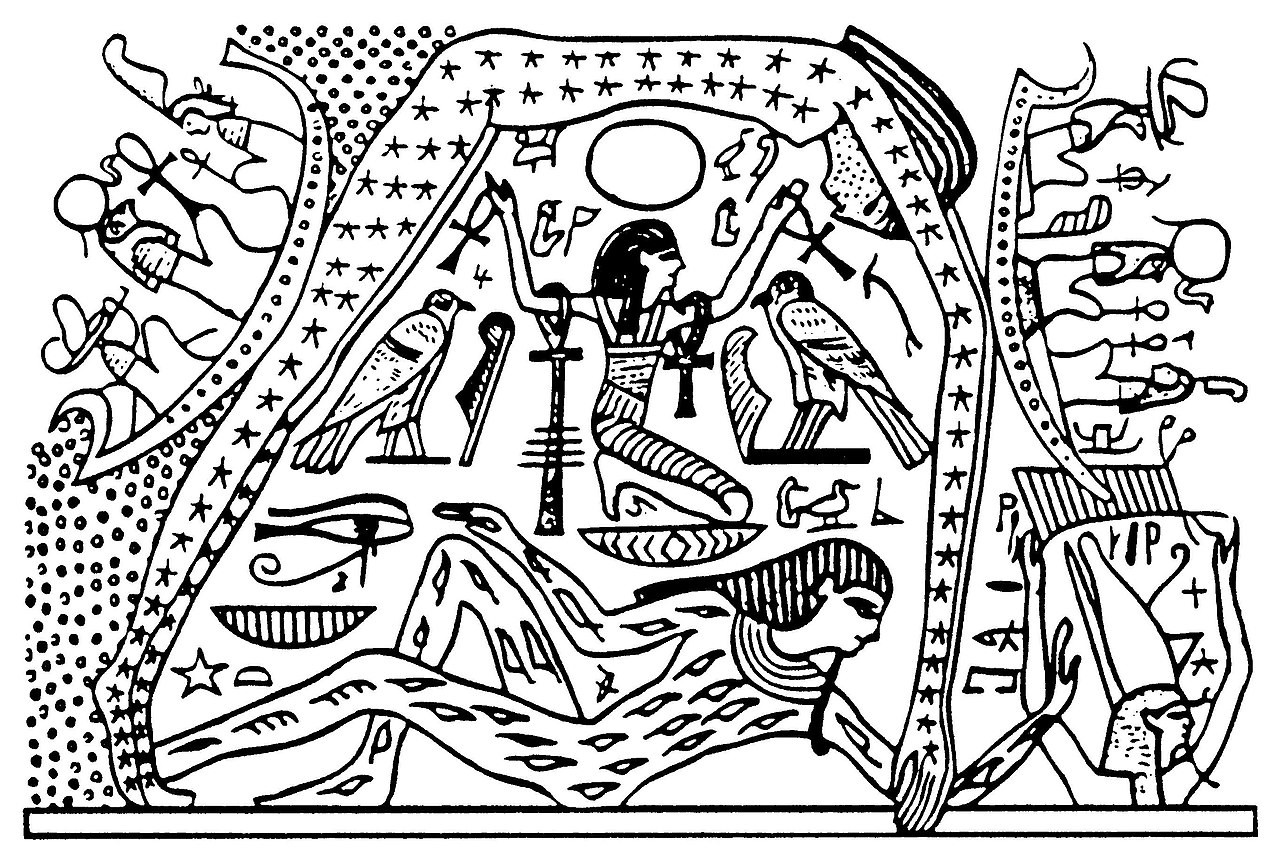
Family and mythic role
Geb belongs to the second generation of the Heliopolitan Ennead. He is the son of Tefnut and Shu, and the consort and sibling of Nut. Their offspring include several of the best-known deities of ancient Egypt: Osiris, Isis, Nephthys, Set and the elder Horus. In stories that describe disputes over rulership, Geb plays a judicial or supportive role; for example, he is said to have given the kingship to Horus in the conflict with Set, affecting succession and legitimacy in Egypt.
Iconography and symbols
Artistic depictions of Geb vary, but common elements reflect his terrestrial character. He is often shown as a reclining man with plants sprouting from his body or as a man seated beneath Nut’s arch. Two animals are particularly associated with him: the snake and the goose. The goose—sometimes placed on his head in imagery—served as a symbol of his identity. These motifs underline his ties to fertility, the life of the land and the animal world (animals) that inhabit it.
Functions, myths and natural phenomena
Beyond his role as the ground beneath human feet, Geb is linked to agricultural fertility and vegetation (vegetation) because the earth was understood as the source of crops. The Egyptians explained some natural events through his temperament: for instance, quakes of the earth were popularly attributed to the laughter or movements of Geb, an image preserved in texts that equate his mirth with earthquakes. The mythic separation of Nut and Geb by Shu establishes them as the permanent boundary between the primeval waters and the ordered world.
Cult, kingship and later reception
Geb enjoyed religious significance especially in connections to kingship. Pharaohs claimed descent or symbolic kinship with him, and the royal seat was sometimes called the "throne of Geb," reflecting the idea that rulership sprang from the ordered land itself. His primary theological context is the Heliopolitan tradition centered at Heliopolis, though his cult and references to him appear broadly across the Nile valley. In Greco-Roman times Egyptian deities were compared with Greek figures; Geb was sometimes equated with the titan Kronos or associated with the concept of a titan in interpretive traditions.
Notable distinctions
- Member of the Heliopolitan Ennead and second-generation deity descended from Tefnut and Shu.
- Personifies the earth, with functions in fertility, vegetation and natural phenomena like earthquakes.
- Associated animals include the goose and the snake; the goose is a recurring emblem in his iconography.
- Connected to royal ideology; the "throne of Geb" underscores his link to pharaonic legitimacy and to the land of Egypt.
For readers interested in primary texts and archaeological contexts, study of Heliopolitan theology and funerary literature illuminates Geb’s place in the Egyptian pantheon and the way the ancients explained the relation between sky and earth, gods and kings, and the rhythms of the natural world.
Questions and answers
Q: Who is Geb in Egyptian mythology?
A: Geb is the god of the earth in Egyptian mythology.
Q: Who is Geb married to and who are his children?
A: Geb is married to and the brother of the sky goddess Nut, and the father of Osiris, Isis, Nephthys, Horus the Elder, and Set.
Q: What did Geb do when Seth and Horus fought to become the king of Egypt?
A: Geb made Horus the ruler of the living when Seth and Horus fought to become the king of Egypt.
Q: Who are Geb's parents?
A: Geb's parents are Tefnut and Shu.
Q: What did Geb and Nut together form according to ancient Egyptian beliefs?
A: Geb and Nut together formed the permanent boundary between the primeval waters and the newly created world.
Q: What is the significance of earthquakes in Geb's mythology?
A: The ancient Egyptians believed that earthquakes were Geb's laughter.
Q: What animals are associated with Geb and what is his other domain?
A: A snake and a goose (sometimes depicted on his head) are associated with Geb, who is also the god of vegetation.
Related articles
Author
AlegsaOnline.com Geb — Ancient Egyptian god of the Earth Leandro Alegsa
URL: https://en.alegsaonline.com/art/37817