
Analogue computer: overview, history, design, and modern relevance
Comprehensive introduction to analogue computers: their principles, major historical devices, components and applications, and how they differ from digital systems.
Overview
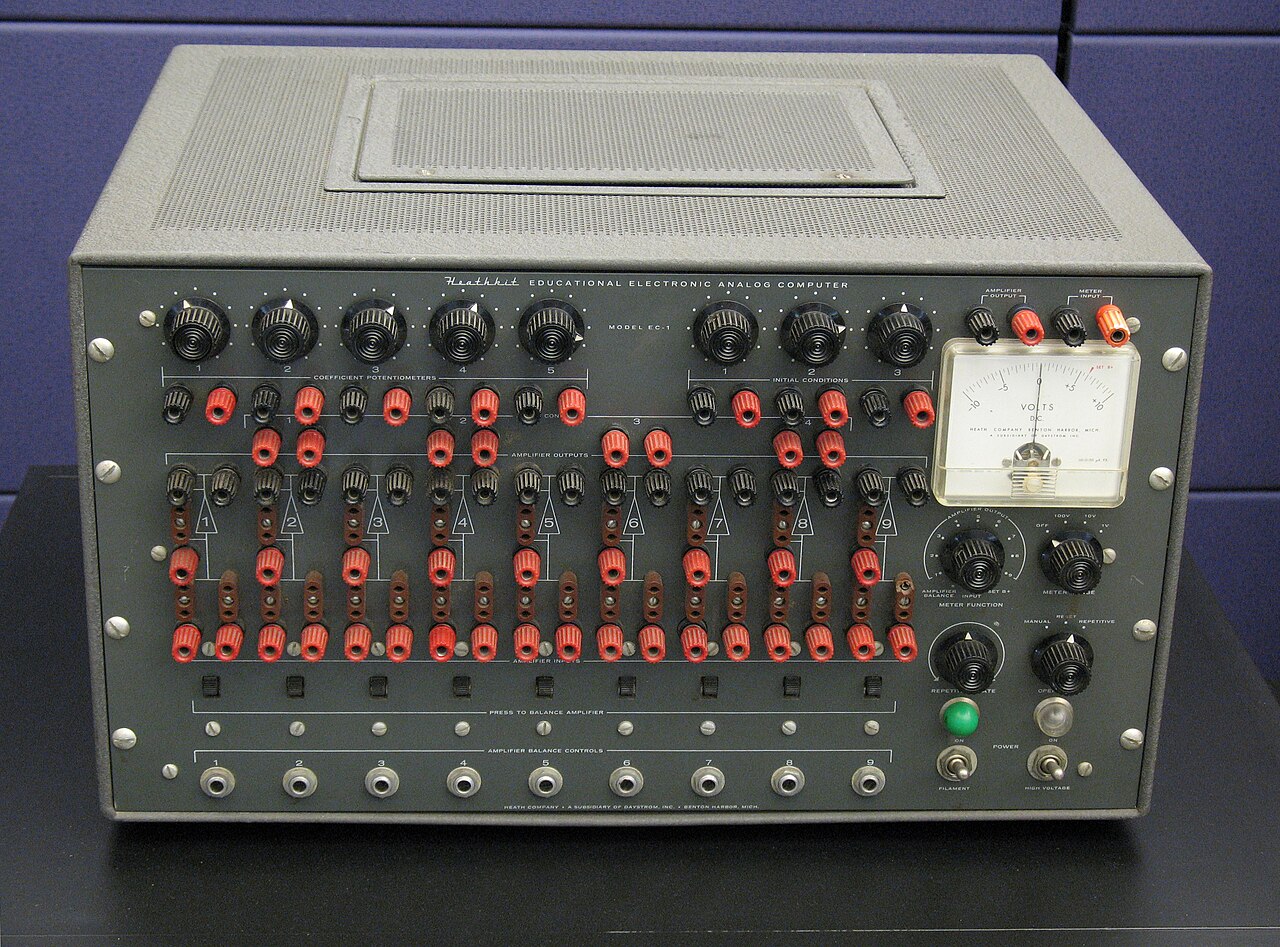
An analogue computer is a device—mechanical, electrical, or hybrid—that represents and manipulates continuous physical quantities to model and solve problems. Unlike digital computers, which compute with discrete symbols and binary states, analogue machines work with variables such as voltage, rotation, fluid pressure or mechanical displacement to represent numerical values directly. Early human counting aids such as the abacus are sometimes called computers in a loose sense, but the term "analogue computer" is generally reserved for systems that perform continuous mathematical operations rather than digit-by-digit calculations; see a concise description of physical implementations here.
Image gallery
10 Images




History and notable devices
Concepts of analogical modelling have very long roots. The famous Antikythera mechanism, a complex geared instrument discovered in the Mediterranean, is widely regarded as an early mechanical analogue device used for astronomical prediction and calendrical calculations (Antikythera device). Mechanical regulators such as James Watt's governor introduced feedback control in the industrial era and illustrate how mechanical analogues model dynamic behaviour on steam engines and pumps (James Watt, pumps, negative feedback).
The mathematical slide rule, developed after the discovery of logarithms, became the principal hand-held analogue calculator for scientists and engineers for several centuries. Work by figures such as John Napier on logarithms and later innovations by William Oughtred led to the slide rule (slide rule) and ultimately to compact circular versions used in pilot watches in the 20th century.
Characteristics and components
- Representation: Quantities are represented continuously (e.g., voltage proportional to a variable) rather than as discrete numbers.
- Operators: Core elements include integrators, differentiators, adders (summers), multipliers and function generators; electronic analogue computers often implement these with operational amplifiers.
- Feedback and control: Analog systems naturally express feedback loops used for regulation and real‑time control.
- Accuracy: Precision is limited by component tolerances and noise; calibration and environmental stability are important.
Uses, examples and importance
In the 20th century electronic analogue computers were widely used to simulate differential equations in engineering and physics because they produced continuous outputs in real time. They played a role in analog fire‑control and navigation systems, instrument displays, and process control. Hybrid machines combined analogue front ends with digital control for data handling and storage.
Even after digital systems became dominant in the 1960s and 1970s (mid 20th century), analogue techniques remained valuable where real‑time response, low latency, or natural representation of continuous phenomena were advantageous. Aviation retained specialized circular slide rules built into some watches for flight calculations; these are a compact variant of the analogue slide calculator.
Distinctions and modern perspective
Analogue devices differ from digital ones in how they encode information (digital vs continuous) and in typical trade‑offs: analogue systems can be faster and more direct for some tasks but are more susceptible to drift and noise. Certain elements of human problem solving and early numerical concepts—while not usually classed as analogue computers—illustrate how tools and notation shape computation (for example, historical numerical innovations such as the concept of zero are milestones in mathematical representation rather than analogue machinery; see a general discussion here).
Further reading and notable links
For introductions to practical and historical aspects, consult specialized resources on computing history, control theory, and instrumentation. Topics connected to analogue computation include classical scientific instruments (science), engineering practice (engineering), archaeological studies of ancient mechanisms (Antikythera device), and summaries of early counting systems that predate modern computers (Babylonians, abacus).
For compact online summaries, historical timelines and technical overviews, see resources on mechanical governors and regulation (James Watt), mathematical tools and logarithms (John Napier, William Oughtred), and modern comparisons of continuous versus discrete computation models (negative feedback, mechanical or electronic devices, digital). Additional context on mid‑century developments is available in surveys of instrumentation from the mid 20th century.
Questions and answers
Q: What are analogue computers?
A: Analogue computers are mechanical or electronic devices which solve problems and can be used to control machines.
Q: When was the abacus invented?
A: The abacus, a digital device also sometimes called a computer, was used by Babylonians in c. 2500 BC.
Q: Who developed the slide rule?
A: The slide rule was developed in the 17th century by William Oughtred, after John Napier's work on logarithms.
Q: How did James Watt's governor contribute to the industrial revolution?
A: James Watt's governor was critical for the industrial revolution as it was a negative feedback control for large pumps and engines.
Q: Are analogue computers digital or continuous data-based?
A: Analogue computers work with continuous data rather than discrete or digital data. They are like abstract models of the real world.
Q: Were wristwatches with circular slide rules common before 1960s/1970s?
A: Before the 1960s/1970s some wristwatches had a circular slide rule built in and they were mostly used in aviation but considered too technical for most other watch wearers.
Q: Has there been any notable applications of circular slide rules since then?
A: Since the middle 20th century, there have not been any notable applications of circular slide rules digitally.
Related articles
Author
AlegsaOnline.com Analogue computer: overview, history, design, and modern relevance Leandro Alegsa
URL: https://en.alegsaonline.com/art/3757