
Gareth (Knight of the Round Table)
Gareth, an Arthurian knight nicknamed "Beaumains", is known for arriving at Arthur's court in disguise, undertaking a famed rescue quest, and dying in the conflict described in Malory's Le Morte d'Arthur.
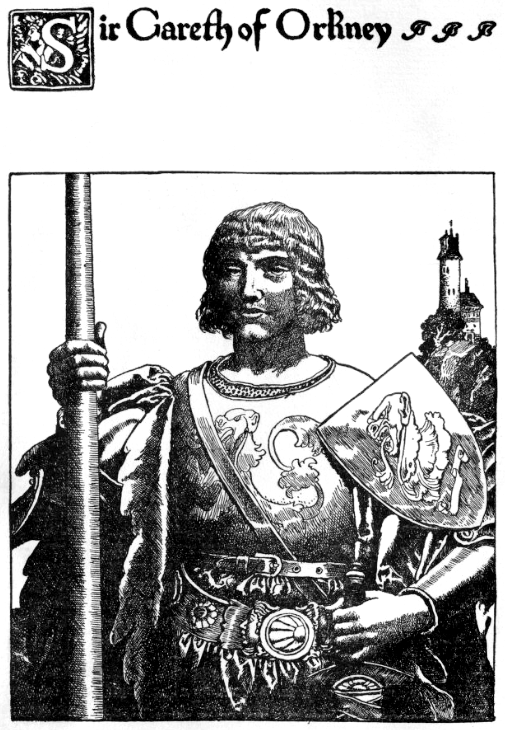
Gareth is a notable figure in Arthurian romance, traditionally counted among the Knights of the Round Table. In many medieval accounts he is presented as the youngest son of King Lot and Queen Morgause, and thus commonly described as a nephew of King Arthur. His character is associated with courtesy, restraint and the ideals of chivalry; later writers treat him as an exemplar of knightly courtesy rather than mere martial ferocity.
Image gallery
4 Images


Origins and literary tradition
Gareth appears mainly in the later medieval cycles of Arthurian legend, especially the French prose romances and in Sir Thomas Malory's Le Morte d'Arthur. His story varies by source, but Malory's account remains the best known in English. Over time his name has been rendered in different spellings, and some traditions conflate or distinguish him from other members of Arthur's family, such as Gawain and Gaheris.
Famous episodes and characteristics
One of the most enduring episodes recounts Gareth's arrival at court in disguise and his service in the royal kitchen. Mocked by Sir Kay, he is given the nickname "Beaumains" (beautiful hands) because of his fair appearance. After a year in the kitchens he reveals his lineage and sets out on a quest to assist a distressed lady and her sister, demonstrating patience, courtesy and martial skill.
- He undertakes a multi-stage adventure, overcoming a series of hostile knights and challenges to rescue a noblewoman.
- During these deeds he distinguishes himself in combat and in demeanor, earning respect rather than immediate renown.
- Following his successes, he is raised to knighthood by Sir Lancelot after trials that include jousting and sword engagements.
Gareth's temperament—gentle, courteous, and dutiful—contrasts with some more aggressive knights. His story emphasizes moral qualities as well as battlefield prowess, and his patience with insults and willingness to serve before seeking fame have often been highlighted by writers as central virtues.
Tragically, in Malory's narrative Gareth meets his end during the civil conflict that follows Lancelot's rescue of Queen Guinevere. He is slain in the fight that deeply fractures Arthur's court, an event that contributes to the collapse of the Round Table's fellowship. This death lends a sorrowful, cautionary note to his tale and to the larger Arthurian cycle.
Legacy
Gareth's episode has influenced many later retellings and adaptations in literature, theatre, television and film. Writers and artists often draw on the contrast between his humble introduction at court and his later chivalric achievements to explore themes of identity, honor and the costs of loyalty. His portrayal remains one of the clearer illustrations of courtly conduct within Arthurian legend.
For further reading on Gareth and related material see editions and translations of the medieval romances and Malory's Le Morte d'Arthur, which preserve multiple variants of his story and its meaning within the cycle.
Questions and answers
Q: Who was Gareth in King Arthur's Court?
A: Gareth was one of the Knights of the Round Table in King Arthur's Court.
Q: What was Gareth's nickname in Sir Thomas Mallory's classic story?
A: Gareth was given the nickname of "Beaumains" by Sir Kay in Sir Thomas Mallory's classic story, Le Morte D'Arthur.
Q: Did Gareth reveal his identity after a year?
A: Yes, Gareth revealed his identity as Sir Gawain's brother after one year in the story.
Q: What did Arthur give Gareth as a gift?
A: Arthur gave Gareth a quest as a gift in the story.
Q: Who named Gareth a knight?
A: Sir Lancelot named Gareth a knight after a jousting and sword fighting challenge in the story.
Q: Did Gareth die in the story?
A: Yes, Gareth dies in the same story, which is the last in the series.
Q: What does Le Morte D'Arthur mean in English?
A: Le Morte D'Arthur means "the death of Arthur" in French, the language in which it was originally written.
Related articles
Author
AlegsaOnline.com Gareth (Knight of the Round Table) Leandro Alegsa
URL: https://en.alegsaonline.com/art/37565