
Gallimimus — Late Cretaceous ornithomimosaur (the 'chicken mimic')
Gallimimus was an ostrich-like, fast-running, toothless theropod from the Late Cretaceous of Mongolia. Known for its long legs, small head and beak, it informs studies of ornithomimosaur anatomy, locomotion and ecology.
Overview
Gallimimus is an ornithomimosaur theropod from the Late Cretaceous of what is now Mongolia. The genus name is often rendered informally as "chicken mimic" and reflects its placement among the ostrich-like ornithomimosaurs. Fossils come from Upper Cretaceous deposits and date to near the end of the Cretaceous (temporal context), in environments preserved in sections of the Gobi Desert.
Image gallery
10 Images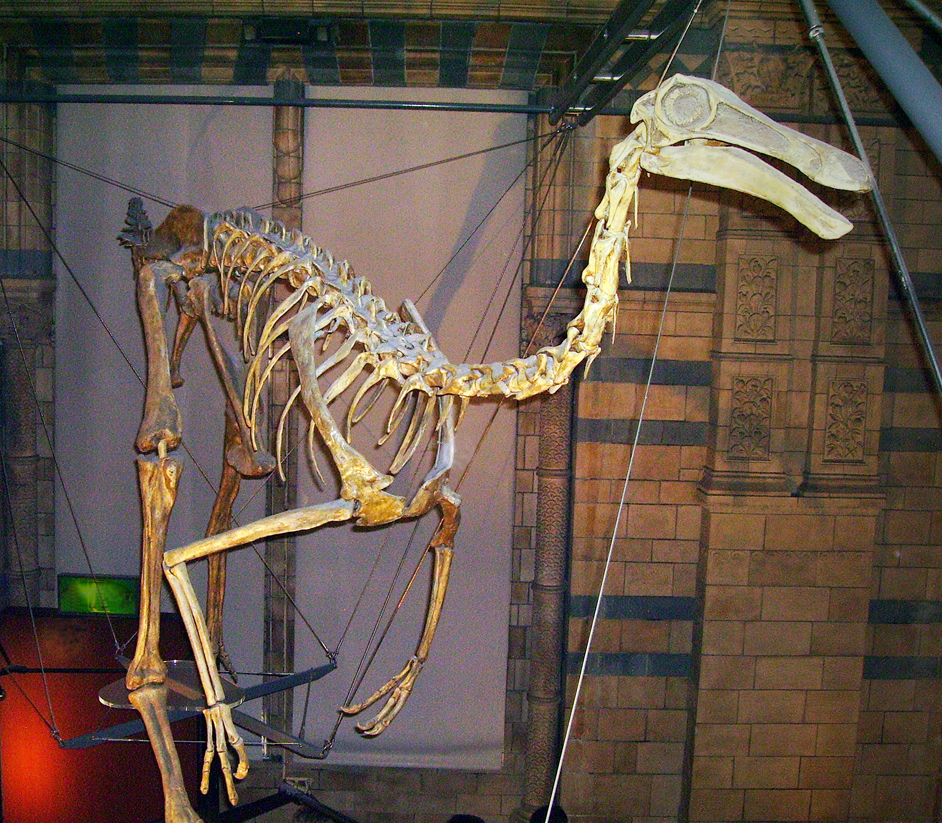


Anatomy and adaptations
Gallimimus combined a lightly built, cursorial body with a toothless, flattened beak that was probably covered by a horny sheath. It had a relatively small skull, long neck and elongated hindlimbs suited to sustained running. The braincase is proportionally large for a non-avian theropod, suggesting keen senses and good coordination for fast movement (braincase analyses, skull studies).
- Long, slender legs and a gracile pelvis for efficient locomotion (cursorial adaptations).
- Toothless beak with a broad, flattened profile, likely sheathed in keratin (name meaning and beak).
- Light skeleton with a stiffening tail for balance during running.
Discovery and classification
Remains attributed to Gallimimus were recovered from several Upper Cretaceous localities and were described in the later 20th century. The genus is placed in Ornithomimosauria, a group often called "ostrich dinosaurs" because of their convergent body plan. Multiple partial skeletons and skull material have allowed paleontologists to reconstruct its proportions with reasonable confidence.
Paleobiology and behavior
Dietary interpretations range from omnivory to herbivory or opportunistic feeding; the toothless beak and jaw mechanics indicate Gallimimus could process a variety of foods, though precise diet remains debated. Evidence from related ornithomimosaurs and some Gallimimus finds suggests possible gregarious behavior, and its anatomy indicates it was well adapted for rapid movement across floodplain and semiarid landscapes.
Importance and cultural notes
Gallimimus is important for understanding convergent evolution toward bird-like, cursorial forms among theropods and is frequently cited in discussions of locomotion, sensory capabilities and feeding strategies in ornithomimosaurs. It has also appeared in popular media, raising public interest in this group (name and meaning, comparative skull work, braincase references, locomotion studies, stratigraphic context).
Questions and answers
Q: What was Gallimimus?
A: Gallimimus was a type of dinosaur.
Q: What does the name Gallimimus mean?
A: The name "Gallimimus" means "chicken mimic" in Latin.
Q: What were the physical features of Gallimimus?
A: Gallimimus had a long, thin, flattened, toothless, horny beak, a small head, and a relatively large brain.
Q: When did Gallimimus live?
A: Gallimimus lived in the Upper Cretaceous period, about 75-70 million years ago.
Q: Was Gallimimus a slow or fast-running dinosaur?
A: Gallimimus was a fast-running dinosaur.
Q: Did Gallimimus have teeth?
A: No, Gallimimus did not have teeth.
Q: What was the size of Gallimimus' brain relative to its body size?
A: Gallimimus had a relatively large brain compared to its body size.
Related articles
Author
AlegsaOnline.com Gallimimus — Late Cretaceous ornithomimosaur (the 'chicken mimic') Leandro Alegsa
URL: https://en.alegsaonline.com/art/37317
Sources
- geol.umd.edu : Winter 2011 Appendix.