
Galápagos Islands
Volcanic archipelago in the eastern Pacific belonging to Ecuador, celebrated for endemic species, Darwin’s observations, and extensive terrestrial and marine protection.
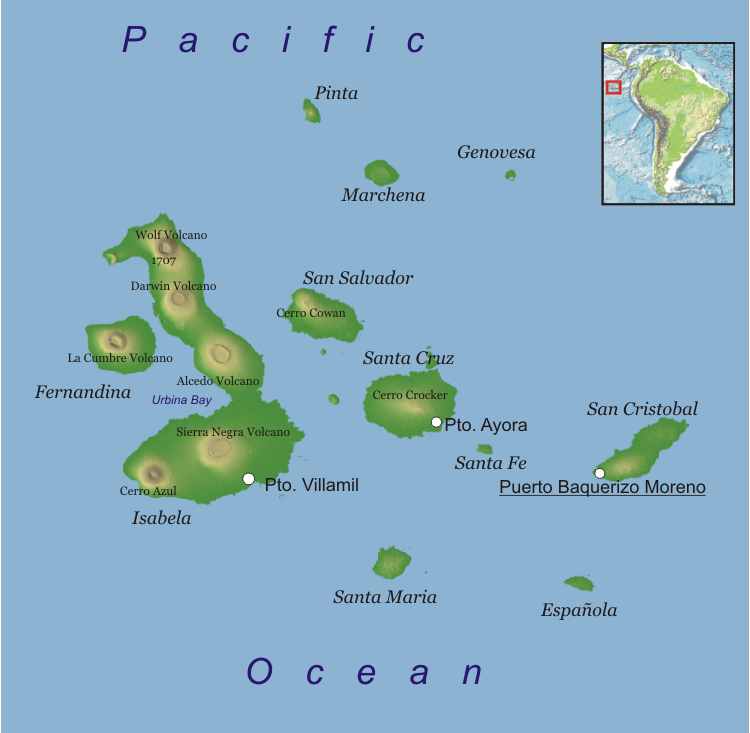
The Galápagos Islands are a volcanic archipelago located in the eastern Pacific Ocean and administered by the Republic of Ecuador. Straddling near-equatorial waters, the islands are renowned for an exceptional level of endemism: many plants and animals occur there nowhere else on Earth. That distinctiveness, and the patterns of variation among island populations, played a significant role in the development of modern ideas about evolution when naturalist Charles Darwin visited in 1835 and later used observations to inform the theory of evolution by natural selection.
Image gallery
10 Images




Geography and geology
The archipelago is composed of several large islands and dozens of smaller islets and rocks formed by volcanic activity on the Nazca tectonic plate. Island ages range from geologically young lava fields to older, more eroded highlands with soils capable of supporting forests and agricultural use in limited areas. Ocean currents meet around the islands, producing a mixture of warm and cool-water influences that shape local climates and marine life.
Flora and fauna
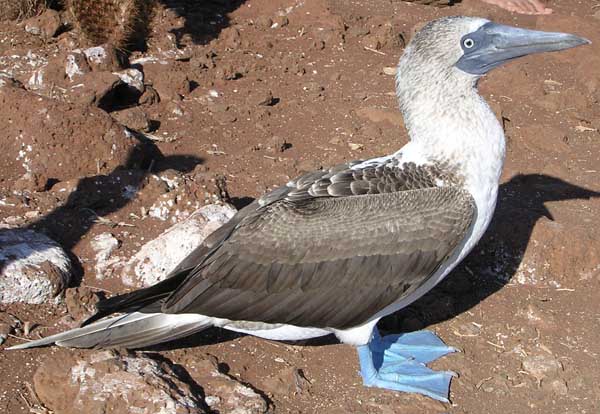
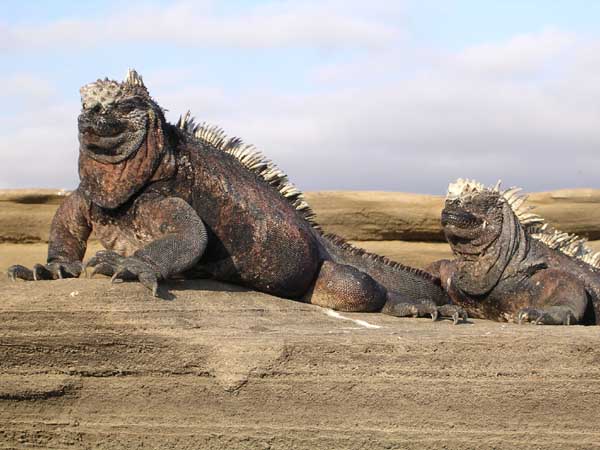
Habitats include arid lowlands, coastal mangroves, highland moist zones and extensive intertidal and offshore marine environments. Iconic animals known from the islands include the giant tortoises, which vary in size and shell shape between islands (giant tortoises), the marine iguana that forages in the sea, land iguanas, the flightless cormorant, small resident finches often called Darwin’s finches, the Galápagos penguin and several sea bird and sea lion species. Many of these are endemic or have island-specific subspecies, and a variety of marine organisms are characteristic of the archipelago’s surrounding waters (unique species).
Climate and ocean influence
Climate across the islands is influenced by seasonal shifts in ocean currents and by large-scale events such as El Niño, which can alter food availability and reproductive success among native species. Some islands have marked dry seasons and wetter highland zones where distinct plant communities support different animal assemblages.
Human presence and history
Human settlement is limited and concentrated on a few islands; communities serve as bases for fishing, research and tourism. Human activities historically included whaling, ranching and limited agriculture; today the economy is dominated by tourism and scientific work. The islands are valued for their cultural as well as natural history and continue to attract researchers and visitors interested in ecology, conservation and natural history.
Conservation, protected status and management
Most of the terrestrial area of the archipelago has been designated protected: roughly the vast majority of land falls under the Galápagos National Park, with only narrow zones set aside for towns and infrastructure (national park). The islands and surrounding waters have received international recognition for their biodiversity, including designation by UNESCO as a World Heritage Site, and establishment of a large marine reserve to conserve ocean habitats (marine reserve). The archipelago is also recognized as a biosphere reserve, which reflects efforts to combine conservation with research and sustainable local development.
Despite protection, the Galápagos face persistent threats: invasive species introduced by humans, pressures from tourism and settlement, illegal fishing in offshore areas, and climate-driven events that affect food webs. Management strategies include biosecurity and invasive-species eradication programs, regulations on visitor movements and numbers, scientific monitoring, fisheries controls, and international cooperation to support conservation and sustainable livelihoods for island residents.
Scientific and global importance
- Natural laboratory: The islands provide an accessible setting for studies of speciation, adaptation and island biogeography.
- Conservation example: Integrated protection of land and sea demonstrates approaches to linking biodiversity conservation with local economies.
- Education and tourism: Responsible tourism supports research and local income but requires careful management to limit ecological impacts.
As a living archive of evolutionary and ecological processes, the Galápagos Islands remain central to discussions about biodiversity protection, the effects of human activity on isolated ecosystems, and long-term strategies for conserving fragile island environments while supporting scientific research and sustainable communities.
Questions and answers
Q: Where are the Galápagos Islands located?
A: The Galápagos Islands are located in the Pacific Ocean and belong to Ecuador.
Q: What kind of animals are native to the Galápagos Islands?
A: The Galápagos Islands are famous for having many native animals, including giant tortoises, that are found nowhere else on Earth.
Q: What does the term Archipiélago de Colón mean?
A: The term Archipiélago de Colón is the Spanish name for the Galápagos Islands.
Q: Who visited the Galápagos Islands in 1835?
A: Charles Darwin visited the Galápagos Islands in 1835.
Q: What theory did Charles Darwin develop after visiting the Galápagos Islands?
A: Charles Darwin developed his theory of evolution by natural selection after visiting the Galápagos Islands.
Q: How much of the Galápagos Islands are a national park?
A: 97% of the Galápagos Islands are a national park, with the exception of the inhabited parts.
Q: What kind of designations does the Galápagos National Park hold?
A: The Galápagos National Park is a UNESCO World Heritage Site (1978), a marine reserve (1980), and a biosphere reserve (1986).
Related articles
Author
AlegsaOnline.com Galápagos Islands Leandro Alegsa
URL: https://en.alegsaonline.com/art/37252
Sources
- whc.unesco.org : "Galápagos Islands"
- unesco.org : "Archipielágo de Colon (Galápagos)"
- britannica.com : "Galapagos Islands"
- gct.org : "The Galapagos Islands Fact Sheet"